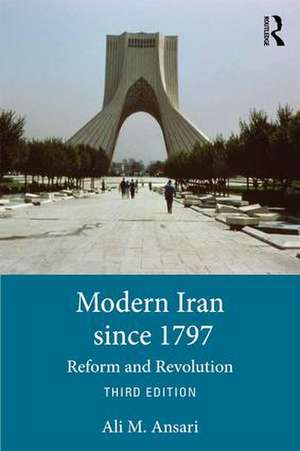
Modern Iran since 1797: Reform and Revolution
Autor Ali Ansarien Limba Engleză Paperback – 10 apr 2019
The book presents an overview of this crucial period in Iran’s history, its emergence from the political turmoil of the eighteenth century through to its initial encounter with the industrial powers of Europe and its attempts to navigate the turbulent waters of European imperialism. It assesses the impact of European ideas on the triumph and tragedy of the Constitutional Revolution, which established the political template for the country going forward and against which all other political developments have been measured. This new edition has been updated to incorporate new scholarship and research to make a rounded assessment of recent developments and bring the text fully up to date. A substantive new prequel has also been added, covering the long nineteenth century from 1797 through to 1921, including a fuller and more detailed treatment both of the Constitutional Revolution and the events and ideology that underpinned it.
Written in a clear, engaging style and highlighting Iran as a state and society grappling with the realities of the modern age, Modern Iran since 1797 remains the perfect guide for all those studying the history of modern Iran.
Preț: 442.29 lei
Puncte Express: 663
Carte tipărită la comandă
Livrare economică 19 noiembrie-03 decembrie
Livrare prin curier în România Termenul estimat este afișat lângă disponibilitate.
Transport gratuit pentru acest produs Plată online sau ramburs, în funcție de opțiunile comenzii.
Retur gratuit în 14 zile Comandă securizată și suport în română.
Specificații
ISBN-13: 9781138281851
ISBN-10: 1138281859
Pagini: 462
Ilustrații: 1 Line drawings, black and white
Dimensiuni: 156 x 234 x 28 mm
Greutate: 0.64 kg
Ediția:Nouă
Editura: Taylor & Francis
Colecția Routledge
Locul publicării:Oxford, United Kingdom
ISBN-10: 1138281859
Pagini: 462
Ilustrații: 1 Line drawings, black and white
Dimensiuni: 156 x 234 x 28 mm
Greutate: 0.64 kg
Ediția:Nouă
Editura: Taylor & Francis
Colecția Routledge
Locul publicării:Oxford, United Kingdom
Public țintă
UndergraduateCuprins
Preface to the third edition Glossary Chronology of Modern Iran Map 1 Introduction 2 The legacy of the eighteenth century 3 Fath Ali Shah and the challenge of Europe 4 Resistance, revolt and reaction 5 ‘Enlightenment’ and the Iranian awakening 6 The Constitutional Revolution and its aftermath 7 Reza Khan and the establishment of the Pahlavi state 8 Reza Shah: modernisation and tradition, 1926–41 9 Political pluralism and the ascendancy of nationalism, 1941–53 10 The consolidation of power, 1953–60 11 The ‘White Revolution’ 12 Towards the Great Civilisation 13 Revolution, war and ‘Islamic Republic’ 14 Khatami and the challenge of reform 15 Ahmadinejad, populism and the politics of confrontation 16 Conclusion: Iranians and their history Guide to further research Select bibliography Index
Notă biografică
Ali M Ansari is Professor of Iranian History at the University of St Andrews. His most recent publications include The Politics of Nationalism in Modern Iran (2012) and Iran: A Very Short Introduction (2014).
Recenzii
'Since it was first published in 2003, Ali Ansari’s book has established itself as one of the very few really first-class histories of modern Iran. It is exceedingly well-informed, judicious in its judgements, and thoroughly up to date in its use of the essential source-material and previous scholarship. It is also remarkably accessible: a pleasure to read, and ideal for both students and the wider readership of those who wish to understand Iran. The new chapters of this edition, dealing with and analysing the developments of the period between 1797 and the early 20th century, add greatly to the book’s value and interest.'
David Morgan, Emeritus Professor, University of Wisconsin-Madison, USA
David Morgan, Emeritus Professor, University of Wisconsin-Madison, USA
Descriere
Modern Iran since 1797 offers a comprehensive analysis of political, social and economic developments in Iran since the beginning of the nineteenth century. This edition has been extended to stretch from 1797 up until the present day. It remains the perfect guide for all those studying the history of modern Iran.