Modern in the Making: MoMA and the Modern Experiment, 1929–1949
Editat de Austin Porter, Sandra Zalmanen Limba Engleză Paperback – 21 apr 2022
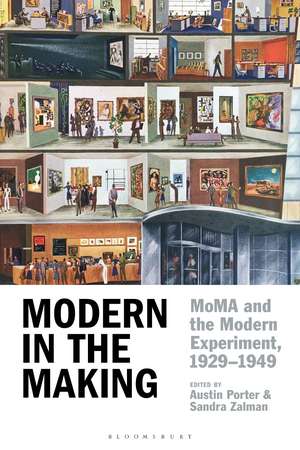
Between its founding in 1929 and its 20th anniversary in 1949, MoMA created the first museum departments of architecture and design, film, and photography in the country, marshaled modern art as a political tool, and brought consumer culture into a versatile yet institutional context. Encompassing 14 essays that investigate the diversity of modern art, this volume demonstrates how MoMA's programming shaped a version of modern art that was not elitist but fundamentally intertwined with all levels of cultural production.
Preț: 214.63 lei
Preț vechi: 307.50 lei
-30%
Puncte Express: 322
Carte tipărită la comandă
Livrare economică 20 noiembrie-04 decembrie
Livrare prin curier în România Termenul estimat este afișat lângă disponibilitate.
Transport gratuit de la 400.00 lei Plată online sau ramburs, în funcție de opțiunile comenzii.
Retur gratuit în 14 zile Comandă securizată și suport în română.
Specificații
ISBN-13: 9781350186392
ISBN-10: 1350186392
Pagini: 288
Ilustrații: 60 bw illus
Dimensiuni: 160 x 232 x 18 mm
Greutate: 0.39 kg
Editura: Bloomsbury Publishing
Colecția Bloomsbury Visual Arts
Locul publicării:London, United Kingdom
ISBN-10: 1350186392
Pagini: 288
Ilustrații: 60 bw illus
Dimensiuni: 160 x 232 x 18 mm
Greutate: 0.39 kg
Editura: Bloomsbury Publishing
Colecția Bloomsbury Visual Arts
Locul publicării:London, United Kingdom
Cuprins
Introduction
Establishing the Modern: MoMA and the Modern Experiment, Austin Porter (Kenyon College, USA) and Sandra Zalman (University of Houston, USA)
Part I: Vernacular Influences
Chapter 1: Folk Surrealism, Marci Kwon (Stanford University, USA)
Chapter 2: New Rugs by American Artists: Modernism, Abstraction, and Rug Design at MoMA, Jennifer Padgett (Crystal Bridges Museum of American Art, USA)
Chapter 3: MoMA's Child Artists, John Blakinger (University of Southern California, USA)
Chapter 4: "Floor, Ceiling, Wall, Garden Market: The Curatorial Scene of Twenty Centuries of Mexican Art, Andy Campbell (University of Southern California, USA)
Part II: New Mediums for a New Museum: Photography, Dance, Architecture and Design
Chapter 5: Aesthetic versus the "Mere Historic": Civil War and Frontier Photography at MoMA, Sarah Kate Gillespie (Gettysburg College, USA)
Chapter 6: An Exact Instant in the History of the Modern, Jason Hill (University of Delaware, USA)
Chapter 7: Performance and the Dance Archives at the Museum of Modern Art, Swagato Chakravorty (Yale University, USA)
Chapter 8: Architecture on Display: Breuer's House in the Museum Garden, Catarina Schlee Flaksman (Independent Scholar)
Part III: Mobilizing Modernism
Chapter 9: Reproducing Art and the Museum: Ancestral Sources in and beyond the Museum of Modern Art, Rachel Kaplan (Los Angeles County Museum of Art, USA)
Chapter 10: The 'Great Gallery' Goes to New York: Ancient American Rock Art, MOMA, and the New York Avant-Garde, James Farmer (Virginia Commonwealth University, USA)
Chapter 11: "Toward a Happier and More Successful Life," or When Veterans Made, Art in the Modern Museum, Suzanne Hudson (University of Southern California, USA)
Part IV: MoMA's Global Vision
Chapter 12: Occidental Arrangements: MoMA's Emerging Global History of Art at Midcentury, John Ott (James Madison University, USA)
Chapter 13: Exhibiting Italian Democracy in Twentieth Century Italian Art at the Museum of Modern Art, Antje Gamble (Murray State University, USA)
Chapter 14: American Exceptionalism at the Modern, 1942-1959: Dorothy Miller's Americans, Angela Miller (Washington University, USA)
Index
Establishing the Modern: MoMA and the Modern Experiment, Austin Porter (Kenyon College, USA) and Sandra Zalman (University of Houston, USA)
Part I: Vernacular Influences
Chapter 1: Folk Surrealism, Marci Kwon (Stanford University, USA)
Chapter 2: New Rugs by American Artists: Modernism, Abstraction, and Rug Design at MoMA, Jennifer Padgett (Crystal Bridges Museum of American Art, USA)
Chapter 3: MoMA's Child Artists, John Blakinger (University of Southern California, USA)
Chapter 4: "Floor, Ceiling, Wall, Garden Market: The Curatorial Scene of Twenty Centuries of Mexican Art, Andy Campbell (University of Southern California, USA)
Part II: New Mediums for a New Museum: Photography, Dance, Architecture and Design
Chapter 5: Aesthetic versus the "Mere Historic": Civil War and Frontier Photography at MoMA, Sarah Kate Gillespie (Gettysburg College, USA)
Chapter 6: An Exact Instant in the History of the Modern, Jason Hill (University of Delaware, USA)
Chapter 7: Performance and the Dance Archives at the Museum of Modern Art, Swagato Chakravorty (Yale University, USA)
Chapter 8: Architecture on Display: Breuer's House in the Museum Garden, Catarina Schlee Flaksman (Independent Scholar)
Part III: Mobilizing Modernism
Chapter 9: Reproducing Art and the Museum: Ancestral Sources in and beyond the Museum of Modern Art, Rachel Kaplan (Los Angeles County Museum of Art, USA)
Chapter 10: The 'Great Gallery' Goes to New York: Ancient American Rock Art, MOMA, and the New York Avant-Garde, James Farmer (Virginia Commonwealth University, USA)
Chapter 11: "Toward a Happier and More Successful Life," or When Veterans Made, Art in the Modern Museum, Suzanne Hudson (University of Southern California, USA)
Part IV: MoMA's Global Vision
Chapter 12: Occidental Arrangements: MoMA's Emerging Global History of Art at Midcentury, John Ott (James Madison University, USA)
Chapter 13: Exhibiting Italian Democracy in Twentieth Century Italian Art at the Museum of Modern Art, Antje Gamble (Murray State University, USA)
Chapter 14: American Exceptionalism at the Modern, 1942-1959: Dorothy Miller's Americans, Angela Miller (Washington University, USA)
Index
Recenzii
For those accustomed to thinking of the history of MoMA in terms of Alfred Barr's canon-setting chart, this collection is an eye opener, exploring the wide range of early MoMA exhibitions in such domains as popular culture, design, performance, and rock art. An important contribution to the ongoing work of producing a critical history of museums.
That MoMA in its early years was a more open-ended and risk-taking institution than it is today is generally known but how-in what ways-it was so remains a largely untold story. This wide-ranging, wellresearched, and eye-opening collection of essays offers new insights into the history of one of the world's most prominent museums.
That MoMA in its early years was a more open-ended and risk-taking institution than it is today is generally known but how-in what ways-it was so remains a largely untold story. This wide-ranging, wellresearched, and eye-opening collection of essays offers new insights into the history of one of the world's most prominent museums.