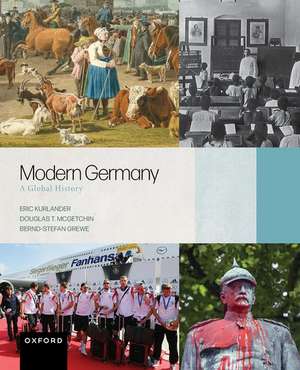
Modern Germany: A Global History
Autor Eric Kurlander, Douglas T. McGetchin, Bernd-Stefan Greween Limba Engleză Paperback – mar 2023
Preț: 395.06 lei
Preț vechi: 485.91 lei
-19%
Puncte Express: 593
Carte disponibilă
Livrare economică 12-18 noiembrie
Livrare express 28 octombrie-03 noiembrie pentru 128.98 lei
Livrare prin curier în România Termenul estimat este afișat lângă disponibilitate.
Transport gratuit de la 400.00 lei Plată online sau ramburs, în funcție de opțiunile comenzii.
Retur gratuit în 14 zile Comandă securizată și suport în română.
Specificații
ISBN-13: 9780190641528
ISBN-10: 0190641525
Pagini: 928
Ilustrații: 340
Dimensiuni: 189 x 236 x 41 mm
Greutate: 1.54 kg
Editura: Oxford University Press
Colecția OUP USA
Locul publicării:New York, United States
ISBN-10: 0190641525
Pagini: 928
Ilustrații: 340
Dimensiuni: 189 x 236 x 41 mm
Greutate: 1.54 kg
Editura: Oxford University Press
Colecția OUP USA
Locul publicării:New York, United States
Recenzii
Modern Germany is superior in its comprehensive, cultural, interdisciplinary, international approach. If you are teaching survey courses in German history and/or culture, it will benefit your students more than any other book on the market."-Bernd Schaefer, George Washington University
Modern Germany more intentionally places Germany in a global and transnational context, while offering a broad scope of chronological and thematic coverage."-David G. Tompkins, Carleton College
I find the synthesis of both recent and classic scholarship exemplary. The authors have gracefully woven in historiographic debates and all the topics seem highly appropriate and interesting. Individual voices and lives of key personalities have been brought in as well, so it's not only about structures, but also lived experience. The writing is first-rate."-Vejas Gabriel Liulevicius, University of Tennessee
The text weaves in more current scholarship and themes (place of regionalism, role of outsiders, relationship of Germany to the world) without sacrificing more traditional themes."-Christopher Fischer, Indiana State University
"Modern Germany. A Global History" is a valuable teaching tool despite the weaknesses mentioned. As a didactically well thought-out and richly illustrated compendium, it introduces students-not only in the Anglo-American language area-to a subject area that is also the subject of books that are also worth reading, but which do not make any decidedly pedagogical claims. "Modern Germany. A Global History" offers a good basis for confronting students with the complex contexts in which German-speaking Central Europe has been constituted, while at the same time promoting their critical understanding of history and teaching them how to question established narratives. But whether Germany was or is "modern" remains a question to which students should probably find the answer themselves.
Modern Germany more intentionally places Germany in a global and transnational context, while offering a broad scope of chronological and thematic coverage."-David G. Tompkins, Carleton College
I find the synthesis of both recent and classic scholarship exemplary. The authors have gracefully woven in historiographic debates and all the topics seem highly appropriate and interesting. Individual voices and lives of key personalities have been brought in as well, so it's not only about structures, but also lived experience. The writing is first-rate."-Vejas Gabriel Liulevicius, University of Tennessee
The text weaves in more current scholarship and themes (place of regionalism, role of outsiders, relationship of Germany to the world) without sacrificing more traditional themes."-Christopher Fischer, Indiana State University
"Modern Germany. A Global History" is a valuable teaching tool despite the weaknesses mentioned. As a didactically well thought-out and richly illustrated compendium, it introduces students-not only in the Anglo-American language area-to a subject area that is also the subject of books that are also worth reading, but which do not make any decidedly pedagogical claims. "Modern Germany. A Global History" offers a good basis for confronting students with the complex contexts in which German-speaking Central Europe has been constituted, while at the same time promoting their critical understanding of history and teaching them how to question established narratives. But whether Germany was or is "modern" remains a question to which students should probably find the answer themselves.
Notă biografică
Dr. Eric Kurlander, William R. Kenan Jr. Professor of History, Stetson UniversityDoug McGetchin, Associate Professor of History, Florida Atlantic University.Bernd-Stefan Grewe, Professor of History, Director of the Institute of Didactics of History and Public History, University of Tübingen, Germany.
Cuprins
- List of Maps
- Preface
- Acknowledgements
- About the Authors
- Chapter One: A World in Flux: 1500-1648
- The Politics of Empire
- Charles V and Universal Monarchy
- Culture and Society in the Age of Exploration
- The Reformation
- The Social and Political Consequences of the Reformation
- Conclusion
- Chapter Two: Germans in the Age of Absolutism, 1648-1740
- Dynastic Politics, Trade, and Imperial Exchange
- Society, Popular Culture, and Belief
- Conclusion
- Chapter Three: German Empires and Enlightenments, 1740-1790
- Poets, Philosophers, and World Citizens
- Reforming State and Society
- War and Empire
- Conclusion
- Chapter Four: Revolution and Reform, 1789-1815
- The French Revolution in Germany
- The Impact of the Revolution on German States and Peoples, 1803-1815
- The End of the Holy Roman Empire and the Emerging German Nation, 1803-1815
- Conclusion
- Chapter Five: Between Reaction and Revolution, 1815-1848
- Society and Economy
- Culture and Politics in the Vormärz
- The Revolutions of 1848
- Conclusion
- Chapter Six: Toward Germany, 1848-1871
- Industry and Society
- German Culture Beyond Borders
- The Politics of Nationhood
- Conclusion
- Chapter Seven: Building Empire at Home and Abroad, 1871-1890
- Building Democracy
- Nation-Building and its Discontents
- Building Empire
- Conclusion
- Chapter Eight: Wilhelmine Germany and "World Policy," 1890-1914
- Democracy and Empire
- Progress and Anxiety: Economy, Society and Culture
- Empire and Colonial Policy
- Conclusion
- Chapter Nine: The First World War, 1914-1918
- The Origins and Course of the First World War
- Total War
- Wartime Politics and Revolution
- Conclusion
- Chapter Ten: The Weimar Republic, 1918-1933
- The Challenges of Democracy: Domestic Politics and Socioeconomic Crisis
- The Challenges of Modernity: Culture and Society in the Weimar Republic
- National Conflict and International Compromise, 1919-1933
- Conclusion
- Chapter Eleven: The Third Reich, 1933-1945
- Nazi Politics in a Global Context
- Society and Economy: A National Socialist Revolution?
- The Culture of Coercion and Consent 1933-1939
- Conclusion
- Chapter Twelve: The Second World War, 1939-1945
- Strange Victories, 1938-1941
- Nazi Empire Building, 1941-1943
- Collapse and End of the Second World War, 1943-1945
- Conclusion
- Chapter Thirteen: The Holocaust and Ethnic Cleansing, 1941-1945
- Global Contexts: European Colonialism, Ethnic Cleansing, and Antisemitism, 1918-1938
- From "Jewish Question" to "Final Solution," 1933-1942
- Conclusion
- Chapter Fourteen: German Republics, 1945-1969
- Germans and the New Postwar Order, 1945-1949
- Culture, Economy, and Society in Two Germanies, 1949-1969
- Cold War Politics and Diplomacy, 1949-1969
- Conclusion
- Chapter Fifteen: Transcending Divisions, 1969-1991
- Politic and Diplomacy (Ostpolitik, Détente, and Disillusion)
- Economy, Culture, and Society in Two Germanies, 1969-1989
- The Fall of the Wall and Reunification Summer 1989-Summer 1991
- Conclusion
- Chapter Sixteen: Germany and the World, 1991-Present
- Multicultural Germany
- Politics and Economy
- Germany in the World
- Conclusion
- Glossary
- Credits
- Index