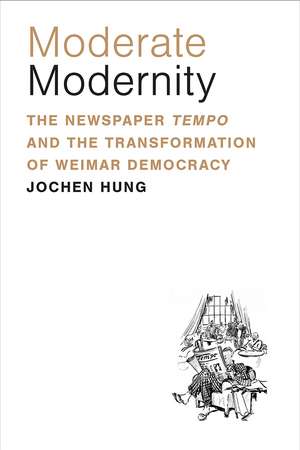
Moderate Modernity: The Newspaper Tempo and the Transformation of Weimar Democracy: Social History, Popular Culture, And Politics In Germany
Autor Jochen Hungen Limba Engleză Hardback – 6 feb 2023
The newspaper’s idea of a modern, democratic Germany was undermined by the political and economic crises that hit Germany at the beginning of the 1930s. The way the newspaper described German democracy changed under these pressures. Flappers, American fridges, and modern music—the things that Tempo had once marshalled as representatives of a German future—were now rejected by the newspaper as emblems of a bygone age. The changes in Tempo’s vision of Germany’s future show that descriptions of Weimar politics as a standoff between upright democrats and rabid extremists do not do justice to the historical complexity of the period. Rather, we need to accept the Nazis as a lethal product of a German democracy itself. The history of Tempo teaches us how liberal democracies can create and nurture their own worst enemies.
Din seria Social History, Popular Culture, And Politics In Germany
-
 Preț: 306.33 lei
 -
 Preț: 185.34 lei
 - 8%
 Preț: 581.25 lei
 -
 Preț: 154.19 lei
 -
 Preț: 339.97 lei
 -
 Preț: 262.26 lei
 -
 Preț: 261.70 lei
 - 23%
 Preț: 541.09 lei
 -
 Preț: 323.04 lei
 - 15%
 Preț: 548.68 lei
 -
 Preț: 298.48 lei
 - 15%
 Preț: 548.51 lei
 -
 Preț: 287.85 lei
 -
 Preț: 325.94 lei
 -
 Preț: 221.94 lei
 - 20%
 Preț: 607.84 lei
 - 19%
 Preț: 427.24 lei
 - 32%
 Preț: 490.71 lei
 - 25%
 Preț: 507.50 lei
 - 19%
 Preț: 550.46 lei
 - 19%
 Preț: 518.14 lei
 - 13%
 Preț: 421.69 lei
 - 19%
 Preț: 486.77 lei
 - 19%
 Preț: 518.17 lei
 -
 Preț: 175.95 lei
 -
 Preț: 282.57 lei
 - 25%
 Preț: 541.27 lei
 - 20%
 Preț: 577.03 lei
 -
 Preț: 296.78 lei
 - 20%
 Preț: 609.07 lei
 - 28%
 Preț: 491.14 lei
 - 20%
 Preț: 576.55 lei
 - 19%
 Preț: 582.53 lei
 - 23%
 Preț: 513.06 lei
 - 25%
 Preț: 541.27 lei
 -
 Preț: 296.40 lei
 -
 Preț: 263.28 lei
 - 20%
 Preț: 542.26 lei
 -
 Preț: 220.75 lei
 -
 Preț: 323.37 lei
 - 24%
 Preț: 607.03 lei
 -
 Preț: 334.31 lei
 - 23%
 Preț: 613.57 lei
 -
 Preț: 272.19 lei
Preț: 487.10 lei
Preț vechi: 601.36 lei
-19%
Puncte Express: 731
Preț estimativ în valută:
86.23€ • 100.33$ • 74.78£
86.23€ • 100.33$ • 74.78£
Carte indisponibilă temporar
Doresc să fiu notificat când acest titlu va fi disponibil:
Se trimite...
Preluare comenzi: 021 569.72.76
Specificații
ISBN-13: 9780472133321
ISBN-10: 0472133322
Pagini: 274
Ilustrații: 29 illustrations
Dimensiuni: 152 x 229 x 23 mm
Greutate: 0.51 kg
Editura: UNIVERSITY OF MICHIGAN PRESS
Colecția University of Michigan Press
Seria Social History, Popular Culture, And Politics In Germany
ISBN-10: 0472133322
Pagini: 274
Ilustrații: 29 illustrations
Dimensiuni: 152 x 229 x 23 mm
Greutate: 0.51 kg
Editura: UNIVERSITY OF MICHIGAN PRESS
Colecția University of Michigan Press
Seria Social History, Popular Culture, And Politics In Germany
Notă biografică
Jochen Hung is Associate Professor of Cultural History at Utrecht University.
Recenzii
"An engaging, concisely written, and well-organized study. . . . Highly recommended."
"A creative and very readable book. . . . One of the many strengths of this volume is that it illustrates transformation processes using examples from the history of the everyday. From the advice of the newspaper's agony aunt to travel tips for singles and the inexpensive organisation of leisure activities at the weekend, Hung focuses on the interaction between Tempo and its readership. In doing so, he provides insights into an Alltagskultur (everyday culture) that had thoroughly positive connotations. He shows, almost casually, how citizens negotiated the big questions of life and work in a new republican state on a small scale." [translated from German]
“einer längst überfälligen und dabei profunden, fest in den historischen Kontexten verwurzelten Studie zu dieser Pioniertat des Printjournalismus. (a long overdue and profound study of this pioneering achievement in print journalism, firmly rooted in its historical context)."
"Jochen Hung’s engaging monograph is an important addition to the scholarship on modernity, media, democracy, and the late Weimar Republic."
"Jochen Hung uses Tempo to provide an illuminating microhistory of Weimar’s upbeat. . . Hung’s richly illustrated and expertly argued book explores ‘nowadays’ and their passing, when ‘postwar’ gave way to ‘prewar’, and tempo became signal."
"A creative and very readable book. . . . One of the many strengths of this volume is that it illustrates transformation processes using examples from the history of the everyday. From the advice of the newspaper's agony aunt to travel tips for singles and the inexpensive organisation of leisure activities at the weekend, Hung focuses on the interaction between Tempo and its readership. In doing so, he provides insights into an Alltagskultur (everyday culture) that had thoroughly positive connotations. He shows, almost casually, how citizens negotiated the big questions of life and work in a new republican state on a small scale." [translated from German]
“einer längst überfälligen und dabei profunden, fest in den historischen Kontexten verwurzelten Studie zu dieser Pioniertat des Printjournalismus. (a long overdue and profound study of this pioneering achievement in print journalism, firmly rooted in its historical context)."
"Jochen Hung’s engaging monograph is an important addition to the scholarship on modernity, media, democracy, and the late Weimar Republic."
Descriere
A history of “Germany’s most modern newspaper” through the rise of the Nazis and the collapse of Germany’s first democracy