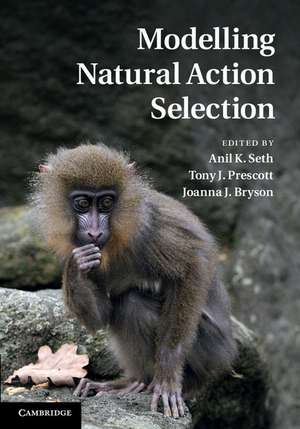
Modelling Natural Action Selection
Editat de Anil K. Seth, Tony J. Prescott, Joanna J. Brysonen Limba Engleză Hardback – 9 noi 2011
Preț: 1173.83 lei
Preț vechi: 1364.91 lei
-14%
Puncte Express: 1761
Carte tipărită la comandă
Livrare economică 17-31 iulie
Livrare prin curier în România Termenul estimat este afișat lângă disponibilitate.
Transport gratuit pentru acest produs Plată online sau ramburs, în funcție de opțiunile comenzii.
Retur gratuit în 14 zile Comandă securizată și suport în română.
Specificații
ISBN-13: 9781107000490
ISBN-10: 1107000491
Pagini: 560
Ilustrații: 135 b/w illus.
Dimensiuni: 183 x 254 x 30 mm
Greutate: 1.27 kg
Ediția:New.
Editura: Cambridge University Press
Colecția Cambridge University Press
Locul publicării:New York, United States
ISBN-10: 1107000491
Pagini: 560
Ilustrații: 135 b/w illus.
Dimensiuni: 183 x 254 x 30 mm
Greutate: 1.27 kg
Ediția:New.
Editura: Cambridge University Press
Colecția Cambridge University Press
Locul publicării:New York, United States
V-ar putea interesa
-
 -30%Preț: 1103.07 lei1570.77 lei
 -
 Perspectives on Animal BehaviorBetty Mcguire-23%Preț: 1485.41 lei1929.11 lei
 -
 Wildlife Search and RescueRebecca Dmytryk-8%Preț: 431.32 lei468.83 lei
 -
 How Vertebrates Left the WaterMichel Laurin-23%Preț: 484.64 lei629.40 lei
 -
 The Chemistry of LifeRobert HillPreț: 335.65 lei
 -
 The Effects of Low Temperature on Biological SystemsB. W. W. GroutPreț: 452.60 lei
 -
 Machina CarnisDorothy M. Needham-5%Preț: 466.89 lei491.46 lei
 -
 Major Topics in Primate and Human EvolutionBernard A. WoodPreț: 371.39 lei
 -
 Evolution of SexRonald Ted SmithPreț: 407.79 lei
 -
 The Behavioural Biology of AggressionJohn ArcherPreț: 332.17 lei
 -
 Cell Commitment and DifferentiationN. MacLeanPreț: 396.16 lei
 -
 Enzyme KineticsArthur R. SchulzPreț: 442.27 lei
 -
 Animal IntelligenceZhanna Reznikova-11%Preț: 565.98 lei635.93 lei
 -
 The Shaping of LifeLionel G. Harrison-5%Preț: 934.15 lei983.32 lei
 -
 Cluster and Classification Techniques for the BiosciencesAlan H. Fielding-5%Preț: 327.63 lei344.87 lei
 -
 Analysis of Variance and CovarianceC. Patrick Doncaster-5%Preț: 432.49 lei455.26 lei
 -
 Evolutionary History of BatsGregg F. GunnellPreț: 398.00 lei
 -
 Aquaculture and BehaviorFelicity Huntingford-8%Preț: 481.34 lei523.20 lei
 -
 Biomimetic and Biohybrid SystemsUriel Martinez-Hernandez-20%Preț: 327.48 lei409.36 lei
 -
 Biomimetic and Biohybrid SystemsArmin Duff-20%Preț: 330.96 lei413.70 lei
 -
 Biomimetic and Biohybrid SystemsStuart P. Wilson-20%Preț: 331.80 lei414.75 lei
 -
 Biomimetic and Biohybrid SystemsNathan F. Lepora-20%Preț: 336.07 lei420.09 lei
 -
 Biomimetic and Biohybrid SystemsVasiliki Vouloutsi-20%Preț: 336.07 lei420.09 lei
 -
 Biomimetic and Biohybrid SystemsNathan F. Lepora-20%Preț: 331.59 lei414.49 lei
Cuprins
Foreword Peter M. Todd; 1. General introduction Anil K. Seth, Joanna J. Bryson and Tony J. Prescott; Part I. Rational and Optimal Decision Making: 2. Introduction to Part I: rational and optimal decision making Anil K. Seth, Tony J. Prescott and Joanna J. Bryson; 3. Do we expect natural selection to produce rational behaviour? Alasdair I. Houston, John M. McNamara and Mark D. Steer; 4. Optimised agent-based modelling of action selection Anil K. Seth; 5. Compromise strategies for action selection Frederick L. Crabbe; 6. Extending a biologically inspired model of choice: multi-alternatives, nonlinearity and value based multidimensional choice Rafal Bogacz, Marius Usher, Jiaxiang Zhang and James L. McClelland; 7. Bayesian approaches to modelling action selection Max Berniker, Kunlin Wei and Konrad Kording; 8. Post-retrieval inhibition in sequential memory search Eddy J. Davelaar; Part II. Computational Neuroscience Models: 9. Introduction to Part II: computational neuroscience models Tony J. Prescott, Joanna J. Bryson and Anil K. Seth; 10. Action selection and refinement in subcortical loops through basal ganglia and cerebellum James C. Houk; 11. Cortical mechanisms of action selection: the affordance competition hypothesis Paul Cisek; 12. Toward an executive without a homunculus: computational models of the prefrontal/basal ganglia system Thomas E. Hazy, Michael J. Frank and Randall C. O'Reilly; 13. Hierarchically organized behaviour and its neural foundations Matthew M. Botvinick, Yael Niv and Andrew C. Barto; 14. The medial reticular formation: a brainstem substrate for simple action selection? Mark D. Humphries, Kevin N. Gurney and Tony J. Prescott; 15. Understanding decision making deficits in neurological conditions: insights from models of natural action selection Michael J. Frank, Anouk Scheres and Scott J. Sherman; 16. Biologically constrained action selection improves cognitive control in a model of the Stroop task Tom Stafford and Kevin N. Gurney; 17. Mechanisms of choice in the primate brain: a quick look at positive feedback Jonathan M. Chambers, Kevin N. Gurney, Mark D. Humphries and Tony J. Prescott; Part III. Action Selection in Social Contexts: 18. Introduction to Part III: action selection in social contexts Joanna J. Bryson, Tony J. Prescott and Anil K. Seth; 19. Agent-based models as scientific methodology: a case study analyzing the DomWorld theory of primate social structure and female dominance Joanna J. Bryson, Yasushi Ando and Hagen Lehmann; 20. An agent-based model of group decision making in baboons Russell A. Hill, Brian S. Logan, William I. Sellers and Julian Zappala; 21. Endogenous birth and death of political parties in dynamic party competition Michael Laver, Ernest Sergenti and Michel Schilperoord; 22. On optimal decision-making in brains and social insect colonies James A. R. Marshall, Rafal Bogacz, Anna Dornhaus, Robert Planqué, Tim Kovacs and Nigel R. Franks; 23. State-dependent foraging rules for social animals in selfish herds Sean A. Rands, Richard A. Pettifor, J. Marcus Rowcliffe and Guy Cowlishaw; Index.
Recenzii
'… the volume could make the basis for a terrific interdisciplinary graduate seminar, or serve as a means for postdoctoral researchers to get into a related field …' Marc Mangel, The Quarterly Review of Biology
Descriere
Uses cutting-edge computational models to explore the fundamental biological problem of action selection in nature.