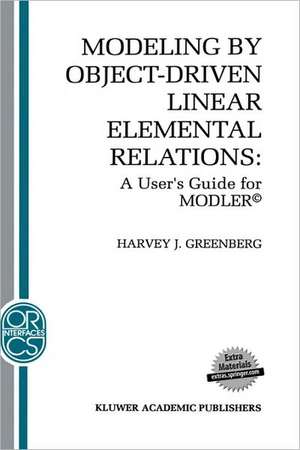
Modeling by Object-Driven Linear Elemental Relations
Autor H J Greenbergen Limba Engleză Hardback – 31 mar 1993
Preț: 928.35 lei
Preț vechi: 1132.13 lei
-18%
Puncte Express: 1393
Carte tipărită la comandă
Livrare economică 27 noiembrie-11 decembrie
Livrare prin curier în România Termenul estimat este afișat lângă disponibilitate.
Transport gratuit pentru acest produs Plată online sau ramburs, în funcție de opțiunile comenzii.
Retur gratuit în 14 zile Comandă securizată și suport în română.
Specificații
ISBN-13: 9780792393238
ISBN-10: 0792393236
Pagini: 163
Ilustrații: X, 163 p.
Dimensiuni: 156 x 234 x 11 mm
Greutate: 0.43 kg
Ediția:1993 edition
Editura: Springer Us
Locul publicării:New York, NY, United States
ISBN-10: 0792393236
Pagini: 163
Ilustrații: X, 163 p.
Dimensiuni: 156 x 234 x 11 mm
Greutate: 0.43 kg
Ediția:1993 edition
Editura: Springer Us
Locul publicării:New York, NY, United States
V-ar putea interesa
-
 Preț: 109.97 lei
 -
 Stand OutDorie Clark-48%Preț: 61.77 lei118.03 lei
 -
 The Mindful LeaderMichael BuntingPreț: 99.71 lei
 -
 PowerhouseJames BowenPreț: 217.82 lei
 -
 Positive Psychology and ChangeSarah LewisPreț: 258.99 lei
 -
 Learning LeadershipJames M. KouzesPreț: 150.02 lei
 -
 Organizational Culture and Leadership, 5th editionEdgar H. Schein-8%Preț: 374.44 lei406.99 lei
 -
 Preț: 360.94 lei
 -
 The First Two Rules of LeadershipDavid CottrellPreț: 124.35 lei
 -
 When Execution Isn't EnoughClaudio FeserPreț: 161.09 lei
 -
 Your Next RoleNiamh O'KeeffePreț: 102.25 lei
 -
 JumpStart Your PrioritiesJohn C. MaxwellPreț: 236.15 lei
 -
 Leading Virtual TeamsHarvard Business ReviewPreț: 68.48 lei
 -
 Virtual CollaborationHarvard Business ReviewPreț: 63.70 lei
 -
 Harvard Business Review Leadership & Strategy SetHarvard Business Review-9%Preț: 800.62 lei879.81 lei
Public țintă
ResearchCuprins
Chapter1 Overview, Installation, and Help.- 1.1 What you have and how to begin.- 1.2 Quick installation for DOS environment.- 1.3 Alternative environments.- 1.4 Some interactive language conventions.- 1.5 On-line documentation.- Chapter2 Anatomy of a Linear Program.- 2.1 Algebraic form.- 2.2 Model syntax.- 2.3 Objects and relations.- Chapter3 Preliminaries.- 3.1 The sign-on and basic interactive conventions.- 3.2 Elementary models and query.- 3.3 Randomization by command.- Chapter4 Models and Instances.- 4.1 Some precepts.- 4.2 More examples.- 4.3 Data objects.- 4.4 Randomization options.- Chapter5 Special Structures.- 5.1 Binary variables and logical constraints.- 5.2 Dynamic models.- 5.3 Approximation of nonlinear functions.- 5.4 Elastic programming.- Chapter6 The SUM Expression.- 6.1 Simple examples.- 6.2 Index conditions.- 6.3 Data conditions.- Chapter7 Dependencies.- 7.1 Set maps.- 7.2 Implicit sets.- 7.3 Implicit tables.- 7.4 The SHOW command.- Chapter8 File Interfaces.- 8.1 Environment controls.- 8.2 Dictionaries, documents, help, and keyword files.- 8.3 Execution files.- 8.4 Model files.- 8.5 Data files.- 8.6 Matrix and packed files.- 8.7 Schema and syntax files.- 8.8 Explain files.- Chapter9 More Model Description.- 9.1 Term expressions.- 9.2 A blending model.- 9.3 The REPORT execution file.- 9.4 Attribute inheritance.- 9.5 Equation conditions.- 9.6 Use of set maps.- Chapter10 Model Management.- 10.1 Overview.- 10.2 A case study.- 10.3 Using directories to aid model formulation.