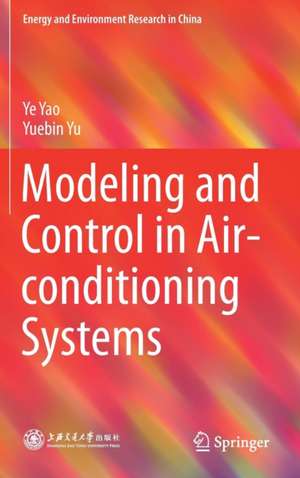
Modeling and Control in Air-conditioning Systems: Energy and Environment Research in China
Autor Ye Yao, Yuebin Yuen Limba Engleză Hardback – 12 oct 2016
Subsequently, virtual sensor calibration and virtual sensing methods (which are very useful for real system control) are illustrated together with a case study. Model-based predictive control and state-space feedback control are applied to air-conditioning systems to yield better local control, while the air-side synergic control scheme and a global optimization strategy based on the decomposition-coordination method are developed so as to achieve energy conservation in the central air-conditioning system. Lastly, control strategies for VAV systems including total air volume control and trim & response static pressure control are investigated in practice.
Preț: 935.13 lei
Preț vechi: 1140.40 lei
-18%
Puncte Express: 1403
Carte tipărită la comandă
Livrare economică 16-30 noiembrie
Livrare prin curier în România Termenul estimat este afișat lângă disponibilitate.
Transport gratuit pentru acest produs Plată online sau ramburs, în funcție de opțiunile comenzii.
Retur gratuit în 14 zile Comandă securizată și suport în română.
Specificații
ISBN-13: 9783662533116
ISBN-10: 3662533111
Pagini: 504
Ilustrații: XXI, 479 p. 272 illus., 46 illus. in color.
Dimensiuni: 160 x 241 x 33 mm
Greutate: 0.92 kg
Ediția:1st edition 2017
Editura: Springer
Colecția Energy and Environment Research in China
Seria Energy and Environment Research in China
Locul publicării:Berlin, Heidelberg, Germany
ISBN-10: 3662533111
Pagini: 504
Ilustrații: XXI, 479 p. 272 illus., 46 illus. in color.
Dimensiuni: 160 x 241 x 33 mm
Greutate: 0.92 kg
Ediția:1st edition 2017
Editura: Springer
Colecția Energy and Environment Research in China
Seria Energy and Environment Research in China
Locul publicării:Berlin, Heidelberg, Germany
V-ar putea interesa
-
 Agile Energy Systems: Global Distributed On-Site and Central Grid PowerWoodrow W. Clark, II-26%Preț: 892.07 lei1212.72 lei
 -
 -18%Preț: 899.12 lei1096.49 lei
 -
 Thermodynamics for Sustainable Management of Natural ResourcesWojciech Stanek-18%Preț: 1252.78 lei1527.78 lei
 -
 Food Waste Reduction and ValorisationPiergiuseppe Morone-18%Preț: 1022.49 lei1246.94 lei
 -
 Renewable Energy ClustersGudrun Jaegersberg-18%Preț: 735.52 lei896.97 lei
 -
 Probabilistic Prognostics and Health Management of Energy SystemsStephen Ekwaro-Osire-15%Preț: 621.34 lei730.99 lei
 -
 District Heating and Cooling Networks in the European UnionAntonio Colmenar-Santos-15%Preț: 612.98 lei721.14 lei
 -
 Power System Optimization Modeling in GAMSAlireza Soroudi-18%Preț: 1119.18 lei1364.86 lei
 -
 Designing Impedance Networks ConvertersGuidong Zhang-18%Preț: 697.19 lei850.24 lei
 -
 Sustainable Automotive Energy System in ChinaCAERC, Tsinghua University-18%Preț: 928.03 lei1131.73 lei
 -
 Preț: 394.42 lei
 -
 EnergiewirtschaftDietmar Winje-15%Preț: 488.11 lei574.25 lei
 -
 EnergieeffizienzBernadette WeylandPreț: 245.31 lei
 -
 Praxishandbuch MieterstromIris Behr-11%Preț: 554.60 lei623.14 lei
 -
 Preț: 330.78 lei
 -
 Preț: 398.09 lei
 -
 Preț: 339.67 lei
 -
 Preț: 330.05 lei
 -
 Preț: 392.55 lei
 -
 Preț: 394.78 lei
 -
 The German Energy TransitionThomas Unnerstall-15%Preț: 455.17 lei535.49 lei
 -
 -18%Preț: 1583.59 lei1931.21 lei
 -
 Design and Control of Matrix ConvertersAnindya Dasgupta-15%Preț: 646.80 lei760.94 lei
 -
 -15%Preț: 619.92 lei729.33 lei
 -
 ICT Investment for Energy Use in the Industrial SectorsNabaz T. Khayyat-15%Preț: 643.28 lei756.80 lei
Cuprins
Introduction.- State-space modelling for air-conditioning system.- Modelling based on graph theory and structure-matrix theory.- Control design based on state-space model.- Air-conditioning load forecasting model.- Optimal operation and energy analysis modelling for air-conditioning system.- Thermal comfort of human body indoors.- Multizone network modelling of building ventilation and contaminant transport.- Computational fluid dynamics of building environment.- Coupled multizone and CFD modelling of building environment.- New trends of advanced modelling of building environment.
Textul de pe ultima copertă
This book investigates the latest modeling and control technologies in the context of air-conditioning systems. Firstly, it introduces the state-space method for developing dynamic models of all components in a central air-conditioning system. The models are primarily nonlinear and based on the fundamental principle of energy and mass conservation, and are transformed into state-space form through linearization. The book goes on to describe and discuss the state-space models with the help of graph theory and the structure-matrix theory.
Subsequently, virtual sensor calibration and virtual sensing methods (which are very useful for real system control) are illustrated together with a case study. Model-based predictive control and state-space feedback control are applied to air-conditioning systems to yield betterlocal control, while the air-side synergic control scheme and a global optimization strategy based on the decomposition-coordination method are developed so as to achieve energy conservation in the central air-conditioning system. Lastly, control strategies for VAV systems including total air volume control and trim & response static pressure control are investigated in practice.
Subsequently, virtual sensor calibration and virtual sensing methods (which are very useful for real system control) are illustrated together with a case study. Model-based predictive control and state-space feedback control are applied to air-conditioning systems to yield betterlocal control, while the air-side synergic control scheme and a global optimization strategy based on the decomposition-coordination method are developed so as to achieve energy conservation in the central air-conditioning system. Lastly, control strategies for VAV systems including total air volume control and trim & response static pressure control are investigated in practice.
Caracteristici
Includes many advanced modeling methods in the field of heating, ventilation, air conditioning and refrigeration (HVAC & R) and building environments Offers a detailed introduction to HVAC systems and building environments Makes a significant contribution to the development of energy-saving technologies in air-conditioning systems and buildings Includes supplementary material: sn.pub/extras