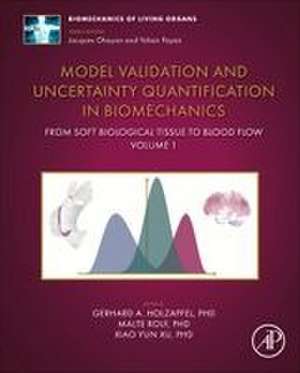
Model Validation and Uncertainty Quantification in Biomechanics: From Soft Biological Tissue to Blood Flow: Biomechanics of Living Organs
Editat de Gerhard A. Holzapfel, Malte Rolf, Xiao Yun Xuen Limba Engleză Hardback – 16 oct 2026
Part 3 introduces current and innovative approaches for quantifying uncertainties inherent in biomechanical modeling. Chapters range from established methodologies to emerging techniques, providing a comprehensive overview of the various strategies employed in addressing uncertainty in biomechanical studies. Finally, in Part 4, the book concludes with a focus on cutting-edge methods, specifically spotlighting the utilization of machine learning and surrogate modeling for both model validation and uncertainty quantification. Through real-world applications and case studies, this book provides an in-depth understanding of how these advanced techniques are reshaping the landscape of biomechanics research.
- Provides an overview of the basics of uncertainty quantification, sensitivity analysis, machine learning, and surrogate modeling
- Focuses on the underlying biomechanics and computational modeling of the cardiovascular system
- Introduces current and novel methods for quantifying uncertainties in various biomechanical applications


Preț: 1294.89 lei
Preț vechi: 1802.24 lei
-28% Precomandă
Puncte Express: 1942
Carte nepublicată încă
Livrare prin curier în România Precomanda se expediază când titlul devine disponibil.
Transport gratuit pentru acest produs Plată online sau ramburs, în funcție de opțiunile comenzii.
Retur gratuit în 14 zile Comandă securizată și suport în română.
Doresc să fiu notificat când acest titlu va fi disponibil:
Se trimite...
Specificații
ISBN-13: 9780443330162
ISBN-10: 0443330166
Pagini: 400
Dimensiuni: 191 x 235 mm
Editura: ELSEVIER SCIENCE
Colecția Biomechanics of Living Organs
Seria Biomechanics of Living Organs
ISBN-10: 0443330166
Pagini: 400
Dimensiuni: 191 x 235 mm
Editura: ELSEVIER SCIENCE
Colecția Biomechanics of Living Organs
Seria Biomechanics of Living Organs
V-ar putea interesa
-
 The Exquisite MachineSian E. Harding-21%Preț: 122.47 lei155.89 lei
 -
 SimulationSheldon M. Ross-32%Preț: 507.74 lei748.11 lei
 -
 -23%Preț: 1204.35 lei1555.12 lei
 -
 Snapshots of HemodynamicsNico Westerhof-5%Preț: 1125.32 lei1184.55 lei
 -
 BiomechanicsY. C. Fung-5%Preț: 1087.91 lei1145.16 lei
 -
 Oh's Intensive Care ManualJonathan M. Handy-29%Preț: 688.26 lei970.31 leiRecomandat
 -
 Sabiston Textbook of Surgery: The Biological Basis of Modern Surgical PracticeDouglas Scott Tyler-29%Preț: 1167.99 lei1644.95 leiRecomandat
 -
 Kern's Cardiac Catheterization HandbookPaul Sorajja-28%Preț: 393.87 lei544.20 leiRecomandat
 -
![The Comprehensive Textbook of Clinical Biomechanics: with access to e-learning course [formerly Biomechanics in Clinic and Research]](https://i4.books-express.ro/bt/9780702054891/the-comprehensive-textbook-of-clinical-biomechanics.jpg) -28%Preț: 692.58 lei957.75 lei
-28%Preț: 692.58 lei957.75 lei -
 A First Course in Systems BiologyEberhard Voit-8%Preț: 632.47 lei687.47 lei
 -
 -8%Preț: 437.71 lei475.77 lei
 -
 Methods in Cardiovascular and Lymphatic BiologyEvangelia Papadimitriou-5%Preț: 1422.25 lei1497.11 lei
 -
 Replaceable YouMary Roach-5%Preț: 106.62 lei112.23 lei
 -
 -18%Preț: 1243.66 lei1516.65 lei
 -
 Computational Biomechanics for MedicinePoul M. F. Nielsen-18%Preț: 1476.24 lei1800.30 lei
 -
 Simulation in Cardiovascular Critical Care MedicineRonald A. Bronicki-5%Preț: 1040.89 lei1095.67 lei
 -
 Computational Biomechanics for MedicineAdam Wittek-18%Preț: 1175.90 lei1434.02 lei
 -
 Statistics for ScientistsUmberto Michelucci-20%Preț: 275.88 lei344.84 lei
 -
 -57%Preț: 1697.00 lei3908.44 lei
 -
 -5%Preț: 1240.38 lei1305.66 lei
Cuprins
Part 1. Basics and fundamentals
1. Model validation in biomechanics: terminology and regulatory guidelines for in silico medicine
2. Machine learning in continuum biomechanics: techniques, applications, and future directions
3. Physics-informed neural operators for biomechanics: advancing computational modeling with separable architectures
Part 2. Validation in cardiovascular modeling
4. Verification and validation of growth and remodeling models: Application to thoracic aortic aneurysms
5. Model validation of stent-graft deployment and migration simulations in large arteries
6. Validation and uncertainty quantification of patient-specific TAVI simulations within the ASME V&V40 credibility framework
7. Validation of computational fluid dynamics simulations in arteries
8. Uncertainty quantification analysis in artificial intelligence-based prediction of myocardial ischemia
9. Generation and validation of virtual patient cohorts for in silico clinical trials: achievements from the SIMCor project
Part 3. Validation beyond the heart
10. Computational continuum models in soft tissue biomechanics: The way from verification to uncertainty quantification
11. Validation of computational brain models
12. Validating the predictions of mathematical models describing tumor growth and treatment response
1. Model validation in biomechanics: terminology and regulatory guidelines for in silico medicine
2. Machine learning in continuum biomechanics: techniques, applications, and future directions
3. Physics-informed neural operators for biomechanics: advancing computational modeling with separable architectures
Part 2. Validation in cardiovascular modeling
4. Verification and validation of growth and remodeling models: Application to thoracic aortic aneurysms
5. Model validation of stent-graft deployment and migration simulations in large arteries
6. Validation and uncertainty quantification of patient-specific TAVI simulations within the ASME V&V40 credibility framework
7. Validation of computational fluid dynamics simulations in arteries
8. Uncertainty quantification analysis in artificial intelligence-based prediction of myocardial ischemia
9. Generation and validation of virtual patient cohorts for in silico clinical trials: achievements from the SIMCor project
Part 3. Validation beyond the heart
10. Computational continuum models in soft tissue biomechanics: The way from verification to uncertainty quantification
11. Validation of computational brain models
12. Validating the predictions of mathematical models describing tumor growth and treatment response