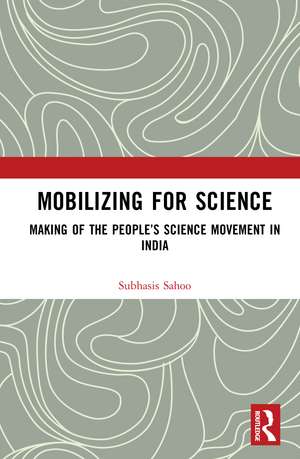
Mobilizing for Science: Making of the People’s Science Movement in India
Autor Subhasis Sahooen Limba Engleză Hardback – 28 aug 2026
This interdisciplinary volume spotlights cases and focused content which thoroughly analyses mobilization, institutionalization and how science movement organizations have emerged and changed since independence. Drawing out theoretical perspectives on the people’s science movement in India, it identifies new areas of research in science, technology and society studies.
Written in a lucid and engaging style, this book will be useful to the departments of Sociology, Anthropology, Philosophy, Political Science, Education, Social Work, Development Studies, Science and Technology Studies and South Asian Studies. It would also be useful to social activists, social workers and professionals in the voluntary sector.
Preț: 977.64 lei
Preț vechi: 1316.82 lei
-26% Precomandă
Puncte Express: 1466
Carte nepublicată încă
Livrare prin curier în România Precomanda se expediază când titlul devine disponibil.
Transport gratuit pentru acest produs Plată online sau ramburs, în funcție de opțiunile comenzii.
Retur gratuit în 14 zile Comandă securizată și suport în română.
Doresc să fiu notificat când acest titlu va fi disponibil:
Se trimite...
Specificații
ISBN-13: 9781041109426
ISBN-10: 1041109423
Pagini: 150
Ilustrații: 4
Dimensiuni: 156 x 234 mm
Ediția:1
Editura: Taylor & Francis
Colecția Routledge
Locul publicării:Oxford, United Kingdom
ISBN-10: 1041109423
Pagini: 150
Ilustrații: 4
Dimensiuni: 156 x 234 mm
Ediția:1
Editura: Taylor & Francis
Colecția Routledge
Locul publicării:Oxford, United Kingdom
Public țintă
PostgraduateCuprins
1. Introduction 2. A Genealogy of Science Movements 3. Popularisation Of Science: The Case of Marathi Vigyan Parishad 4. Pedagogy of Science: The Case of Eklavya 5. Processions of Science: Evidence from Bharat Gyan Vigyan Samiti 6. Policy Intervention of Science and Technology: The Role of Delhi Science Forum 7. Conclusions: The Making of a Movement References Appendices
Notă biografică
Subhasis Sahoo is Assistant Professor at the Department of Sociology, University of Allahabad. He holds MA and MPhil from University of Hyderabad and earned his doctoral degree in Sociology from IIT Kanpur. He was selected for International Visiting Faculty at Bielefeld University, Germany and an Overseas Young Scholar at Japan Sociological Society (JSS), Tokyo and Visiting Fellow at National Institute of Science Education and Research (NISER), Bhubaneswar. He taught at Delhi School of Economics and Sri Venkateswar College, University of Delhi. He has previously worked at the Institute for Human Development (IHD), Delhi; National Council of Applied Economic Research (NCAER), New Delhi; The Energy and Resources Institute (TERI), New Delhi and University of Hyderabad. He is the recipients of prestigious Professor M. N. Srinivas Memorial Award for the Young Sociologist; Professor Radhakamal Mukherjee Memorial Award for the Young Social Scientist; the CIGA Grants of University of Padova, Italy; CNMT Grants of Korea Institute of Science and Technology, Seoul; Revolving Fund Scholarship of University of California, Los Angeles, USA. His writings have been appeared in three languages including English, Hindi and Odia. His research interests include sociology of science and technology, social movements, public policy, knowledge systems, religion and society, urban ecology, identity and indigenous groups, social stratification and education, material culture, innovation and entrepreneurship.
Descriere
This book is a pioneering exploration of science and society through insights gathered from social movements in India post-Independence. Based on rigorous empirical investigation of civil society organizations, it unearths the geneaology of science activism in India while raising pertinents questions on science-society coupling.