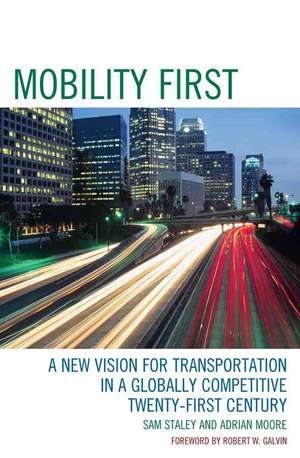
Mobility First: A New Vision for Transportation in a Globally Competitive Twenty-first Century
Autor Sam Staley, Adrian Mooreen Limba Engleză Hardback – 16 dec 2008
The book considers transportation policy through the intersection of four crucial and timely elements: global, economic, and cultural competitiveness; urban development trends; demographics; and transportation engineering and design. It sets goals for congestion reduction, outlines performance standards that increase transparency, calls for the redesign of the regional transportation network, and describes sufficient investment in technology.
Preț: 313.58 lei
Preț vechi: 381.83 lei
-18%
Puncte Express: 470
Carte tipărită la comandă
Livrare economică 09-23 decembrie
Livrare prin curier în România Termenul estimat este afișat lângă disponibilitate.
Transport gratuit de la 400.00 lei Plată online sau ramburs, în funcție de opțiunile comenzii.
Retur gratuit în 14 zile Comandă securizată și suport în română.
Specificații
ISBN-13: 9780742558793
ISBN-10: 0742558797
Pagini: 214
Dimensiuni: 160 x 238 x 17 mm
Greutate: 0.43 kg
Editura: Bloomsbury Publishing
Colecția Rowman & Littlefield
Locul publicării:New York, United States
ISBN-10: 0742558797
Pagini: 214
Dimensiuni: 160 x 238 x 17 mm
Greutate: 0.43 kg
Editura: Bloomsbury Publishing
Colecția Rowman & Littlefield
Locul publicării:New York, United States
Cuprins
Chapter 1 Foreword
Part 2 Part I. The Congestion Conundrum
Chapter 3 Chapter 1. It's the Cars, Stupid!
Chapter 4 Chapter 2. Congestion's Relentless Pursuit
Part 5 Part II. Mobility and Global Competitiveness
Chapter 6 Chapter 3. The Need for Speed
Chapter 7 Chapter 4. The Apple of Automobility
Chapter 8 Chapter 5. A New Approach to Congestion and Transportation
Part 9 Part III. Getting from Here to There
Chapter 10 Chapter 6. Eight Steps to Building Road Capacity
Chapter 11 Chapter 7. The Missing Link
Chapter 12 Chapter 8. Taking System Management Seriously
Chapter 13 Chapter 9. Transitioning Transit
Part 14 Part IV. Making It Work
Chapter 15 Chapter 10. Where's the Beef? Funding Twenty-first Century Mobility
Chapter 16 Chapter 11. Charting the Uncharted
Chapter 17 Appendix A. Transportation and Climate Change
Chapter 18 Appendix B. Land Use and Transportation Choice
Part 2 Part I. The Congestion Conundrum
Chapter 3 Chapter 1. It's the Cars, Stupid!
Chapter 4 Chapter 2. Congestion's Relentless Pursuit
Part 5 Part II. Mobility and Global Competitiveness
Chapter 6 Chapter 3. The Need for Speed
Chapter 7 Chapter 4. The Apple of Automobility
Chapter 8 Chapter 5. A New Approach to Congestion and Transportation
Part 9 Part III. Getting from Here to There
Chapter 10 Chapter 6. Eight Steps to Building Road Capacity
Chapter 11 Chapter 7. The Missing Link
Chapter 12 Chapter 8. Taking System Management Seriously
Chapter 13 Chapter 9. Transitioning Transit
Part 14 Part IV. Making It Work
Chapter 15 Chapter 10. Where's the Beef? Funding Twenty-first Century Mobility
Chapter 16 Chapter 11. Charting the Uncharted
Chapter 17 Appendix A. Transportation and Climate Change
Chapter 18 Appendix B. Land Use and Transportation Choice
Recenzii
Speaking from our experiences in Texas, Sam Staley and Adrian Moore get it right in Mobility First. As our nation's population continues to grow and our infrastructure continues to age, we need to come up with new solutions to meeting transportation needs. The recommendations in Mobility First will no doubt cause an uproar in some quarters, but the position they take is one that will move the dialogue forward and help America remain competitive in our increasingly global economy.
In spite of a considerable volume of research by urban economists over the last 40+ years, there is still a huge gap between the policies and projects that are routinely put forward by policy makers and the ones that solid research supports. . . . Serious researchers have little good to say about the conventional approaches; most suggest the policies outlined in Mobility First. The arguments are clearly stated and well documented. The rest is up to those who are serious about better transportation policy. They should read this book.
This work by Staley and Moore is an invaluable contribution to the looming public choice question in the debate over the proper use of roads and railways and how alternative pricing and financial arrangements can allocate resources for mobility that allows for the greatest individual freedom.
Sam Staley and Adrian Moore, both of the Reason Foundation, have come out with an excellent and highly readable book on urban transportation policy. Mobility First belongs on any list of outstanding planning books of 2008 in my opinion. In fact, I would place it very near the top if not at the very top of the list.
Mobility First is an interesting and, yes, reasoned take on the congestion problems plaguing roads in the United States and elsewhere, and it does not stint in suggesting ways to improve how we fund, plan, and build roads. Millions of commuters stuck in agonizing traffic delays or enduring painfully long commutes would surely agree forthwith on any strategy that worked.
Mobility First differs from most other urban transport books by constantly reminding us that the economic viability of cities depends on the ability of the transport system to respond to consumer demand for trips and that that demand is constantly evolving. Staley and Moore cover the economics of transport as well as the design details that could contribute to increased mobility. This book is a must read for urban managers of large cities in the United States and around the world who are facing rapid urbanization coupled with urban income increase and therefore constantly evolving demand for urban transport. They will find answers for adapting existing urban transport systems to constantly evolving land use patterns and to households and firms demand for increased mobility.
The authors detail how to fix America's gridlocked and deteriorating road and transit systems, offering solutions to modernize transit and expand, road capacity, set goals for reducing congestion, increase performance standards and transparency, and change the way the nation funds its roads and highways.
In spite of a considerable volume of research by urban economists over the last 40+ years, there is still a huge gap between the policies and projects that are routinely put forward by policy makers and the ones that solid research supports. . . . Serious researchers have little good to say about the conventional approaches; most suggest the policies outlined in Mobility First. The arguments are clearly stated and well documented. The rest is up to those who are serious about better transportation policy. They should read this book.
This work by Staley and Moore is an invaluable contribution to the looming public choice question in the debate over the proper use of roads and railways and how alternative pricing and financial arrangements can allocate resources for mobility that allows for the greatest individual freedom.
Sam Staley and Adrian Moore, both of the Reason Foundation, have come out with an excellent and highly readable book on urban transportation policy. Mobility First belongs on any list of outstanding planning books of 2008 in my opinion. In fact, I would place it very near the top if not at the very top of the list.
Mobility First is an interesting and, yes, reasoned take on the congestion problems plaguing roads in the United States and elsewhere, and it does not stint in suggesting ways to improve how we fund, plan, and build roads. Millions of commuters stuck in agonizing traffic delays or enduring painfully long commutes would surely agree forthwith on any strategy that worked.
Mobility First differs from most other urban transport books by constantly reminding us that the economic viability of cities depends on the ability of the transport system to respond to consumer demand for trips and that that demand is constantly evolving. Staley and Moore cover the economics of transport as well as the design details that could contribute to increased mobility. This book is a must read for urban managers of large cities in the United States and around the world who are facing rapid urbanization coupled with urban income increase and therefore constantly evolving demand for urban transport. They will find answers for adapting existing urban transport systems to constantly evolving land use patterns and to households and firms demand for increased mobility.
The authors detail how to fix America's gridlocked and deteriorating road and transit systems, offering solutions to modernize transit and expand, road capacity, set goals for reducing congestion, increase performance standards and transparency, and change the way the nation funds its roads and highways.