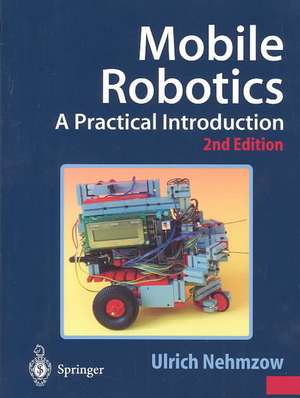
Mobile Robotics
Autor Ulrich Nehmzowen Limba Engleză Paperback – 8 iul 2003
Preț: 478.08 lei
Preț vechi: 562.44 lei
-15%
Puncte Express: 717
Carte tipărită la comandă
Livrare economică 28 noiembrie-12 decembrie
Livrare prin curier în România Termenul estimat este afișat lângă disponibilitate.
Transport gratuit pentru acest produs Plată online sau ramburs, în funcție de opțiunile comenzii.
Retur gratuit în 14 zile Comandă securizată și suport în română.
Specificații
ISBN-13: 9781852337261
ISBN-10: 1852337265
Pagini: 300
Ilustrații: XVI, 280 p. 68 illus.
Dimensiuni: 178 x 254 x 17 mm
Greutate: 0.57 kg
Ediția:Second Edition 2003
Editura: Springer
Locul publicării:London, United Kingdom
ISBN-10: 1852337265
Pagini: 300
Ilustrații: XVI, 280 p. 68 illus.
Dimensiuni: 178 x 254 x 17 mm
Greutate: 0.57 kg
Ediția:Second Edition 2003
Editura: Springer
Locul publicării:London, United Kingdom
V-ar putea interesa
-
 Arduino Robot BonanzaGordon McComb-38%Preț: 210.57 lei339.85 lei
 -
 Robotics: A Very Short IntroductionAlan Winfield-20%Preț: 57.12 lei71.12 lei
 -
 The Technological SingularityMurray Shanahan-21%Preț: 97.48 lei122.92 lei
 -
 Optimal ControlFrank L Lewis-9%Preț: 992.25 lei1090.39 lei
 -
 Practical Field RoboticsSturges-8%Preț: 636.53 lei691.87 lei
 -
 Robot Motion and Control 2011Krzysztof Koz¿owski-18%Preț: 935.60 lei1140.97 lei
 -
 Preț: 369.10 lei
 -
 Snake RobotsPål Liljebäck-18%Preț: 986.96 lei1203.61 lei
 -
 Omnidirectional Vision SystemsLuis Puig-20%Preț: 326.32 lei407.89 lei
 -
 Vehicle-Manipulator SystemsPål Johan From-18%Preț: 991.00 lei1208.53 lei
 -
 -15%Preț: 640.49 lei753.52 lei
 -
 Human-Robot Interaction in Social RoboticsTakayuki Kanda-18%Preț: 1611.04 lei1964.69 lei
 -
 Parallel Robots: Mechanics and ControlHamid D. Taghirad-20%Preț: 1784.20 lei2230.26 lei
 -
 Process Control: Problems, Techniques and ApplicationsSamuel P. Werther-27%Preț: 1165.46 lei1585.77 lei
 -
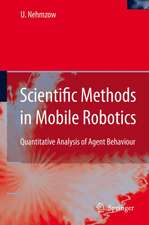 Scientific Methods in Mobile RoboticsUlrich Nehmzow-18%Preț: 935.30 lei1140.60 lei
 -
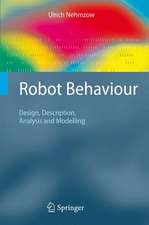 Robot BehaviourUlrich Nehmzow-20%Preț: 333.53 lei416.92 lei
 -
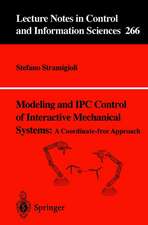 -18%Preț: 949.35 lei1157.74 lei
 -
 Mobile RobotikUlrich NehmzowPreț: 423.55 lei
 -
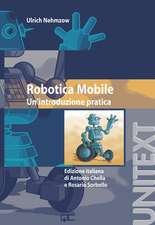 Robotica mobileUlrich Nehmzow-20%Preț: 277.31 lei346.64 lei
Public țintă
Lower undergraduateCuprins
1 Introduction.- 2 Foundations.- 2.1 Definitions.- 2.2 Applications of Mobile Robots.- 2.3 History of Mobile Robotics: Early Implementations.- 2.4 History of Mobile Robotics: Control Paradigms.- 2.5 Further Reading.- 3 Robot Hardware.- 3.1 Introduction.- 3.2 Robot Sensors.- 3.3 Robot Actuators.- 3.4 Example: The Mobile Robot FortyTwo.- 3.5 The Need for Sensor Signal Interpretation.- 3.6 Further Reading.- 4 Robot Learning: Making Sense of Raw Sensor Data.- 4.1 Introduction.- 4.2 Learning Methods in Detail.- 4.3 Further Reading on Learning Methods.- 4.4 Case Studies of Learning Robots.- 4.5 Exercise: A Target-Following, Obstacle-Avoiding Robot.- 5 Navigation.- 5.1 Principles of Navigation.- 5.2 Fundamental Navigation Strategies of Animals and Humans.- 5.3 Robot Navigation.- 5.4 Case Studies of Navigating Robots.- 6 Novelty Detection.- 6.1 Motivation.- 6.2 Approaches to Novelty Detection.- 6.3 Case Study on Novelty Detection.- 6.4 Summary.- 7 Simulation: Modelling Robot-Environment Interaction.- 7.1 Motivation.- 7.2 Fundamentals of Computer Simulation.- 7.3 Alternatives to Numerical Models.- 7.4 Case Study on Simulation of Robot-Environment Interaction.- 8 Analysis of Robot Behaviour.- 8.1 Motivation.- 8.2 Statistical Analysis of Robot Behaviour.- 8.3 Case Studies of Performance Evaluation and Analysis.- 8.4 Summary.- 9 Outlook.- 9.1 Achievements.- 9.2 Reasons for Success.- 9.3 Challenges.- 9.4 The Beginning.- 9.5 Further Reading.- Answers to Exercises.- List of Exercises and Case Studies.- References.
Recenzii
From the reviews of the second edition:
"The book is an admirable introduction to its modern approach to mobile robotics and certainly gives a great deal of food for thought. … Like its first edition, this is an important and thought-provoking book." (Alex M. Andrew, Robotica, Vol. 22 (347), 2004)
"Mobile Robotics: A Practical Introduction (2nd edition) is an excellent introduction to the foundations and methods used for designing completely autonomous mobile robots. … provides a very practical introduction to mobile robotics for a general scientific audience. It is essential reading for 2nd and 3rd year undergraduate students and postgraduate students studying robotics, artificial intelligence, cognitive science and robot engineering. … is an admirable introduction to this modern approach to mobile robotics and certainly gives a great deal of food for thought." (Alex M. Andrew, Artificial Life & Robotics, Vol. 7 (4), 2004)
"The book is an admirable introduction to its modern approach to mobile robotics and certainly gives a great deal of food for thought. … Like its first edition, this is an important and thought-provoking book." (Alex M. Andrew, Robotica, Vol. 22 (347), 2004)
"Mobile Robotics: A Practical Introduction (2nd edition) is an excellent introduction to the foundations and methods used for designing completely autonomous mobile robots. … provides a very practical introduction to mobile robotics for a general scientific audience. It is essential reading for 2nd and 3rd year undergraduate students and postgraduate students studying robotics, artificial intelligence, cognitive science and robot engineering. … is an admirable introduction to this modern approach to mobile robotics and certainly gives a great deal of food for thought." (Alex M. Andrew, Artificial Life & Robotics, Vol. 7 (4), 2004)
Caracteristici
A thorough introduction to the design, construction and evaluation of autonomous mobile robots Includes a new chapter on novelty detection Contains detailed case studies that show how to build and program real working robots