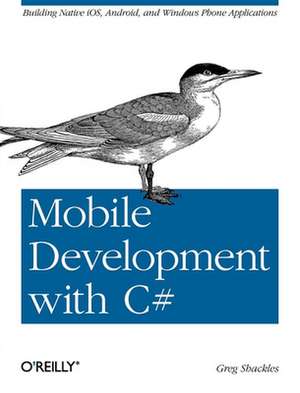
Mobile Development with C
Autor Greg Shacklesen Limba Engleză Paperback – 19 iun 2012
By building a series of simple applications, you'll experience the advantages of using .NET in mobile development and learn how to write complete apps that access the unique features of today's three most important mobile platforms.
- Learn the building blocks for building applications on iOS, Android, and Windows Phone
- Discover how the Mono tools interact with iOS and Android
- Use several techniques and patterns for maximizing non-UI code reuse
- Determine how much functionality can go into the shared business logic layer
- Connect to external resources with .NET's rich networking stack
- Read and write data using each platform's filesystem and local database
- Create apps to explore the platforms' location and mapping capabilities
Preț: 145.40 lei
Preț vechi: 181.75 lei
-20%
Puncte Express: 218
Carte tipărită la comandă
Livrare economică 28 noiembrie-12 decembrie
Livrare prin curier în România Termenul estimat este afișat lângă disponibilitate.
Transport gratuit de la 400.00 lei Plată online sau ramburs, în funcție de opțiunile comenzii.
Retur gratuit în 14 zile Comandă securizată și suport în română.
Specificații
ISBN-13: 9781449320232
ISBN-10: 1449320236
Pagini: 170
Dimensiuni: 177 x 233 x 15 mm
Greutate: 0.29 kg
Editura: O'Reilly
ISBN-10: 1449320236
Pagini: 170
Dimensiuni: 177 x 233 x 15 mm
Greutate: 0.29 kg
Editura: O'Reilly
V-ar putea interesa
-
 C# EssentialsBen Albahari-20%Preț: 206.57 lei258.21 lei
 -
 C# & VB.NET Conversion Pocket ReferenceJose Mojica-20%Preț: 47.29 lei59.11 lei
 -
 Learning C# 2005 2eJesse Liberty-20%Preț: 196.49 lei245.61 lei
 -
 C# 3.0 Design PatternsJudith Bishop-20%Preț: 249.13 lei311.41 lei
 -
 Programming Entity FrameworkLerman-20%Preț: 333.98 lei417.47 lei
 -
 C# Database BasicsMichael Schmalz-20%Preț: 118.97 lei148.72 lei
 -
 Getting Started with Windows 8 AppsBen Dewey-20%Preț: 88.38 lei110.48 lei
 -
 Essential C# 7.0Mark Michaelis-20%Preț: 226.38 lei282.98 lei
 -
 The Art of Unit TestingRoy Osherove-20%Preț: 370.50 lei463.11 lei
Cuprins
Preface;
Who Is This Book For?;
Contents of This Book;
Conventions Used in This Book;
This Book's Example Files;
Using Code Examples;
Safari® Books Online;
How to Contact Us;
Acknowledgments;
Chapter 1: Surveying the Landscape;
1.1 The Players;
1.2 Write Once, Run Anywhere;
1.3 An Alternative Approach;
1.4 Summary;
Chapter 2: Hello, Platforms!;
2.1 iOS;
2.2 Android;
2.3 Windows Phone;
2.4 Summary;
Chapter 3: Code Sharing Techniques;
3.1 Project Setup;
3.2 File Linking;
3.3 Abstraction;
3.4 Observer Pattern;
3.5 Partial Classes;
3.6 Conditional Compilation;
3.7 Summary;
Chapter 4: Accessing the Network;
4.1 Reaching into the Cloud;
4.2 Notifying the User Interface;
4.3 Summary;
Chapter 5: Storing Data;
5.1 Project Setup;
5.2 Accessing the Filesystem;
5.3 Using a Local Database;
5.4 Summary;
Chapter 6: Location, Location, Location;
6.1 Mapping;
6.2 Mocking Location;
6.3 Using Location Data;
6.4 Summary;
Creating Android Virtual Devices;
Further Reading;
iOS;
Android;
Windows Phone;
Who Is This Book For?;
Contents of This Book;
Conventions Used in This Book;
This Book's Example Files;
Using Code Examples;
Safari® Books Online;
How to Contact Us;
Acknowledgments;
Chapter 1: Surveying the Landscape;
1.1 The Players;
1.2 Write Once, Run Anywhere;
1.3 An Alternative Approach;
1.4 Summary;
Chapter 2: Hello, Platforms!;
2.1 iOS;
2.2 Android;
2.3 Windows Phone;
2.4 Summary;
Chapter 3: Code Sharing Techniques;
3.1 Project Setup;
3.2 File Linking;
3.3 Abstraction;
3.4 Observer Pattern;
3.5 Partial Classes;
3.6 Conditional Compilation;
3.7 Summary;
Chapter 4: Accessing the Network;
4.1 Reaching into the Cloud;
4.2 Notifying the User Interface;
4.3 Summary;
Chapter 5: Storing Data;
5.1 Project Setup;
5.2 Accessing the Filesystem;
5.3 Using a Local Database;
5.4 Summary;
Chapter 6: Location, Location, Location;
6.1 Mapping;
6.2 Mocking Location;
6.3 Using Location Data;
6.4 Summary;
Creating Android Virtual Devices;
Further Reading;
iOS;
Android;
Windows Phone;
Descriere
With so many dominant players in the mobile space, each with its own stack, the thought of developing for all of them is daunting but unavoidable. Strange as it may seem, .NET developers are actually in the best position of all to do just that.