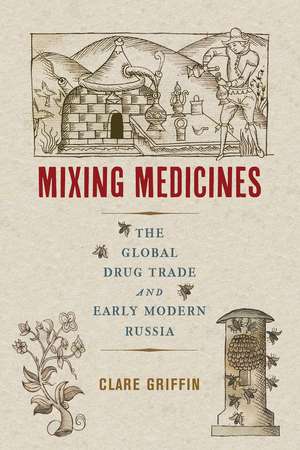
Mixing Medicines: The Global Drug Trade and Early Modern Russia: Intoxicating Histories, cartea 4
Autor Clare Griffinen Limba Engleză Paperback – 14 sep 2022
Early modern Russians preferred one method of treating the sick above all others: prescribing drugs. The Moscow court sourced pharmaceuticals from Asia, Africa, Western Europe, and the Americas, in addition to its own sprawling empire, to heal its ailing tsars.Mixing Medicines explores the dynamic and complex world of early modern Russian medical drugs, from its enthusiasm for newly imported American botanicals to its disgust at Western European medicines made from human corpses. Clare Griffin draws from detailed apothecary records to shed light on the early modern Russian Empire’s role in the global trade in medical drugs. Chapters follow the trade and use of medical ingredients through networks that linked Moscow to Western Europe, Asia, and the Americas; the transformation of natural objects, such as botanicals and chemicals, into medicines; the documentation and translation of medical knowledge; and Western European influence on Russian medical practices. Looking beyond practitioners, texts, and ideas to consider how materials of medicine were used by one of the early modern world’s major empires provides a novel account of the global history of early modern medicine.Mixing Medicines offers unique insight into how the dramatic reshaping of global trade touched the day-to-day lives of the people living in early modern Russia.







Preț: 254.12 lei
Puncte Express: 381
Carte tipărită la comandă
Livrare economică 10-24 noiembrie
Livrare prin curier în România Termenul estimat este afișat lângă disponibilitate.
Transport gratuit de la 400.00 lei Plată online sau ramburs, în funcție de opțiunile comenzii.
Retur gratuit în 14 zile Comandă securizată și suport în română.
Specificații
ISBN-13: 9780228011941
ISBN-10: 0228011949
Pagini: 248
Ilustrații: 5 tables
Dimensiuni: 152 x 229 x 18 mm
Greutate: 0.36 kg
Editura: McGill-Queen's University Press
Colecția McGill-Queen's University Press
Seria Intoxicating Histories
ISBN-10: 0228011949
Pagini: 248
Ilustrații: 5 tables
Dimensiuni: 152 x 229 x 18 mm
Greutate: 0.36 kg
Editura: McGill-Queen's University Press
Colecția McGill-Queen's University Press
Seria Intoxicating Histories
Recenzii
“In this slim but brilliant work ... Griffin makes a crucial contribution to drug history, Russian history, and the history of globalization. Mixing Medicines shows how the global impacts the local, by showing how imported drugs act on domestic lives, and has resonance today.” *Canadian Journal of Health History *
“By shifting attention to the medicines themselves, Clare Griffin makes a novel contribution to long-standing discussions. Griffin provides new insights on Muscovy’s place in the world and on the functioning of the Apothecary Chancery itself. Mixing Medicines will be equally valuable to specialists in Russian history and specialists in the global history of medicine. The Appendices of the book, which list the ingredients recorded in Russian-language prescriptions, giving English or Latin equivalents and place of origin, constitute a much-needed reference glossary. Scholars of the history of medicine gain insight into premodern Russia, presented in terms of discussion familiar to them.” Social History of Medicine
“This fascinating book, by virtue of its focus on early modern Russia, represents an important and significant contribution to the scholarship on globalization and the history of medicine, drugs, and materia medica in the early modern world.” Matthew Crawford, Kent State University and co-editor of Drugs on the Page: Pharmacopoeias and Healing Knowledge in the Early Modern Atlantic World
Notă biografică
Clare Griffin is a historian of science and assistant professor at Nazarbayev University.
Descriere
Mixing Medicines explores the dynamic and complex world of early modern Russian medical drugs. The first study of Russia’s involvement in the early modern drug trade, it provides unique insight into how the dramatic reshaping of global trade affected the day-to-day lives of subjects and tsars alike.