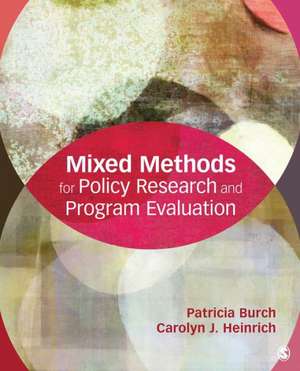
Mixed Methods for Policy Research and Program Evaluation
Autor Carolyn J. Heinrich, Patricia E. Burchen Limba Engleză Paperback – 30 apr 2015
Analizând bazele de date academice și resursele editoriale de la Sage Publications, Inc, observăm că volumul Mixed Methods for Policy Research and Program Evaluation ocupă o nișă distinctă prin orientarea sa pragmatică spre execuție. Spre deosebire de textele pur teoretice, Carolyn J. Heinrich și Patricia E. Burch structurează acest ghid în jurul sarcinilor conceptuale și active necesare pentru a naviga complexitatea cercetării contemporane. Ne-a atras atenția în mod deosebit modul în care autorii fundamentează necesitatea metodelor mixte în contextul actual al politicilor publice bazate pe dovezi (evidence-based policy). Structura cărții este riguroasă și progresivă: începe cu fundamentarea valorii cercetării integrate, trece prin conceptualizare în capitolul al doilea și culminează cu un capitol extins despre implementarea propriu-zisă. Aici, integrarea nu este tratată doar ca o etapă finală, ci este detaliată în instrumentație, colectarea datelor și diseminarea rezultatelor. Cititorii familiarizați cu Mixed Methods Design in Evaluation de Donna M. Mertens vor aprecia aici accentul pus pe „cum se face”, volumul de față oferind un set de instrumente practice mai aplicate pe zona de management public și politici sociale. Această lucrare reprezintă o evoluție firească în opera autoarei Carolyn J. Heinrich. Dacă în Improving Governance ea punea bazele cercetării empirice pentru managementul politicilor, în acest nou titlu oferă metodologia concretă pentru a atinge acele rezultate. Mixed Methods for Policy Research and Program Evaluation transformă provocările metodologice în pași executabili, fiind o resursă esențială pentru cei care doresc să depășească barierele dintre datele cantitative și cele calitative pentru a genera analize cu impact real.
Preț: 618.30 lei
Preț vechi: 672.07 lei
-8%
Carte disponibilă
Livrare economică 14-28 noiembrie
Livrare express 31 octombrie-06 noiembrie pentru 33.46 lei
Specificații
ISBN-10: 1452276625
Pagini: 232
Dimensiuni: 191 x 232 x 12 mm
Greutate: 0.41 kg
Ediția:1
Editura: Sage Publications, Inc
Locul publicării:Thousand Oaks, United States
V-ar putea interesa
-
 Embedded Case Study MethodsRoland W. Scholz-18%Preț: 964.82 lei1176.61 lei
 -
 Cohort AnalysisNorval D. GlennPreț: 317.34 lei
 -
 Diagnosing OrganizationsMichael I. Harrison-15%Preț: 610.24 lei717.94 lei
 -
 Internet Data CollectionSamuel J. BestPreț: 318.88 lei
 -
 Cognitive InterviewingGordon B. Willis-18%Preț: 957.61 lei1167.81 lei
 -
 Practitioner Research for TeachersDiana Burton-15%Preț: 618.17 lei727.26 lei
 -
 Foundations of Multimethod ResearchJohn Brewer-15%Preț: 629.48 lei740.57 lei
 -
 Tests of Significance 4Ramon E. HenkelPreț: 318.58 lei
 -
 Analysis of Ordinal DataDavid K. HildebrandPreț: 318.07 lei
 -
 Discriminant AnalysisWilliam R. KleckaPreț: 325.54 lei
 -
 Game TheoryFrank C. ZagarePreț: 320.06 lei
 -
 Mobility TablesMichael HoutPreț: 318.66 lei
 -
 Models for Innovation DiffusionVijay MahajanPreț: 292.98 lei
 -
 Stochastic Parameter Regression ModelsPaul NewboldPreț: 318.07 lei
 -
 Contextual AnalysisGudmund R. IversenPreț: 318.46 lei
 -
 Basics of Structural Equation ModelingGeoffrey M. Maruyama-18%Preț: 1130.68 lei1378.88 lei
 -
 -27%Preț: 1025.15 lei1404.32 lei
 -
 -23%Preț: 612.83 lei795.88 lei
 -
 Doing Development ResearchVandana Desai-8%Preț: 522.45 lei567.89 lei
 -
 Psychological TestingTheresa J. B. Kline-27%Preț: 1366.47 lei1871.87 lei
 -
 Statistics for the Social SciencesR . Mark Sirkin-27%Preț: 1136.25 lei1556.51 lei
 -
 Measurement Error and Research DesignMadhu Viswanathan-18%Preț: 960.95 lei1171.88 lei
 -
 A Handbook for Social Science Field ResearchEllen Perecman-18%Preț: 817.29 lei996.70 lei
 -
 Bibliografia de La Literatura Colombiana del Siglo XIX - Tomo II (M-Z)Flor Maria Rodriguez-ArenasPreț: 272.58 lei
De ce să citești această carte
Recomandăm această carte cercetătorilor și evaluatorilor de programe care caută un ghid aplicat, nu doar teorie. Cititorul câștigă o metodologie clară pentru integrarea deplină a datelor calitative și cantitative, susținută de studii de caz reale. Este un volum esențial pentru a învăța cum să transformi cercetarea complexă în soluții de politici publice fundamentate, oferind instrumente de lucru imediat aplicabile prin secțiunile de exerciții de la finalul fiecărui capitol.
Despre autor
Carolyn J. Heinrich este profesor Sid Richardson de afaceri publice la Școala de Afaceri Publice Lyndon B. Johnson și profesor afiliat de economie la University of Texas at Austin. Deținând un doctorat de la University of Chicago, Dr. Heinrich este recunoscută pentru cercetările sale în domeniul politicilor de asistență socială, educație și metode econometrice pentru evaluarea programelor. Expertiza sa în managementul performanței, reflectată anterior în lucrări precum Managing for Results 2005, se traduce în acest volum printr-o abordare pragmatică și riguroasă a modului în care datele pot îmbunătăți rezultatele în sectorul public.
Descriere scurtă
Recenzii
In a time of scarce resources for social programs, wise policy requires making tough choices. To do this well, policymakers need reliable information on what works, why some approaches are more successful than others, and what can be done to improve effectiveness. This book is a vital primer on how to do that. It attacks the mistaken view that quantitative and qualitative research are alternatives, rather than essential complements that, when combined in a mix of research methods, can best provide guidance to policymakers and practitioners.
This book is just what is needed as we move into a new phase of evidence informed policy and practice. It advocates an integrated and coherent approach to policy research and program evaluation while recognizing the realities and complexities of both policy and research. It will be immensely helpful to those engaged in mixed methods research across a variety of policy fields.
The gulf between qualitative and quantitative researchers is an old problem. With this useful and important new book, Burch and Heinrich help to bridge the divide, highlighting the need for a more complementary and integrated approach that can help us learn not just whether programs "work", but how and why they do.
This rich and sophisticated book provides a wealth of insights and practical guidelines that will enhance the work of both novice and experienced researchers. Burch and Heinrich show the way to making mixed methods research more relevant and more rigorous.
This is a very useful book for researchers and evaluators contemplating or already using mixed methods in policy research and evaluation, as well as for those teaching applied evaluation courses.
In this book, Burch and Heinrich have successfully explained how a mixed methods approach can be applied to policy analysis and evaluation. I highly recommend it for scholars applying mixed methods to the study of public policy issues. This book should be required reading for all public policy students and researchers.
The book’s biggest strength is its emphasis on the practicalities of integrating different methods throughout the life cycle of a research project. For example, all the chapters end with discussion questions, which force the reader to think through and better understand how the material presented might apply to their own work. The book is also illustrated with rich case studies (mostly from the education and social welfare arenas) to aid understanding.
Cuprins
The Role of Mixed Methods Research in Meeting the Demand for Evidenced-Based Policy and Practice
What Distinguishes This Book in the Mixed Methods Literature
Overview of Remaining Chapters
Recommendations for How to Use This Book
Chapter 2: Conceptualizing Mixed Methods Research
Introduction
Rationale and Conditions for Mixed Methods Research
Categorizing Mixed Methods Approaches
Overview of a Fully Integrated, Mixed Methods Research Effort
Discussion Questions
Applications to Your Own Work
Chapter 3: Designing and Implementing Fully Integrated Mixed Methods Research
Introduction
Integration in Research Objectives and Design
Integration in Instrumentation Design and Data Collection
Integration in Data Analysis and Interpretation of Findings
Integration in Dissemination of Research Findings
Discussion Questions
Applications to Your Own Work
Chapter 4: Practical Tools for Integrated Mixed Methods Studies of Policy Implementation
Introduction
Mixed Methods Integration Strategy #1: Bridging Research Instruments for Qualitative and Quantitative Integration
Mixed Methods Integration Strategy #2: Mixed Methods Coding and Analysis Memoing
Mixed Methods Integration Strategy #3: Adapted Monitoring Tool and Research Reviews
Mixed Methods Integration Strategy #4: Research-to-Practice Collaborative
Conclusion
Discussion Questions
Applications to Your Own Work
Chapter 5: Fully Integrated Mixed Methods Research in K-12 and Higher Education in the United States
Introduction
Program Evaluation of Student Achievement Guarantee in Education
Racial and Ethnic Inequity in Access and Successful Student Outcomes in Higher Education
Challenges and Strategies for Addressing Challenges
Discussion Questions
Applications to Your Own Work
Chapter 6: An Application of Fully Integrated Mixed Methods in Program Development and Evaluation
Introduction
Program and Evaluation Motivation
Pilot Program Development for Child Support Debt Reduction
Demonstration Program Rollout and Early Evaluation Focus
Impact Evaluation Findings and Their Interpretation and Use
Conclusion
Discussion Questions
Applications to Your Own Work
Chapter 7: Mixed Methods Research in an International Context
Introduction
Child Support Grant Impact Evaluation in South Africa
Qualitative-Quantitative Integration Process in the CSG Impact Evaluation
Benefits of a Tightly Integrated Qualitative-Quantitative Research Approach
Conclusion
Discussion Questions
Applications to Your Own Work
Chapter 8: On the Future of Fully Integrated Mixed Methods Research: Context and Common Lessons From the Cases for the Field
How Context Matters
Broader Lessons for the Field
Concluding Thoughts