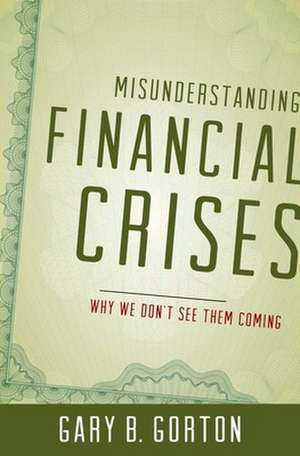
Misunderstanding Financial Crises: Why We Don't See Them Coming
Autor Gary B. Gortonen Limba Engleză Hardback – 27 dec 2012
Preț: 215.24 lei
Puncte Express: 323
Carte disponibilă
Livrare economică 10-24 noiembrie
Livrare prin curier în România Termenul estimat este afișat lângă disponibilitate.
Transport gratuit de la 400.00 lei Plată online sau ramburs, în funcție de opțiunile comenzii.
Retur gratuit în 14 zile Comandă securizată și suport în română.
Specificații
ISBN-13: 9780199922901
ISBN-10: 019992290X
Pagini: 296
Dimensiuni: 157 x 236 x 23 mm
Greutate: 0.57 kg
Editura: Oxford University Press
Colecția OUP USA
Locul publicării:New York, United States
ISBN-10: 019992290X
Pagini: 296
Dimensiuni: 157 x 236 x 23 mm
Greutate: 0.57 kg
Editura: Oxford University Press
Colecția OUP USA
Locul publicării:New York, United States
V-ar putea interesa
-
 How Markets Fail: The Logic of Economic CalamitiesCassidy John-18%Preț: 77.00 lei94.06 lei
 -
 Panic!Michael Lewis-30%Preț: 66.24 lei94.14 lei
 -
 Whoops!John LanchesterPreț: 78.82 lei
 -
 Crisis EconomicsNouriel Roubini-18%Preț: 65.57 lei79.82 lei
 -
 Risk and LiquidityHyun Song Shin-18%Preț: 249.74 lei304.94 lei
 -
 Preț: 138.88 lei
 -
 -26%Preț: 69.96 lei94.17 lei
 -
 -25%Preț: 81.03 lei108.74 lei
 -
 This Time is DifferentCarmen M. ReinhartPreț: 140.27 lei
 -
 Preț: 254.13 lei
 -
 Crisis CycleJohn H. CochranePreț: 218.68 lei
 -
 History and Financial Crisis: Lessons from the 20th centuryChristopher Kobrak-8%Preț: 480.39 lei522.16 lei
 -
 Preț: 195.95 lei
 -
 -26%Preț: 74.71 lei100.42 lei
 -
 Shocks, Crises and False AlarmsPhilipp Carlsson-SzlezakPreț: 214.26 lei
 -
 Firefighting: The Financial Crisis and its LessonsBen S. Bernanke-21%Preț: 66.82 lei84.13 lei
 -
 The Return of Depression EconomicsPaul Krugman-32%Preț: 62.97 lei92.20 lei
 -
 Lords of FinanceLiaquat Ahamed-37%Preț: 69.89 lei110.32 lei
 -
 The Origin of Financial CrisesGeorge Cooper-22%Preț: 68.79 lei88.76 lei
Recenzii
Gorton brings to the question a combination of historical perspective, academic expertise and, unlike most academics, personal experience...his book is a refreshing and valuable account that should take its place among the essential reading of any student of crises.
[An] important book. A Financial Times Book of the Year.
[An] important book. A Financial Times Book of the Year.
Notă biografică
The Frederick Frank Class of 1954 Professor of Finance at the Yale School of Management
Cuprins
- Preface
- I. Introduction
- II. Creating the Quiet Period
- III. Financial Crises
- IV. Liquidity and Secrets
- V. Credit Booms and Manias
- VI. The Timing of Crises
- VII. Economic Theory without History
- VIII. Debt During Crises
- IX. The Quiet Period and Its End
- X. Moral Hazard and Too-Big-To-Fail
- XI. Bank Capital
- XII. Fat Cats, Crisis Costs, and the Paradox of Financial Crises
- XIII. The Panic of 2007-2008
- XIV. The Theory and Practice of Seeing
- Bibliographic Notes
- Notes
- References
- Index