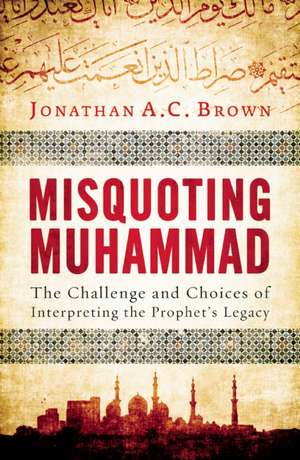
Misquoting Muhammad: Islam in the Twenty-First Century
Autor Jonathan A. C. Brownen Limba Engleză Paperback – 6 aug 2015
Nivel de studiu: Referință academică pentru licență și master în studiile islamice și istoria religiilor. În această lucrare publicată de Oneworld Publications, Jonathan A C Brown propune o analiză riguroasă a modului în care tradiția islamică s-a cristalizat nu ca o entitate statică, ci ca un produs complex al interpretării umane. Subliniem modul în care autorul navighează prin secole de civilizație islamică pentru a demonstra că pilonii legii și dogmei nu au fost stabiliți definitiv în momentul fondator, ci au fost modelați treptat de către clasa savanților musulmani. Ne-a atras atenția echilibrul pe care Brown îl menține între rigoarea filologică și accesibilitatea narativă. Autorul explică procesul prin care intelectualii musulmani au încercat să reconcilieze revelația cu rațiunea și știința, adaptând adevărurile scripturale la valori sociale în continuă schimbare. Această abordare istorică oferă o perspectivă internă asupra mecanismelor puterii și căutării adevărului în cadrul tradiției sunnite. Alternativă la Islam de Fazlur Rahman pentru cursurile de gândire islamică, Misquoting Muhammad aduce un avantaj competitiv prin focalizarea pe procesul de transmitere și interpretare a textelor sacre, spre deosebire de sinteza istorică generală a lui Rahman. În contextul operei sale, volumul reprezintă o extensie naturală a cercetărilor din Hadith, unde Brown a explorat importanța relatărilor despre faptele Profetului. Dacă în lucrări precum Justice and Islamic Law s-a concentrat pe instituții juridice specifice, aici mizează pe o reconstrucție a cadrului intelectual global care permite sau restricționează inovația în interiorul credinței.
Preț: 111.08 lei
Carte disponibilă
Livrare economică 30 noiembrie-14 decembrie
Livrare express 13-19 noiembrie pentru 49.70 lei
Specificații
ISBN-10: 1780747829
Pagini: 384
Ilustrații: 8 colour plates
Dimensiuni: 126 x 199 x 32 mm
Greutate: 0.37 kg
Editura: Oneworld Publications
Colecția Islam in the Twenty-First Century
Seria Islam in the Twenty-First Century
Locul publicării:United Kingdom
V-ar putea interesa
-
 -13%Preț: 110.74 lei127.42 lei
-
 Abu Bakr As-SiddiqRuhi Demirel-16%Preț: 34.72 lei41.43 lei
-
 Umar Ibn Al-KhattabZekeriya UlasliPreț: 32.48 lei
-
 Uthman Ibn AffanRuhi DemirelPreț: 33.70 lei
-
 Ali Ibn Abu TalibZekeriya Ulasli-16%Preț: 34.54 lei41.33 lei
-
 Aisha Bint Abu BakrOmer YilmazPreț: 33.13 lei
-
 Fatima Bint MuhammadOmer Yilmaz-17%Preț: 34.33 lei41.19 lei
-
 Hasan & Husayn Ibn AliOmer Yilmaz-16%Preț: 34.63 lei41.24 lei
-
 Khalid Ibn Al-WalidOmer Yilmaz-15%Preț: 35.01 lei41.33 lei
-
 Prophet MuhammadMustafa Erdogan-14%Preț: 36.24 lei42.04 lei
-
 The Emergence of Modern Shi'ism: Islamic Reform in Iraq and IranZackery M Heern-29%Preț: 158.64 lei223.94 lei
-
 Shi'i IslamMoojan MomenPreț: 86.56 lei
-
 Animals in Islamic Tradition and Muslim CulturesRichard FoltzPreț: 170.75 lei
-
 Preț: 252.01 lei
-
 IslamHans KungPreț: 149.08 lei
-
 The Qur'anAnna M GadePreț: 164.89 lei
-
 Key Themes for the Study of IslamJamal J EliasPreț: 175.09 lei
De ce să citești această carte
Această carte este esențială pentru studenții și specialiștii care doresc să înțeleagă complexitatea dreptului islamic dincolo de clișee. Cititorul câștigă o înțelegere profundă a modului în care interpretarea umană influențează autoritatea religioasă. Este un instrument critic pentru oricine analizează tensiunea dintre tradiție și modernitate în lumea musulmană, oferind argumente documentate despre evoluția dogmei.
Despre autor
Jonathan A C Brown este un cercetător american de renume, specializat în studii islamice și profesor la Universitatea Georgetown. Expertiza sa se concentrează pe istoria intelectuală a Islamului, cu un interes deosebit pentru studiul Hadith-ului și evoluția jurisprudenței. Prin lucrările sale, printre care se numără și Slavery and Islam, Brown s-a impus ca o voce academică importantă care reușește să traducă concepte teologice complexe pentru un public larg, menținând în același timp standarde înalte de cercetare istorică și lingvistică în spațiul tradiției sunnite.
Descriere scurtă
AN INDEPENDENT RELIGION BOOK OF THE YEAR
'Lucid, learned and engaging.' The Sunday Times
Few things provoke controversy in the modern world like the religion brought by Prophet Muhammad. Modern media are replete with alarm over jihad, underage marriage and the threat of amputation or stoning under Shariah law. Sometimes rumor, sometimes based on fact and often misunderstood, the tenets of Islamic law and dogma were not set in the religion's founding moments. They were developed, like in other world religions, over centuries by the clerical class of Muslim scholars.
Misquoting Muhammad takes the reader back in time through Islamic civilization and traces how and why such controversies developed, offering an inside view into how key and controversial aspects of Islam took shape. From the protests of the Arab Spring to Istanbul at the fall of the Ottoman Empire, and from the ochre red walls of Delhi's great mosques to the trade routes of the Indian Ocean world, Misquoting Muhammad lays out how Muslim intellectuals have sought to balance reason and revelation, weigh science and religion, and negotiate the eternal truths of scripture amid shifting values.
***
'Brown possesses formidable knowledge of premodern Muslim scholars... Misquoting Muhammad sheds light on the considerable dynamism and sophistication within the Sunni tradition.' Washington Post
'Exhilarating... Brown is among the most talented and productive scholars in the field of Islamic Studies today.' Los Angeles Review of Books
'Erudite and provocative... compelling.' Literary Review
Recenzii
— The Washington Post
"Lucid, learned and engaging."
— Karen Armstrong, The Sunday Times
"Superb... an essential read for anyone seeking to understand Islam and the Muslim world... fascinating."
— The Tribune
"'Misquoting Muhammad identifies and contextualizes the larger interpretive issues at stake in the global competition between diverse traditional and Salafi Sunni voices, and is written in such an engaging manner that the reader may find it difficult to put it down."
—Scott Lucas, Journal of Shi'a Islamic Studies
"Brown ably navigates the cutting edge of Hadith studies while offering his able insight, encyclopedic knowledge of Muslim textual traditions, and awareness of the political contentiousness of scholarship in Islamic studies... highly recommended."
— ALA CHOICE Magazine
"Exhilarating ... Brown is among the most talented and productive scholars in the field of Islamic Studies today ... He is also a practicing Muslim who has the rare ability to sit at the feet of traditional scholars from Egypt to Malaysia for hours on end and translate that knowledge into something beneficial for his American audiences."
—Los Angeles Review of Books
"Misquoting Muhammad makes the important point that what many Muslims believe to be essential tenets of their faith are often nothing of the sort."
— The Independent, which named Misquoting Muhammad one of the best books of the year
"An inside view into how key controversial aspects of how Islam took shape."
—Asian Art Newspaper
"Erudite and provocative... compelling."
— Literary Review
"Eminently qualified... Brown eloquently parses Islam's rich interpretive tradition."
—Kirkus Reviews
"There aren't many books on Islam where the Prophet Muhammad and Martin Scorsese appear together... helpful for the lay reader."
— The Independent
Notă biografică
Cuprins
Foreword
Preface
Acknowledgments
Notes on dates, transliteration, abbreviations and citations
1 The Problem(s) with Islam
A world full of God
Taking Islamic scripture and its interpreters seriously
2 A Map of the Islamic Interpretive Tradition
The word of God, the teachings of His Prophet and the mind of man
Obey God and obey His Messenger
The beginnings of the Islamic interpretive tradition
Abu Hanifa and the Partisans of Reason
Malik and the authority of custom
The power of reason: the Greek legacy and Islamic theology
Shafi‘i and the beginnings of Sunni Islam
The collection and criticism of Hadiths
Putting reason in its place in Sunni theology and law
The great convergence of Sunni Islam
Legal theory and its discontents
Sufism and inspiration from God
The iconoclasts and Islamic revival
Twilight of an era
3 The Fragile Truth of Scripture
A crisis of confidence
Canons and reading scripture with charity
The turning over of an era
Reading scripture so it’s true
The Islamic science of epistemology and interpretation (Usul al-Fiqh)
The language of God and the rhetoric of His Prophet
The Qur’an: valid for all times and places
Hadiths and interpreting the life of the Prophet
Changing times and the reasons behind scriptural law
The interaction of the Qur’an and Hadiths in time
Into the weeds: the case of raising one’s hands in prayer
The summer of the liberal age
4 Clinging to the Canon in a Ruptured World
Upstarts at the end of time
The treason of interpretation
Heresy acceptable: ruptures in canonical communities
Slay the unbelievers wherever you find them: jihad and (re)interpreting scripture
Women cannot lead: historicizing scripture versus God’s inscrutable law
Sex with little girls: interpreting scripture amid changing norms
The ulama, the state and Shariah authenticity without scripture
The court must not be political – morality and truth in a ruptured world
5 Muslim Martin Luthers and the Paradox of Tradition
The paradox of interpretive control
The rule of interpretation in the conflict between Sunni and Shiite Islam
Tradition as governor, scripture as subject
Killing one’s children: tradition betraying scripture
Reconsidering the penalty for apostasy: tradition redeeming scripture
Women leading prayer: should scripture trump tradition?
The ‘Qur’an Only’ movement
No escaping tradition
The price of reformation
The guide of tradition: a necessary but thankless job
6 Lying about the Prophet of God
The truth, what’s that?
Noble Lies and profound truths
The ulama as guardians
Appealing to the flesh: using unreliable Hadiths in Sunni Islam
A familiar habit: assisting truth in Western scripture and historiography
Seventy-two virgins: pragmatic truth and the heavenly reward of martyrs
The cost of Noble Lying
Muslim objections to the Noble Lie
Genre versus book: reviving an old approach to authenticating Hadiths
The dangers of Noble Lying for Muslims today
Pragmatic truth and the beauty of Noble Lying
7 When Scripture Can’t Be True
The Qur’an and domestic violence
Who decides what God means?
Courts have the final word
Saying ‘no’ to the text and the hermeneutics of suspicion
Appendix I: Marracci and Ockley on Aisha’s Marriage to the Prophet
Appendix II: Hadiths on a Parent Killing His Child
Ratings of the Hadith by Muslim critics
Examination of individual narrations
My evaluation of the Hadith
Citations for Hadith of a Father Killing His Child
Appendix III: The Hadith of riba and Incest
Ratings by Hadith critics
My evaluation of the Hadith of Riba and Incest
Citations for the Hadith
Appendix IV: The Hadith of the Seventy-Two Virgins
Overall rating
Citations for the Hadith of the Seventy-Two Virgins
Notes
Select Bibliography
Index