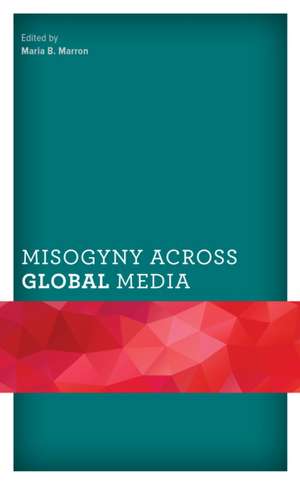
Misogyny across Global Media: Communicating Gender
Editat de Maria B. Marron Contribuţii de Deb Aikat, Becky Beamer, Masudul Karim Biswas, Bernadette Bowen, Lori F. Brost, Sana Fatima, Adelina Mbinjama-Gamatham, Chloé S. Georas, Shreenita Ghosh, K. M. Baharul Islam, Kruthika Kamath, Muthoni E. King'ori, Khanyile Mlotshwa, Nancy Laura Morkel, Nikhil Moro, Joseph Nyanoti, Thabo Ramphobole, Ali Kumael Rizvi, Wajiha Raza Rizvi, Cemile Tokgöz Sahoglu, Tamanna M. Shah, Sonali Srivastaven Limba Engleză Hardback – mar 2021
| Toate formatele și edițiile | Preț | Express |
|---|---|---|
| Paperback (1) | 246.71 lei 6-8 săpt. | |
| Bloomsbury Publishing – 18 aug 2022 | 246.71 lei 6-8 săpt. | |
| Hardback (1) | 629.01 lei 6-8 săpt. | |
| Bloomsbury Publishing – mar 2021 | 629.01 lei 6-8 săpt. |
Din seria Communicating Gender
- 27%
 Preț: 255.12 lei
 - 23%
 Preț: 304.07 lei
 - 32%
 Preț: 509.05 lei
 - 32%
 Preț: 482.32 lei
 - 26%
 Preț: 242.39 lei
 - 18%
 Preț: 664.73 lei
 - 26%
 Preț: 272.88 lei
 - 34%
 Preț: 523.30 lei
 - 34%
 Preț: 522.64 lei
 - 34%
 Preț: 522.64 lei
 - 26%
 Preț: 244.46 lei
 - 27%
 Preț: 241.43 lei
 - 26%
 Preț: 257.21 lei
 - 26%
 Preț: 242.93 lei
 - 14%
 Preț: 246.71 lei
 - 27%
 Preț: 241.43 lei
 - 25%
 Preț: 208.98 lei
 - 34%
 Preț: 500.72 lei
 - 22%
 Preț: 304.37 lei
 - 34%
 Preț: 627.57 lei
 - 34%
 Preț: 499.99 lei
Preț: 629.01 lei
Preț vechi: 948.62 lei
-34%
Puncte Express: 944
Preț estimativ în valută:
111.34€ • 129.89$ • 96.41£
111.34€ • 129.89$ • 96.41£
Carte tipărită la comandă
Livrare economică 26 februarie-12 martie
Preluare comenzi: 021 569.72.76
Specificații
ISBN-13: 9781793606211
ISBN-10: 1793606218
Pagini: 356
Ilustrații: 3 tables; 1 graphs;
Dimensiuni: 162 x 240 x 30 mm
Greutate: 0.68 kg
Editura: Bloomsbury Publishing
Colecția Lexington Books
Seria Communicating Gender
Locul publicării:New York, United States
ISBN-10: 1793606218
Pagini: 356
Ilustrații: 3 tables; 1 graphs;
Dimensiuni: 162 x 240 x 30 mm
Greutate: 0.68 kg
Editura: Bloomsbury Publishing
Colecția Lexington Books
Seria Communicating Gender
Locul publicării:New York, United States
Cuprins
Preface
Chapter 1: #WhatNext: Political Implications of the #MeToo Campaign Aftermath
Bernadette Ann Bowen
Chapter 2: From Sexual Explicitness to Invisibility in Resistance Art: Coloniality, Rape Culture, and Technology
Chloe S. Georas
Chapter 3: The Artists, the Institutions, and the Accusations: The #MeToo Movement ant the ArtWorld
Becky Beamer
Chapter 4: Women as 'Sites of Gendered Politics': Misogyny of Religions in Armed Conflict
Tamanna M. Shah
Chapter 5: Misogyny and Philogyny in Music: Shakira, Rihanna, and Madonna
Ali Kumael Rizvi and Wajiha Raza Rizvi
Chapter 6: "The R in R&B": Rape, Race, and Representation in Surviving R. Kelly
Adelina Mbinjama-Gamatham, Thabo Ramphobole, and Nancy Morkel
Chapter 7: Media Coverage of the Misogynistic and Controversial Child Marriage Restraint Act (2017) in Bangladesh
Masudul Biswas
Chapter 8: Misogyny and Social Ethics: Responses in Vedic and Other Texts
Nikhil Moro
Chapter 9: Mitigating Misogyny in India: Theorizing Digital-Age Feminist Activism
Chapter 1: #WhatNext: Political Implications of the #MeToo Campaign Aftermath
Bernadette Ann Bowen
Chapter 2: From Sexual Explicitness to Invisibility in Resistance Art: Coloniality, Rape Culture, and Technology
Chloe S. Georas
Chapter 3: The Artists, the Institutions, and the Accusations: The #MeToo Movement ant the ArtWorld
Becky Beamer
Chapter 4: Women as 'Sites of Gendered Politics': Misogyny of Religions in Armed Conflict
Tamanna M. Shah
Chapter 5: Misogyny and Philogyny in Music: Shakira, Rihanna, and Madonna
Ali Kumael Rizvi and Wajiha Raza Rizvi
Chapter 6: "The R in R&B": Rape, Race, and Representation in Surviving R. Kelly
Adelina Mbinjama-Gamatham, Thabo Ramphobole, and Nancy Morkel
Chapter 7: Media Coverage of the Misogynistic and Controversial Child Marriage Restraint Act (2017) in Bangladesh
Masudul Biswas
Chapter 8: Misogyny and Social Ethics: Responses in Vedic and Other Texts
Nikhil Moro
Chapter 9: Mitigating Misogyny in India: Theorizing Digital-Age Feminist Activism
Recenzii
Focusing on different media (music, film, social media) in diverse regions of the world - from the U.S. and the U.K. to Turkey, India, Kenya, and Zimbabwe - Misogyny across Global Media is a welcome addition to the growing research and debates in the gender and media field on the sexualization and objectification of women within popular culture in the digital age. Scholars in this timely edition engage with a range of topics, from rape culture and technology, misogyny, Madonna and hip-hop, feminist digital activism and hate speech to the #MeToo movement in India and the US. A must read!
Misogyny is not new, but its representation in today's media is modernized in multiple ways through new digital formats, as well as traditional ones. As the contributors in Maria B. Marron's timely edited volume Misogyny across Global Media reveal, hateful and stereotypical misogynistic representation today is also shaped by media conglomeration, new technologies, culture, war, and the legacies of colonialism. Most importantly, authors reveal the ways in which women across cultures are defying mediated misogyny through art, the #MeToo movement, and other strategies. Together, these chapters offer a fresh look at feminist media representation, ethics, and activism in a range of cultural contexts. Interdisciplinary, international, intercultural, and intersectional, this book greatly expands the women-and-media literature.
Across the broad diversity of women in the world-trans and cis, rich and poor, urban and rural, spiritual and agnostic-one thing that is common to their experiences is misogyny. In an age where some powerful women publicly say, "I'm not a feminist", it is crucial that feminism is re-emphasized by scholars and activists alike as the simple fight against gender-based violence in all forms, including the discursive. This book makes a fantastic contribution to the project of fighting for gender equity by showing how misogyny is mediated in diverse contexts across the globe. It is an apt and timely reminder of how our struggles are connected.
It is a new world of old misogynistic practices enacted by a white global patriarchy that is documented in Misogyny across Global Media. Technology has extended male colonial power, but women have countered with their own technological, interpretive, and artistic interventions. Maria B. Marron has gathered strikingly original contributions to our knowledge of the state of this struggle around the world, complete with provocative theoretical explanations of the parts played by technology, religion, politics, news, and art. Contributors give us an unflinching look at the challenges and shortcomings of the resistance, making this book a must-have for every transnational feminist.
This international collection is both timely and important. The contributors tackle an on-going, pervasive, and critical issue with interesting and relevant examples from all over the world. Thus, the volume should be of great interest to scholars and students, as well as the general public.
Misogyny across Global Media will be an excellent resource for all who are interested in misogyny's ongoing impacts on traditional and "new" media in jurisdictions from around the world. From analyses of the potential and limits of digitally networked movements (e.g. #MeToo) and mainstream media (e.g. newspapers, video, and film) in the battle against misogyny to assessments of the change-making capacities of art in a digital era, this collection provides nuanced, intersectionally-informed accounts related to the US, UK, Bangladesh, India, Kenya, Zimbabwe, and Turkey. Its insights are meaningful not only for feminist and media scholars, but also for policymakers, activists, and community organizations engaged in addressing media and its complex relationship with misogyny.
Misogyny is not new, but its representation in today's media is modernized in multiple ways through new digital formats, as well as traditional ones. As the contributors in Maria B. Marron's timely edited volume Misogyny across Global Media reveal, hateful and stereotypical misogynistic representation today is also shaped by media conglomeration, new technologies, culture, war, and the legacies of colonialism. Most importantly, authors reveal the ways in which women across cultures are defying mediated misogyny through art, the #MeToo movement, and other strategies. Together, these chapters offer a fresh look at feminist media representation, ethics, and activism in a range of cultural contexts. Interdisciplinary, international, intercultural, and intersectional, this book greatly expands the women-and-media literature.
Across the broad diversity of women in the world-trans and cis, rich and poor, urban and rural, spiritual and agnostic-one thing that is common to their experiences is misogyny. In an age where some powerful women publicly say, "I'm not a feminist", it is crucial that feminism is re-emphasized by scholars and activists alike as the simple fight against gender-based violence in all forms, including the discursive. This book makes a fantastic contribution to the project of fighting for gender equity by showing how misogyny is mediated in diverse contexts across the globe. It is an apt and timely reminder of how our struggles are connected.
It is a new world of old misogynistic practices enacted by a white global patriarchy that is documented in Misogyny across Global Media. Technology has extended male colonial power, but women have countered with their own technological, interpretive, and artistic interventions. Maria B. Marron has gathered strikingly original contributions to our knowledge of the state of this struggle around the world, complete with provocative theoretical explanations of the parts played by technology, religion, politics, news, and art. Contributors give us an unflinching look at the challenges and shortcomings of the resistance, making this book a must-have for every transnational feminist.
This international collection is both timely and important. The contributors tackle an on-going, pervasive, and critical issue with interesting and relevant examples from all over the world. Thus, the volume should be of great interest to scholars and students, as well as the general public.
Misogyny across Global Media will be an excellent resource for all who are interested in misogyny's ongoing impacts on traditional and "new" media in jurisdictions from around the world. From analyses of the potential and limits of digitally networked movements (e.g. #MeToo) and mainstream media (e.g. newspapers, video, and film) in the battle against misogyny to assessments of the change-making capacities of art in a digital era, this collection provides nuanced, intersectionally-informed accounts related to the US, UK, Bangladesh, India, Kenya, Zimbabwe, and Turkey. Its insights are meaningful not only for feminist and media scholars, but also for policymakers, activists, and community organizations engaged in addressing media and its complex relationship with misogyny.