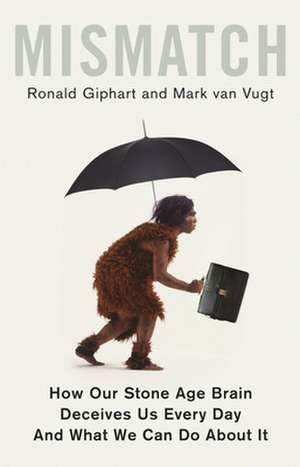
Mismatch: How Our Stone Age Brain Deceives Us Every Day (And What We Can Do About It)
Autor Ronald Giphart, Mark van Vugten Limba Engleză Paperback – 4 mar 2021
Mismatch is about the clash between our biology and our culture. It is about the dramatic contrast between the first few million years of human history - when humans lived as hunters and gatherers in small-scale societies - and the past twelve thousand years following the agricultural revolution which have led us to comfortable lives in a very different social structure. Has this rapid transition been good for us? How do we, using our primitive minds, try to survive in a modern information society that radically changes every ten years or so?
Ronald Giphart and Mark van Vugt show that humans have changed their environment so drastically that the chances for mismatch have significantly increased, and these conflicts can have profound consequences.
Reviewed through mismatch glasses, social, societal, and technological trends can be better understood, ranging from the popularity of Facebook and internet porn, to the desire for cosmetic surgery, to our attitudes towards refugees.
Mismatches can also affect our physical and psychological well-being, in terms of our attitudes to happiness, physical exercise, choosing good leaders, or finding ways to feel better at home or work.
Finally, Mismatch gives us an insight into politics and policy which could enable governments, institutions and businesses to create an environment better suited to human nature, its potential and its constraints.
This book is about converting mismatches into matches. The better your life is matched to how your mind operates, the greater your chances of leading a happy, healthy and productive life.
Preț: 71.88 lei
Puncte Express: 108
Carte disponibilă
Livrare economică 05-19 noiembrie
Livrare express 22-28 octombrie pentru 22.70 lei
Livrare prin curier în România Termenul estimat este afișat lângă disponibilitate.
Transport gratuit de la 400.00 lei Plată online sau ramburs, în funcție de opțiunile comenzii.
Retur gratuit în 14 zile Comandă securizată și suport în română.
Specificații
ISBN-13: 9781472139726
ISBN-10: 1472139720
Pagini: 352
Dimensiuni: 124 x 198 x 30 mm
Greutate: 0.28 kg
Editura: Little Brown
Colecția Robinson
Locul publicării:London, United Kingdom
ISBN-10: 1472139720
Pagini: 352
Dimensiuni: 124 x 198 x 30 mm
Greutate: 0.28 kg
Editura: Little Brown
Colecția Robinson
Locul publicării:London, United Kingdom
Recenzii
Have you ever felt the urge to run and hide before a big presentation or enjoyed the cosy feeling of contentment as you curl up in front of a fire? If you've ever had your wisdom teeth removed or felt pure terror at the sight of a spider in your bathroom, you have experienced a mismatch - a clash between our age-old biology and modern culture.
Our primitive brains evolved to meet Stone Age demands, so when faced with modern day situations that are less extreme, they often encounter a mismatch, putting us on the wrong foot by responding to stimuli that - in prehistoric times - would have prompted behaviour that was beneficial. The primeval mind has lost its way in a new world of anonymous cities, social inequality and stress at work.
Mismatch is about the dramatic contrast between the first few million years of human history - when humans lived as hunters and gatherers in small-scale societies - and the past twelve thousand years following the agricultural revolution which have led us to comfortable lives in a very different social structure. Has this rapid transition been good for us? How do we cope in a modern information society that radically changes every decade or so?
Award-winning and bestselling novelist Ronald Giphart and Vrije Universiteit Amsterdam Professor of Evolutionary, Work and Organizational Psychology Mark van Vugt (who is also a researcher at the University of Oxford) propose broad changes to politics and policy which could enable governments, institutions and businesses to create an environment better suited to human nature, while offering everyday advice on how to convert mismatches into matches. The better your life is matched to how your mind operates, the greater your chances of leading a happy, healthy and productive existence.
Our primitive brains evolved to meet Stone Age demands, so when faced with modern day situations that are less extreme, they often encounter a mismatch, putting us on the wrong foot by responding to stimuli that - in prehistoric times - would have prompted behaviour that was beneficial. The primeval mind has lost its way in a new world of anonymous cities, social inequality and stress at work.
Mismatch is about the dramatic contrast between the first few million years of human history - when humans lived as hunters and gatherers in small-scale societies - and the past twelve thousand years following the agricultural revolution which have led us to comfortable lives in a very different social structure. Has this rapid transition been good for us? How do we cope in a modern information society that radically changes every decade or so?
Award-winning and bestselling novelist Ronald Giphart and Vrije Universiteit Amsterdam Professor of Evolutionary, Work and Organizational Psychology Mark van Vugt (who is also a researcher at the University of Oxford) propose broad changes to politics and policy which could enable governments, institutions and businesses to create an environment better suited to human nature, while offering everyday advice on how to convert mismatches into matches. The better your life is matched to how your mind operates, the greater your chances of leading a happy, healthy and productive existence.