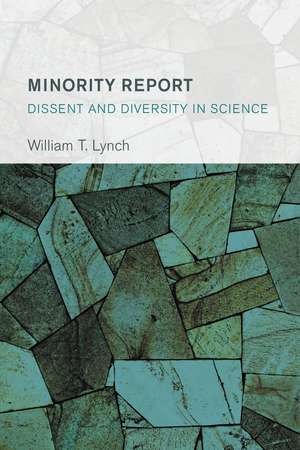
Minority Report: Dissent and Diversity in Science: Collective Studies in Knowledge and Society
Autor William T. Lynchen Limba Engleză Hardback – 16 oct 2020
This book analyzes the support that should be given to minority views, reconsidering classic debates in science and technology studies and examining numerous case studies.
Din seria Collective Studies in Knowledge and Society
- 29%
 Preț: 346.24 lei
 - 27%
 Preț: 284.39 lei
 - 16%
 Preț: 344.18 lei
 - 27%
 Preț: 276.43 lei
 - 22%
 Preț: 331.75 lei
 - 27%
 Preț: 256.31 lei
 - 25%
 Preț: 258.39 lei
 - 23%
 Preț: 288.14 lei
 - 34%
 Preț: 725.29 lei
 - 23%
 Preț: 259.57 lei
 - 23%
 Preț: 265.19 lei
 - 28%
 Preț: 220.96 lei
 - 33%
 Preț: 516.17 lei
 - 32%
 Preț: 536.51 lei
 - 35%
 Preț: 683.67 lei
 -
 Preț: 220.15 lei
 - 25%
 Preț: 211.85 lei
 - 32%
 Preț: 525.97 lei
 - 30%
 Preț: 502.31 lei
 - 30%
 Preț: 551.63 lei
 - 32%
 Preț: 563.88 lei
 - 32%
 Preț: 551.54 lei
Preț: 700.95 lei
Preț vechi: 1007.45 lei
-30%
Puncte Express: 1051
Carte tipărită la comandă
Livrare economică 01-15 decembrie
Livrare prin curier în România Termenul estimat este afișat lângă disponibilitate.
Transport gratuit pentru acest produs Plată online sau ramburs, în funcție de opțiunile comenzii.
Retur gratuit în 14 zile Comandă securizată și suport în română.
Specificații
ISBN-13: 9781786612373
ISBN-10: 1786612372
Pagini: 380
Ilustrații: 1 b/w illustrations;3 tables;
Dimensiuni: 154 x 232 x 28 mm
Greutate: 0.73 kg
Editura: Bloomsbury Publishing
Colecția Rowman & Littlefield
Seria Collective Studies in Knowledge and Society
Locul publicării:New York, United States
ISBN-10: 1786612372
Pagini: 380
Ilustrații: 1 b/w illustrations;3 tables;
Dimensiuni: 154 x 232 x 28 mm
Greutate: 0.73 kg
Editura: Bloomsbury Publishing
Colecția Rowman & Littlefield
Seria Collective Studies in Knowledge and Society
Locul publicării:New York, United States
Cuprins
1. Minority Report: Research Programmes and the Debate about Climate Change
2. Generating Challenges to Dominant Ideas: Lakatos and Feyerabend's Dialectical Alternative
3. Making Anomalies Work: Dialectical Engagement versus Anomaly-Mongering in Evolutionary Biology
4. Members Only: Wittgensteinian Sociology and the Debate about Carbohydrates and Fat
5. The Place of Science and the Turn to Material Practice: A Lab of One's Own for Patient Activists
6. Counterfactuals and Second-Guessing Scientists and Engineers: Green Chemistry, the Precautionary Principle, and Social Movements in the History of Science
7. Commodification and the Erosion of the Scientific Ethos
Bibliography
Index
2. Generating Challenges to Dominant Ideas: Lakatos and Feyerabend's Dialectical Alternative
3. Making Anomalies Work: Dialectical Engagement versus Anomaly-Mongering in Evolutionary Biology
4. Members Only: Wittgensteinian Sociology and the Debate about Carbohydrates and Fat
5. The Place of Science and the Turn to Material Practice: A Lab of One's Own for Patient Activists
6. Counterfactuals and Second-Guessing Scientists and Engineers: Green Chemistry, the Precautionary Principle, and Social Movements in the History of Science
7. Commodification and the Erosion of the Scientific Ethos
Bibliography
Index
Recenzii
The interdisciplinary field of science, technology, and society (STS) was launched in the 1980s to challenge perceived overreach of scientific authority. As STS scholars honed their critical tools, however, assaults on scientific authority gradually became associated with the same conservative, rapaciously capitalist interests the field of STS had first set out to critique. Championing scientific dissent, possibly undercutting scientists' expertise, and emphasizing contingencies in the scientific process became problematic for STS scholars to pursue. The subsequent reckoning has motivated Lynch to develop tools for determining when minority scientific positions should and should not be taken seriously. Lynch's argument follows Bruno Latour, whose Down to Earth (CH, May'19, 56-3759) attempted to put STS on a new footing. The result is a thorough and thoughtful overview of the past half-century of thinking on scientific consensus and dissent, articulated through cases ranging from dietary science to climate change. The book proposes useful conceptual tools to help sort the minority wheat from the minority chaff. Scholars in STS and adjacent fields will find this a rewarding and provocative read. Recommended. Graduate students and faculty.