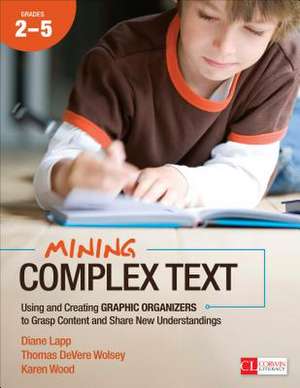
Mining Complex Text, Grades 2-5
Autor Diane Lapp, Thomas Devere Wolsey, Karen Wooden Limba Engleză Paperback – 16 oct 2014
Now more than ever, our students are being asked to do highly advanced thinking, talking, and writing around their reading. If only there were ingenious new tools that could give our students the space to tease apart complex ideas in order to comprehend and weld their understandings into a new whole. Good news: these tools exist—Mining Complex Text. You’ll learn how graphic organizers can:
- Help students read, reread, and take notes on a text
- Promote students’ oral sharing of information and their ideas
- Elevate organized note-making from complex text(s)
- Scaffold students’ narrative and informational writing
Preț: 201.32 lei
Puncte Express: 302
Carte tipărită la comandă
Livrare economică 01-15 decembrie
Livrare prin curier în România Termenul estimat este afișat lângă disponibilitate.
Transport gratuit de la 400.00 lei Plată online sau ramburs, în funcție de opțiunile comenzii.
Retur gratuit în 14 zile Comandă securizată și suport în română.
Specificații
ISBN-13: 9781483316291
ISBN-10: 1483316297
Pagini: 184
Dimensiuni: 216 x 280 x 10 mm
Greutate: 0.48 kg
Ediția:1
Editura: Corwin
Locul publicării:Thousand Oaks, United States
ISBN-10: 1483316297
Pagini: 184
Dimensiuni: 216 x 280 x 10 mm
Greutate: 0.48 kg
Ediția:1
Editura: Corwin
Locul publicării:Thousand Oaks, United States
V-ar putea interesa
-
 -26%Preț: 198.12 lei269.26 lei
 -
 Preț: 321.42 lei
 -
 Preț: 212.45 lei
 -
 Chomsky on Mis-EducationNoam Chomsky-21%Preț: 143.76 lei181.16 lei
 -
 Managing Your Classroom 2nd EditionGerard DixiePreț: 74.56 lei
 -
 Differentiation Through Learning Styles and MemoryMarilee SprengerPreț: 281.44 lei
 -
 Fierce TeachingEric JensenPreț: 190.41 lei
 -
 Building Better Behaviour in the Early YearsChris DukesPreț: 396.20 lei
 -
 Changing Behaviour in SchoolsSue RoffeyPreț: 372.54 lei
 -
 Contemporary Issues in Learning and TeachingMargery Mcmahon-15%Preț: 596.82 lei702.15 lei
Recenzii
“How many times have you heard ‘a picture is worth a thousand words.’ Visual, graphic information is important because human brains are hard-wired to attend to images. The challenge is that students still have to read words to achieve success. In this text, Lapp, Wolsey, Wood, and Johnson make a vital connection between reading words and the role of graphics. They demonstrate how teachers and students can blend the two such that great learning occurs in every classroom, every day.”
“Lapp, Wolsey, Wood, and Johnson have written a book that will become the resource for using graphic organizers across disciplines! With careful attention to the details teachers crave in order to design meaningful lessons, the authors guide teachers on a journey that takes them far beyond the traditional uses of graphic organizers—jotting notes and organizing information—and show teachers how these visual tools lead students to independent thinking and inquiry, as well as support the Common Core reading and writing standards. What I love about this book is that it fosters original thinking among students as they design graphic organizers that enable them to unpack meaning from complex texts and develop arguments for essays.”
“Professional books have long urged teachers to use graphic organizers, but most of these books are dreadfully short on specifics. Diane Lapp and her colleagues have addressed this problem in an admirable fashion. They examine with care the kinds of organizers available to teachers, together with when and how to use them. And by showing how organizers transcend disciplinary boundaries, the authors pave the way for a school-wide focus for professional learning. Educators endeavoring to meet the challenges of the Common Core should mark this title as a must-read. This engaging book is long overdue and I recommend it enthusiastically!”
“For educators looking for ways to implement graphic organizers in their classrooms, this is the resource for you. The numerous types of graphic organizers, the research behind them, and the how and why to use them with students are all at your fingertips. I envision this book being especially helpful for teachers new to the field just learning about graphic organizers.”
“Lapp, Wolsey, Wood, and Johnson have written a book that will become the resource for using graphic organizers across disciplines! With careful attention to the details teachers crave in order to design meaningful lessons, the authors guide teachers on a journey that takes them far beyond the traditional uses of graphic organizers—jotting notes and organizing information—and show teachers how these visual tools lead students to independent thinking and inquiry, as well as support the Common Core reading and writing standards. What I love about this book is that it fosters original thinking among students as they design graphic organizers that enable them to unpack meaning from complex texts and develop arguments for essays.”
“Professional books have long urged teachers to use graphic organizers, but most of these books are dreadfully short on specifics. Diane Lapp and her colleagues have addressed this problem in an admirable fashion. They examine with care the kinds of organizers available to teachers, together with when and how to use them. And by showing how organizers transcend disciplinary boundaries, the authors pave the way for a school-wide focus for professional learning. Educators endeavoring to meet the challenges of the Common Core should mark this title as a must-read. This engaging book is long overdue and I recommend it enthusiastically!”
“For educators looking for ways to implement graphic organizers in their classrooms, this is the resource for you. The numerous types of graphic organizers, the research behind them, and the how and why to use them with students are all at your fingertips. I envision this book being especially helpful for teachers new to the field just learning about graphic organizers.”
Cuprins
Acknowledgments
Chapter 1. Graphic Organizers: Making the Complex Comprehensible
How to Think About Standards Alignment
How to Help Students Meet the Standards
Tips for Using Graphic Organizers Dynamically
How to Meet Eight Intertwined Academic Goals
What Lies Ahead in This Book
Chapter 2. Thinking on the Page: The Research Behind Why Graphic Organizers Work
Picture This: Visuals Quicken and Deepen Text Learning
General Tips: How to Use Graphic Organizers Well
Tiered Organizers: Scaffold Student Progress
Examples of Tiered Graphic Organizers
Adapting Graphic Organizers for Tiered Learning
A Sample Tiered Lesson
At-a-Glance Chart of Graphic Organizers Matched to Academic Goals
Chapter 3. Using Graphic Organizers to Acquire Academic Vocabulary
Frayer Organizer
Concept/Definition Map
Word Map
Chapter 4. Graphic Organizers Support Literary Text Reading and Writing Tasks
Character Graphic
Freytag’s Pyramid
Chapter 5. Graphic Organizers Support Informational Text Reading and Writing Tasks
Text Search and Find Board
4-Square With a Diamond
Modified KWL
Tabbed Book Manipulative
Chapter 6. Graphic Organizers Support Students’ Reading Proficiencies
Somebody-Wanted-But-So
Understanding Text Structures: Five Text Types
Chapter 7. Graphic Organizers Boost Questioning and Responding
I-Chart and I-Guide
Flip Chart Manipulative
Text-Dependent Question/Response Organizer
Chapter 8. Graphic Organizers Foster Reading, Forming, and Writing Opinions
Six-Part Opinion Organizer
Thinking Map
Chapter 9. Graphic Organizers Support Collaboration
Project Management Organizer
Conclusion
Appendix
Glossary
References
Index
Chapter 1. Graphic Organizers: Making the Complex Comprehensible
How to Think About Standards Alignment
How to Help Students Meet the Standards
Tips for Using Graphic Organizers Dynamically
How to Meet Eight Intertwined Academic Goals
What Lies Ahead in This Book
Chapter 2. Thinking on the Page: The Research Behind Why Graphic Organizers Work
Picture This: Visuals Quicken and Deepen Text Learning
General Tips: How to Use Graphic Organizers Well
Tiered Organizers: Scaffold Student Progress
Examples of Tiered Graphic Organizers
Adapting Graphic Organizers for Tiered Learning
A Sample Tiered Lesson
At-a-Glance Chart of Graphic Organizers Matched to Academic Goals
Chapter 3. Using Graphic Organizers to Acquire Academic Vocabulary
Frayer Organizer
Concept/Definition Map
Word Map
Chapter 4. Graphic Organizers Support Literary Text Reading and Writing Tasks
Character Graphic
Freytag’s Pyramid
Chapter 5. Graphic Organizers Support Informational Text Reading and Writing Tasks
Text Search and Find Board
4-Square With a Diamond
Modified KWL
Tabbed Book Manipulative
Chapter 6. Graphic Organizers Support Students’ Reading Proficiencies
Somebody-Wanted-But-So
Understanding Text Structures: Five Text Types
Chapter 7. Graphic Organizers Boost Questioning and Responding
I-Chart and I-Guide
Flip Chart Manipulative
Text-Dependent Question/Response Organizer
Chapter 8. Graphic Organizers Foster Reading, Forming, and Writing Opinions
Six-Part Opinion Organizer
Thinking Map
Chapter 9. Graphic Organizers Support Collaboration
Project Management Organizer
Conclusion
Appendix
Glossary
References
Index
Notă biografică
Diane Lapp, EdD, is a distinguished professor of education at San Diego State University where her work continues to be applied to schools. She is also an instructional coach and teacher at Health Sciences High & Middle College. Throughout her career, Diane has taught in elementary, middle, and high schools. Her major areas of research and instruction regard issues related to the planning and assessment of very intentional literacy instruction and learning. A member of both the California and the International Reading Halls of Fame, Diane has authored, coauthored, and edited numerous articles, columns, texts, handbooks and children's materials on instruction, assessment, and literacy related issues. Diane is the recipient of the ILA 2023 William S. Gray Citation of Merit, a prestigious award reserved for those who have made outstanding contributions to multiple facets of literacy development. Diane can be reached at lapp@sdsu.edu. Follow her on twitter @lappsdsu
Descriere
Your power tools for making the complex comprehensible
Now more than ever, our students are being asked to do highly advanced thinking, talking, and writing around their reading. If only there were ingenious new tools that could give our students the space to tease apart complex ideas in order to comprehend and weld their understandings into a new whole. Good news: these tools exist—Mining Complex Text. You’ll learn how graphic organizers can:
Now more than ever, our students are being asked to do highly advanced thinking, talking, and writing around their reading. If only there were ingenious new tools that could give our students the space to tease apart complex ideas in order to comprehend and weld their understandings into a new whole. Good news: these tools exist—Mining Complex Text. You’ll learn how graphic organizers can:
- Help students read, reread, and take notes on a text
- Promote students’ oral sharing of information and their ideas
- Elevate organized note-making from complex text(s)
- Scaffold students’ narrative and informational writing