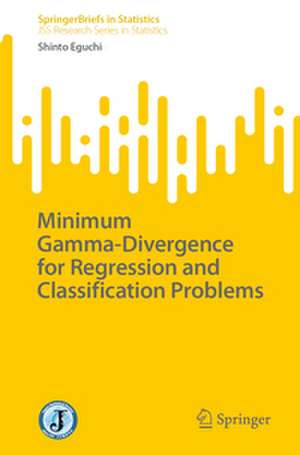
Minimum Gamma-Divergence for Regression and Classification Problems: SpringerBriefs in Statistics
Autor Shinto Eguchien Limba Engleză Paperback – 12 mar 2025
Din seria SpringerBriefs in Statistics
- 15%
 Preț: 479.82 lei
- 5%
 Preț: 448.28 lei
-
 Preț: 402.55 lei
-
 Preț: 402.06 lei
- 5%
 Preț: 447.79 lei
-
 Preț: 402.06 lei
-
 Preț: 397.34 lei
- 5%
 Preț: 377.02 lei
-
 Preț: 402.55 lei
-
 Preț: 438.27 lei
-
 Preț: 287.53 lei
- 5%
 Preț: 297.17 lei
-
 Preț: 388.51 lei
-
 Preț: 364.19 lei
- 5%
 Preț: 345.75 lei
-
 Preț: 290.41 lei
- 20%
 Preț: 345.20 lei
-
 Preț: 402.34 lei
- 15%
 Preț: 489.71 lei
-
 Preț: 401.80 lei
-
 Preț: 401.80 lei
-
 Preț: 400.20 lei
-
 Preț: 401.80 lei
-
 Preț: 401.25 lei
-
 Preț: 401.25 lei
-
 Preț: 286.19 lei
- 5%
 Preț: 345.99 lei
-
 Preț: 400.75 lei
-
 Preț: 272.14 lei
-
 Preț: 401.80 lei
- 5%
 Preț: 328.89 lei
-
 Preț: 400.99 lei
-
 Preț: 400.22 lei
-
 Preț: 403.15 lei
- 20%
 Preț: 287.85 lei
-
 Preț: 402.72 lei
-
 Preț: 399.68 lei
-
 Preț: 399.11 lei
-
 Preț: 289.38 lei
- 5%
 Preț: 426.21 lei
-
 Preț: 379.88 lei
-
 Preț: 400.49 lei
- 5%
 Preț: 326.81 lei
- 15%
 Preț: 464.75 lei
- 33%
 Preț: 313.87 lei
-
 Preț: 398.65 lei
-
 Preț: 398.65 lei
-
 Preț: 399.94 lei
-
 Preț: 473.46 lei
- 5%
 Preț: 327.29 lei
Preț: 344.08 lei
Preț vechi: 430.10 lei
-20%
Puncte Express: 516
Carte tipărită la comandă
Livrare economică 11-25 ianuarie 27
Livrare prin curier în România Termenul estimat este afișat lângă disponibilitate.
Transport gratuit de la 400.00 lei Plată online sau ramburs, în funcție de opțiunile comenzii.
Retur gratuit în 14 zile Comandă securizată și suport în română.
Specificații
ISBN-13: 9789819788798
ISBN-10: 981978879X
Pagini: 128
Dimensiuni: 155 x 235 x 8 mm
Greutate: 0.21 kg
Editura: Springer
Colecția SpringerBriefs in Statistics
Seria SpringerBriefs in Statistics
Notă biografică
Shinto Eguchi received his master degree from Osaka University in 1979 and a Ph.D. from Hiroshima University, Japan, in 1984. His working career started as Assistant Professor of Hiroshima University, 1984, Associate Professor of Shinamne University, 1986, and Professor of The Institute of Statistical Mathematics, 1995-2020. He is currently Emeritus Professor at the Institute of Statistical Mathematics and Graduate University of Advanced Studies. His research interest is primarily statistics, including statistical machine learning, bioinformatics, information geometry, statistical ecology and parametric/semiparametric inference and robust statistics. His recent publication: -A generalized quasi-linear mixed-effects model, Y Saigusa, S Eguchi, O Komori, Statistical Methods in Medical Research, 31 (7), 1280-1291, 2022. -Robust self-tuning semiparametric PCA for contaminated elliptical distribution, H Hung, SY Huang, S Eguchi, IEEE Transactions on Signal Processing 70, 5885-5897, 2022. -Minimum information divergence of Q-functions for dynamic treatment resumes. S Eguchi, Information Geometry, 1-21, 2022.
Descriere
In particular, the authors call the geometric-mean (GM) divergence the gamma-divergence when ? is equal to -1.The book begins by providing an overview of the gamma-divergence and its properties.