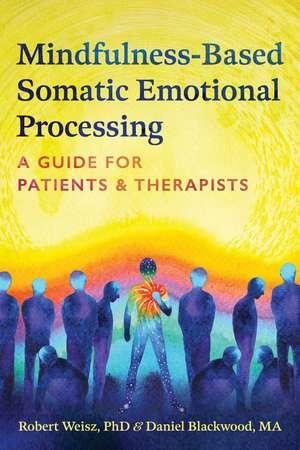
Mindfulness-Based Somatic Emotional Processing: A Guide for Patients and Therapists
Autor Robert Weisz, Daniel Blackwooden Limba Engleză Hardback – 18 iun 2026
• Explains the simple yet transformative protocols and techniques of Mindfulness-Based Somatic Emotional Processing (MBSEP)
• Describes how to work with specific emotional states, such as anxiety, grief and anger, and how to integrate MBSEP with other healing modalities
• Demonstrates concepts and practices in detail through dozens of case studies from the authors’ decades of therapy practice
Developed by Robert Weisz, PhD, the practice of Mindfulness-Based Somatic Emotional Processing (MBSEP) combines mindfulness and somatic perception to help regulate emotions and process traumas that are stored in the body. The authors demonstrate these concepts and methods through decades of case studies and practical, accessible, step-by-step exercises.
Humans are emotional beings who feel and experience emotions in their bodies. Weisz and Blackwood explore the contrast between somatic, body-based emotions and the mental, cognitively-based stories, explanations, and judgments of the thinking mind.
The authors describe the “struggle factor” and why it is futile to resist having negative emotions. They demonstrate how to be mindfully present with emotional states like anxiety, anger, and grief, and they detail the healing influence of compassionate attention. Their methods foster neuroplasticity to create and expand neuronal linkages in the brain and nervous system.
By encouraging acceptance, compassion, and the experiential truth of our embodied emotions, Weisz and Blackwood have created a practical and flexible protocol for processing and regulating emotions. They also show how MBSEP is easily integrated with other healing modalities, making it a valuable resource for home practitioners and therapists alike.
Preț: 154.85 lei
Preț vechi: 214.56 lei
-28%
Puncte Express: 232
Carte disponibilă
Livrare economică 20 noiembrie-02 decembrie
Livrare express 30 octombrie-05 noiembrie pentru 98.02 lei
Livrare prin curier în România Termenul estimat este afișat lângă disponibilitate.
Transport gratuit de la 400.00 lei Plată online sau ramburs, în funcție de opțiunile comenzii.
Retur gratuit în 14 zile Comandă securizată și suport în română.
Specificații
ISBN-13: 9798888503669
Pagini: 272
Ilustrații: 7 b&w illustrations
Dimensiuni: 152 x 229 x 20 mm
Greutate: 0.57 kg
Editura: Inner Traditions/Bear & Company
Colecția Healing Arts Press
Pagini: 272
Ilustrații: 7 b&w illustrations
Dimensiuni: 152 x 229 x 20 mm
Greutate: 0.57 kg
Editura: Inner Traditions/Bear & Company
Colecția Healing Arts Press
Notă biografică
Robert Weisz, PhD, is the developer of MBSEP and a retired clinical psychologist with more than 50 years of experience as a psychotherapist. His deep interest in the healing process and states of consciousness led to three decades of learning and healing work with shamans in Peru, Ecuador, and Brazil. He lives near Santa Fe, New Mexico, in a beautiful mountain home with his partner Diane, two cats, and many tree and rock friends.
Daniel Blackwood, MA, is the founder and director of the Evolution Group, Inc., a behavioral health organization that began in 1998. A practitioner of MBSEP for more than 10 years, Daniel is as passionate about "the work" as when he began as an intern 40 years ago. He is the author of Integrity Recovery, and he and his wife, Shawn, live in Albuquerque, New Mexico. Together they share three children and four dogs.
Daniel Blackwood, MA, is the founder and director of the Evolution Group, Inc., a behavioral health organization that began in 1998. A practitioner of MBSEP for more than 10 years, Daniel is as passionate about "the work" as when he began as an intern 40 years ago. He is the author of Integrity Recovery, and he and his wife, Shawn, live in Albuquerque, New Mexico. Together they share three children and four dogs.
Extras
1
What Is Mindfulness-Based Somatic Emotional Processing?
Feelings or emotions are the universal language and
are to be honored. They are the authentic expression
of who you are at your deepest place.
JUDITH WRIGHT
Your feelings are your god.
CHANAKYA
THE CASE OF JULIA
Case Study from Robert Weisz
Julia was a forty-one-year-old client whose brother had committed suicide ten days before her psychotherapy session with me. She was overwhelmed with grief, and many other emotions. She felt guilty that she had not made a more concerted effort to save her brother and angry at herself for not calling him on the day he took his life. She was very angry and frustrated with her sisters and her brothers for their apparent indifference around her dead brother’s gradual descent into his depression. Julia was also afraid about her ability to function at her job as a surgical nurse in the local hospital. She had only allowed herself to take one week off her work schedule and had forced herself to return to work, even though she was barely able to maintain her focus and concentration during the surgeries where she had to play a critical role.
Julia was also struggling intensely as she tried to understand why her brother had chosen to take his life. She anxiously reviewed and reexamined every memory of her recent history with him to extract any information that would help her to identify how she had not been a good enough, caring sister and how she might have failed to support him. Julia hated the way she felt. She wanted desperately to push away and eliminate the overwhelming emotions that consumed most of her energy and her time. She feared she was losing her mind and that she had lost her capacity to function in her life.
Our work focused on helping Julia to accept and process her profound grief. We identified how and where in her body she was experiencing the intense emotional activation generated by the range of her strong emotions. For the first three sessions, I supported her and coached her to simply feel and acknowledge the indescribable pain and loss she felt in her body about her brother’s shocking demise. My role was to help her stay focused on how she was physically feeling her grief, which at this point encompassed many different, yet related, emotional issues. We had to steer clear of the whys and wherefores, the blaming and the speculation, and the search for answers that could divert Julia from being present with, and processing, her deep and painful loss.
In this way, Julia began the process of gradually being able to accept and process what felt to her to be the impossible and unacceptable—the loss of her brother. My priority in our work together was to support Julia’s grieving process so it could begin to move through her life and her mind-body system with the least amount of interference or struggle.
After the first three sessions, Julia was able to accept and to recognize that she needed and wanted to make room in her daily life for her grieving. Julia was learning that she had access to the basic tools for acknowledging, accepting, and being present with her grief. She was learning to mindfully and compassionately witness the emotional manifestations of her grief in her body. Julia realized that she could choose to just notice her feelings as they were present in her body and allow the emotional energy of her grief and pain to move through her body, instead of struggling with, or against, her emotions.
We continued this work for another three months of biweekly telephone sessions, during which Julia received careful instruction and emotional support so she could honor and process her grief. She was steadily learning how to acknowledge and move through the deep pain and sadness she felt, and would continue to feel, for the foreseeable future. As our work together continued for another six months, Julia was able to more consistently engage in her own emotional self-care. An important element of that self-care consisted of taking time each day to bring compassionate attention to her emotions as they arose and manifested in her body. She was able to develop better boundaries with her family, and she found a more rewarding and less stressful work situation with a medical group practice.
During our last session about ten months after her brother’s suicide, Julia reported that she was no longer feeling overwhelmed in her grief. She was able to allow, to honor, and to accept her feelings of deep loss, even as she admitted that she could not—and might never—understand why her brother took his own life. Julia no longer needed to know when her grief and sadness would end, and she understood that her feelings of grief and sadness were an authentic expression of her undying love for her brother.
THE GIFT OF HUMAN EMOTIONS
We humans are fundamentally emotional, and we function principally as emotional beings. Our emotions move us. Emotions enliven our experiences with energy, flavor, texture, depth, and engagement. Emotions warn us of danger and give us the feeling of safety. Emotions give us love and longing, hope and despair, beauty and ugliness, fear and wonder, anger and avoidance, guilt and shame, envy and betrayal, joy and grief, awe and revulsion, intimacy and abandonment. Emotions shape and energize our behaviors and our thoughts; they can also inhibit or paralyze them.
Emotions create art; they activate our imagination and direct our dreams. They color our perceptions, drive our choices, create our attractions, sculpt our relationships, and mobilize our suffering. Emotions energize, animate, color, and enliven our experiences, and give them their potency, their substance, and their significance.
In short, emotions play an integral part in every human experience, whether internal or external, even when we are not aware of their presence or their influence. Emotions even shape culture and become a means through which culture shapes human consciousness and commands behaviors. The neuroscientist, Jaak Panksepp, summed up the primacy of emotions in human life, saying: “I Feel, therefore I am.”
In their 2021 book, The Archaeology of Mind: Neuroevolutionary Origins of Human Emotions, Jaak Panksepp and Lucy Biven present a neuroscientific framework for the evolution and function of seven intrinsic emotional systems that humans share with many other mammalian species: seeking (expectancy), fear (anxiety), rage (anger), lust (sexual excitement), care (nurturance), grief (sadness), and play (social joy). These seven emotional systems, which are present in most mammalian brains and nervous systems, are the primary sources of our basic, raw emotions. The activation and the interaction of these seven fundamental systems creates the full range of our emotions and is engaged in shaping how those feelings are experienced.
In her 2021 book, Atlas of the Heart: Mapping Meaningful Connection and the Language of Human Experience, best-selling author and emotions researcher Brené Brown elaborates on this emotional range by identifying eighty-seven distinct emotions that can be named and described within the human emotional repertoire. These range from excitement to resignation, anguish to love, heartbreak to empathy; from compassion to contempt, and awe to disgust. This full and varied palette of emotions creates and expresses the richness, intensity, complexity, potency, and subtlety of our human experience, which is energized and enlivened by our emotional capacity to feel and experience ourselves as unique, multifaceted, relational, interdependent, and complex beings.
EMOTIONS AS EMBODIED EXPERIENCES
The actual, real, and tangible experience of emotions is not a mental event; we feel our feelings in our bodies, even if we are not aware of them. Emotions, in humans (and in many other animals), are made of the emotional energies that are generated in, and move through, our bodies in response to internally or externally experienced events. These emotional energies are a felt, sensorially experienced, and somatic expression of the essential life energy that animates our bodies and enlivens our consciousness.
The challenge inherent to our emotional nature is to develop a way of relating to our very emotional experience with a respectful awareness of how that experience is happening, as it happens, and where it happens. An essential fact about our emotions: They are tangible, psychophysiological events and phenomena that take place within our bodies as physical, energetic experiences that we can identify with our body’s sensory abilities. Since emotions happen and are experienced in the body, we are therefore compelled to acknowledge them and to relate with them, as body-based, physically discernible phenomena. If we want to have a realistic, respectful, and effective relationship with our emotions, we must meet them, witness them, acknowledge them, and work with them when and where they are actually manifesting.
However, we rarely, if ever, recognize that our emotional experiences are distinctly different from the thoughts, stories, or explanations created by the thinking mind. When we speak of our feelings, we are literally referring to the fact, and the reality, that we feel our emotions in our bodies.
What Is Mindfulness-Based Somatic Emotional Processing?
Feelings or emotions are the universal language and
are to be honored. They are the authentic expression
of who you are at your deepest place.
JUDITH WRIGHT
Your feelings are your god.
CHANAKYA
THE CASE OF JULIA
Case Study from Robert Weisz
Julia was a forty-one-year-old client whose brother had committed suicide ten days before her psychotherapy session with me. She was overwhelmed with grief, and many other emotions. She felt guilty that she had not made a more concerted effort to save her brother and angry at herself for not calling him on the day he took his life. She was very angry and frustrated with her sisters and her brothers for their apparent indifference around her dead brother’s gradual descent into his depression. Julia was also afraid about her ability to function at her job as a surgical nurse in the local hospital. She had only allowed herself to take one week off her work schedule and had forced herself to return to work, even though she was barely able to maintain her focus and concentration during the surgeries where she had to play a critical role.
Julia was also struggling intensely as she tried to understand why her brother had chosen to take his life. She anxiously reviewed and reexamined every memory of her recent history with him to extract any information that would help her to identify how she had not been a good enough, caring sister and how she might have failed to support him. Julia hated the way she felt. She wanted desperately to push away and eliminate the overwhelming emotions that consumed most of her energy and her time. She feared she was losing her mind and that she had lost her capacity to function in her life.
Our work focused on helping Julia to accept and process her profound grief. We identified how and where in her body she was experiencing the intense emotional activation generated by the range of her strong emotions. For the first three sessions, I supported her and coached her to simply feel and acknowledge the indescribable pain and loss she felt in her body about her brother’s shocking demise. My role was to help her stay focused on how she was physically feeling her grief, which at this point encompassed many different, yet related, emotional issues. We had to steer clear of the whys and wherefores, the blaming and the speculation, and the search for answers that could divert Julia from being present with, and processing, her deep and painful loss.
In this way, Julia began the process of gradually being able to accept and process what felt to her to be the impossible and unacceptable—the loss of her brother. My priority in our work together was to support Julia’s grieving process so it could begin to move through her life and her mind-body system with the least amount of interference or struggle.
After the first three sessions, Julia was able to accept and to recognize that she needed and wanted to make room in her daily life for her grieving. Julia was learning that she had access to the basic tools for acknowledging, accepting, and being present with her grief. She was learning to mindfully and compassionately witness the emotional manifestations of her grief in her body. Julia realized that she could choose to just notice her feelings as they were present in her body and allow the emotional energy of her grief and pain to move through her body, instead of struggling with, or against, her emotions.
We continued this work for another three months of biweekly telephone sessions, during which Julia received careful instruction and emotional support so she could honor and process her grief. She was steadily learning how to acknowledge and move through the deep pain and sadness she felt, and would continue to feel, for the foreseeable future. As our work together continued for another six months, Julia was able to more consistently engage in her own emotional self-care. An important element of that self-care consisted of taking time each day to bring compassionate attention to her emotions as they arose and manifested in her body. She was able to develop better boundaries with her family, and she found a more rewarding and less stressful work situation with a medical group practice.
During our last session about ten months after her brother’s suicide, Julia reported that she was no longer feeling overwhelmed in her grief. She was able to allow, to honor, and to accept her feelings of deep loss, even as she admitted that she could not—and might never—understand why her brother took his own life. Julia no longer needed to know when her grief and sadness would end, and she understood that her feelings of grief and sadness were an authentic expression of her undying love for her brother.
THE GIFT OF HUMAN EMOTIONS
We humans are fundamentally emotional, and we function principally as emotional beings. Our emotions move us. Emotions enliven our experiences with energy, flavor, texture, depth, and engagement. Emotions warn us of danger and give us the feeling of safety. Emotions give us love and longing, hope and despair, beauty and ugliness, fear and wonder, anger and avoidance, guilt and shame, envy and betrayal, joy and grief, awe and revulsion, intimacy and abandonment. Emotions shape and energize our behaviors and our thoughts; they can also inhibit or paralyze them.
Emotions create art; they activate our imagination and direct our dreams. They color our perceptions, drive our choices, create our attractions, sculpt our relationships, and mobilize our suffering. Emotions energize, animate, color, and enliven our experiences, and give them their potency, their substance, and their significance.
In short, emotions play an integral part in every human experience, whether internal or external, even when we are not aware of their presence or their influence. Emotions even shape culture and become a means through which culture shapes human consciousness and commands behaviors. The neuroscientist, Jaak Panksepp, summed up the primacy of emotions in human life, saying: “I Feel, therefore I am.”
In their 2021 book, The Archaeology of Mind: Neuroevolutionary Origins of Human Emotions, Jaak Panksepp and Lucy Biven present a neuroscientific framework for the evolution and function of seven intrinsic emotional systems that humans share with many other mammalian species: seeking (expectancy), fear (anxiety), rage (anger), lust (sexual excitement), care (nurturance), grief (sadness), and play (social joy). These seven emotional systems, which are present in most mammalian brains and nervous systems, are the primary sources of our basic, raw emotions. The activation and the interaction of these seven fundamental systems creates the full range of our emotions and is engaged in shaping how those feelings are experienced.
In her 2021 book, Atlas of the Heart: Mapping Meaningful Connection and the Language of Human Experience, best-selling author and emotions researcher Brené Brown elaborates on this emotional range by identifying eighty-seven distinct emotions that can be named and described within the human emotional repertoire. These range from excitement to resignation, anguish to love, heartbreak to empathy; from compassion to contempt, and awe to disgust. This full and varied palette of emotions creates and expresses the richness, intensity, complexity, potency, and subtlety of our human experience, which is energized and enlivened by our emotional capacity to feel and experience ourselves as unique, multifaceted, relational, interdependent, and complex beings.
EMOTIONS AS EMBODIED EXPERIENCES
The actual, real, and tangible experience of emotions is not a mental event; we feel our feelings in our bodies, even if we are not aware of them. Emotions, in humans (and in many other animals), are made of the emotional energies that are generated in, and move through, our bodies in response to internally or externally experienced events. These emotional energies are a felt, sensorially experienced, and somatic expression of the essential life energy that animates our bodies and enlivens our consciousness.
The challenge inherent to our emotional nature is to develop a way of relating to our very emotional experience with a respectful awareness of how that experience is happening, as it happens, and where it happens. An essential fact about our emotions: They are tangible, psychophysiological events and phenomena that take place within our bodies as physical, energetic experiences that we can identify with our body’s sensory abilities. Since emotions happen and are experienced in the body, we are therefore compelled to acknowledge them and to relate with them, as body-based, physically discernible phenomena. If we want to have a realistic, respectful, and effective relationship with our emotions, we must meet them, witness them, acknowledge them, and work with them when and where they are actually manifesting.
However, we rarely, if ever, recognize that our emotional experiences are distinctly different from the thoughts, stories, or explanations created by the thinking mind. When we speak of our feelings, we are literally referring to the fact, and the reality, that we feel our emotions in our bodies.
Cuprins
PART ONE
DEVELOPING A PERSONAL PRACTICE
Introduction to Part One:
Our Stories and Inspiration
1 What Is Mindfulness-Based
Somatic Emotional Processing?
2 Minding the Body, Embodying the Mind
Practice #1: Witnessing Anger
Practice #2: Emotional Memory
Practice #3: Emotional Memory Part Two
3 The Struggle Factor
Practice #4: Fighting with Fear
Practice #5: Attention to Anger
4 How We Acknowledge and Digest our Feelings
Practice #6: Leave the Story at the Door
Practice #7: Experiencing Pleasure and Pain
Practice #8: Emotional Regulation
5 Resourcing
Practice #9: Identifying Your Resource(s)
6 Breathwork
Practice #10: Mindful Breathing
Practice #11: Slowing Your Breath
Practice #12: Heart Math Breathing
Practice #13: Breath Awareness
7 Mindfulness and Witnessing
Practice #14: Cultivating Sensory Awareness
Practice #15: Mindful Affection
Practice #16: Witnessing Sadness
8 Compassion and Self-Compassion
Practice #17: Musical Attunement
9 Creating and Holding Space for Healing
Practice #18: Cultivating Felt Sense Attention
Practice #19: The Compassionate Witness
10 The Art and Practice of
Witnessing and Processing Emotions
11 A Step by Step Guide to MBSEP Practice
1. Initial Breathwork
2. Establish or Identify an Internal Resource
3. Acknowledge the Experience and Identify the Emotions
4. Notice the Body’s Experience
5. Remain Compassionately Present
6. Repeat Steps 4 and 5 if Necessary to Support Additional
Processing and Release
7. Reflect on the Process and Assess
Additional Exercises for Processing Painful Experiences
Practice #20 Safe Place Resourcing
Practice #21: Breath Resourcing
Practice #22: Processing a Painful Experience
Practice #23: The Last Day of Your Life
PART TWO
THE THERAPEUTIC MANUAL
Introduction to Part Two:
MBSEP in Counseling and Psychotherapy
12 The Attuned Relationship in the
Context of Polyvagal Theory
13 Overview and Considerations
14 Creating Safety
15 Emotional Processing
16 Working with Specific Emotional States
17 Functional Issues
18 Questions about MBSEP
19 Supporting and Honoring Ourselves
20 Case Studies
Resources
References
Index
DEVELOPING A PERSONAL PRACTICE
Introduction to Part One:
Our Stories and Inspiration
1 What Is Mindfulness-Based
Somatic Emotional Processing?
2 Minding the Body, Embodying the Mind
Practice #1: Witnessing Anger
Practice #2: Emotional Memory
Practice #3: Emotional Memory Part Two
3 The Struggle Factor
Practice #4: Fighting with Fear
Practice #5: Attention to Anger
4 How We Acknowledge and Digest our Feelings
Practice #6: Leave the Story at the Door
Practice #7: Experiencing Pleasure and Pain
Practice #8: Emotional Regulation
5 Resourcing
Practice #9: Identifying Your Resource(s)
6 Breathwork
Practice #10: Mindful Breathing
Practice #11: Slowing Your Breath
Practice #12: Heart Math Breathing
Practice #13: Breath Awareness
7 Mindfulness and Witnessing
Practice #14: Cultivating Sensory Awareness
Practice #15: Mindful Affection
Practice #16: Witnessing Sadness
8 Compassion and Self-Compassion
Practice #17: Musical Attunement
9 Creating and Holding Space for Healing
Practice #18: Cultivating Felt Sense Attention
Practice #19: The Compassionate Witness
10 The Art and Practice of
Witnessing and Processing Emotions
11 A Step by Step Guide to MBSEP Practice
1. Initial Breathwork
2. Establish or Identify an Internal Resource
3. Acknowledge the Experience and Identify the Emotions
4. Notice the Body’s Experience
5. Remain Compassionately Present
6. Repeat Steps 4 and 5 if Necessary to Support Additional
Processing and Release
7. Reflect on the Process and Assess
Additional Exercises for Processing Painful Experiences
Practice #20 Safe Place Resourcing
Practice #21: Breath Resourcing
Practice #22: Processing a Painful Experience
Practice #23: The Last Day of Your Life
PART TWO
THE THERAPEUTIC MANUAL
Introduction to Part Two:
MBSEP in Counseling and Psychotherapy
12 The Attuned Relationship in the
Context of Polyvagal Theory
13 Overview and Considerations
14 Creating Safety
15 Emotional Processing
16 Working with Specific Emotional States
17 Functional Issues
18 Questions about MBSEP
19 Supporting and Honoring Ourselves
20 Case Studies
Resources
References
Index
Recenzii
“This book elevates the understanding of well-being to a new level. Every mental health professional should read this book, as should primary care practitioners. MBSEP normalizes emotional openness, helps clients overcome cultural bias against expressing feelings, and provides more complete evidence of underlying emotional issues.”
“Whether you’re supporting clients with emotional dysregulation or navigating your own, add this book to your somatic toolkit. Its framework and many practices guide readers in anchoring emotions in the body and offer a grounded, accessible way to move through challenging feeling states, reinforcing the core insight that relief arises through feeling.”
“Written from a deep personal place with deep professional insights, MBSEP offers many new tools and techniques for healing. Weisz and Blackwood have created an empathic and empowering book that draws from neuroscience, psychology, and spiritual wisdom to gently guide the reader to mindful awareness and acceptance of their emotional lives.”
“Weaving together insights from ancient wisdom traditions with contemporary neuroscience and years of clinical experience, this book offers a clear, accessible, step-by-step guide to effectively working with our challenging emotions. A great resource for clients and therapists alike, it shows us how to be more embodied, present, and compassionate toward ourselves, offering a blueprint anyone can follow to live a richer, more rewarding, and more connected life.”
“We all have bodies, and we all have minds. But how do they relate to each other? And how can we heal ourselves by strengthening that relationship? In this beautiful jewel of a book, Weisz and Blackwood effortlessly synthesize breath and mindfulness practices with sound psychotherapeutic principles in order to resolve disturbances of emotion. It is an invaluable resource for both lay and professional audiences.”
“Having a guide for working with emotions and unprocessed traumas is very important for our traumatized world today. Learning the skills of emotional expression based on body–mind integration is vital to every human being. I highly recommend this book.”
“Mindfulness is critical to spiritual development from a contemplative point of view, and yet mindfulness practice frequently brings us face-to-face with trauma and suffering. The authors have created a highly skillful path through the geography of psychological suffering. This is essential reading for anyone interested in the evolution of mindfulness and its embodiment for the transformation of mind, body, and spirit.”
“This book is full of richness and humanity, with case examples that we can all easily relate to. As a therapist for nearly 40 years, I have seen and experienced many therapeutic trends, and I believe that mindfulness-based practice is the present and future of psychotherapy. The mind–body–emotional connection is useful in all of our work and is particularly relevant in trauma-based treatment. I enjoyed this book immensely.”
“When you open this book you are invited into a world of carefully organized, step-by-step holding, understanding, and hands-on processing of the emotional somatic mysteries of human life. The thoroughness of this opus leaves the reader with no need to look further for potent assistance in befriending the soul in the emotional and somatic life of the body. I will gladly recommend it in my ongoing courses. A must-read for psychotherapeutic practitioners and psychological pilgrims alike.”
“Increasingly, psychotherapy is looking to the body to uncover and resolve emotional challenges that are difficult to discover and to address by focusing solely on the contents of the mind. This wonderful guide offers powerful, body-focused awareness practices for those of us committed to our personal healing to undertake on our own. It is highly recommended for anyone courageous enough to self-reflect and feel what’s actually going on inside their body.”
"MBSEP is a gentle and intuitive way to process our emotional and physical experiences. As a clinician, MBSEP has given me a concrete strategy for how to support clients in learning how to ‘feel their feelings.’ As a human, it has encouraged me to connect more fully to myself and do my own healing work. Whether you’re a therapist seeking new tools or someone just looking for a way to stay more grounded through life’s emotional ups and downs, this book is well worth the read.”
“Weisz and Blackwood have written a tender and compassionate guide for working with emotions and difficult emotional experiences. The practice of mindfulness-based somatic emotional processing lights the way for creating and holding a compassionate healing space for ourselves and others. This book is both a compass and a map for laypeople and therapists for navigating life’s emotional experiences and receiving the truth they carry.”
“The clarity and depth of this book reflect the profound impact that Mindfulness-Based Somatic Emotional Processing (MBSEP) has had on my life. Years after my work with Robert Weisz, MBSEP continues to shape my personal and professional world. I am immensely grateful for the life-changing wisdom in this book, and I can’t wait for more practitioners to experience its transformative power.”
“This book represents a useful and unique contribution to psychotherapy. Rooting their work in deep meditative compassion, Weisz and Blackwood offer insightful practices for healing trauma lodged in the emotional body. Pragmatic, straightforward exercises, backed up with theory and research for the professional, make the book a useful manual for both self-exploration and professional practice. I would have been well served to have had this book and its insights during my career as a psychotherapist.”
“Whether you’re supporting clients with emotional dysregulation or navigating your own, add this book to your somatic toolkit. Its framework and many practices guide readers in anchoring emotions in the body and offer a grounded, accessible way to move through challenging feeling states, reinforcing the core insight that relief arises through feeling.”
“Written from a deep personal place with deep professional insights, MBSEP offers many new tools and techniques for healing. Weisz and Blackwood have created an empathic and empowering book that draws from neuroscience, psychology, and spiritual wisdom to gently guide the reader to mindful awareness and acceptance of their emotional lives.”
“Weaving together insights from ancient wisdom traditions with contemporary neuroscience and years of clinical experience, this book offers a clear, accessible, step-by-step guide to effectively working with our challenging emotions. A great resource for clients and therapists alike, it shows us how to be more embodied, present, and compassionate toward ourselves, offering a blueprint anyone can follow to live a richer, more rewarding, and more connected life.”
“We all have bodies, and we all have minds. But how do they relate to each other? And how can we heal ourselves by strengthening that relationship? In this beautiful jewel of a book, Weisz and Blackwood effortlessly synthesize breath and mindfulness practices with sound psychotherapeutic principles in order to resolve disturbances of emotion. It is an invaluable resource for both lay and professional audiences.”
“Having a guide for working with emotions and unprocessed traumas is very important for our traumatized world today. Learning the skills of emotional expression based on body–mind integration is vital to every human being. I highly recommend this book.”
“Mindfulness is critical to spiritual development from a contemplative point of view, and yet mindfulness practice frequently brings us face-to-face with trauma and suffering. The authors have created a highly skillful path through the geography of psychological suffering. This is essential reading for anyone interested in the evolution of mindfulness and its embodiment for the transformation of mind, body, and spirit.”
“This book is full of richness and humanity, with case examples that we can all easily relate to. As a therapist for nearly 40 years, I have seen and experienced many therapeutic trends, and I believe that mindfulness-based practice is the present and future of psychotherapy. The mind–body–emotional connection is useful in all of our work and is particularly relevant in trauma-based treatment. I enjoyed this book immensely.”
“When you open this book you are invited into a world of carefully organized, step-by-step holding, understanding, and hands-on processing of the emotional somatic mysteries of human life. The thoroughness of this opus leaves the reader with no need to look further for potent assistance in befriending the soul in the emotional and somatic life of the body. I will gladly recommend it in my ongoing courses. A must-read for psychotherapeutic practitioners and psychological pilgrims alike.”
“Increasingly, psychotherapy is looking to the body to uncover and resolve emotional challenges that are difficult to discover and to address by focusing solely on the contents of the mind. This wonderful guide offers powerful, body-focused awareness practices for those of us committed to our personal healing to undertake on our own. It is highly recommended for anyone courageous enough to self-reflect and feel what’s actually going on inside their body.”
"MBSEP is a gentle and intuitive way to process our emotional and physical experiences. As a clinician, MBSEP has given me a concrete strategy for how to support clients in learning how to ‘feel their feelings.’ As a human, it has encouraged me to connect more fully to myself and do my own healing work. Whether you’re a therapist seeking new tools or someone just looking for a way to stay more grounded through life’s emotional ups and downs, this book is well worth the read.”
“Weisz and Blackwood have written a tender and compassionate guide for working with emotions and difficult emotional experiences. The practice of mindfulness-based somatic emotional processing lights the way for creating and holding a compassionate healing space for ourselves and others. This book is both a compass and a map for laypeople and therapists for navigating life’s emotional experiences and receiving the truth they carry.”
“The clarity and depth of this book reflect the profound impact that Mindfulness-Based Somatic Emotional Processing (MBSEP) has had on my life. Years after my work with Robert Weisz, MBSEP continues to shape my personal and professional world. I am immensely grateful for the life-changing wisdom in this book, and I can’t wait for more practitioners to experience its transformative power.”
“This book represents a useful and unique contribution to psychotherapy. Rooting their work in deep meditative compassion, Weisz and Blackwood offer insightful practices for healing trauma lodged in the emotional body. Pragmatic, straightforward exercises, backed up with theory and research for the professional, make the book a useful manual for both self-exploration and professional practice. I would have been well served to have had this book and its insights during my career as a psychotherapist.”
Descriere
A guide for working with emotions and unprocessed traumas