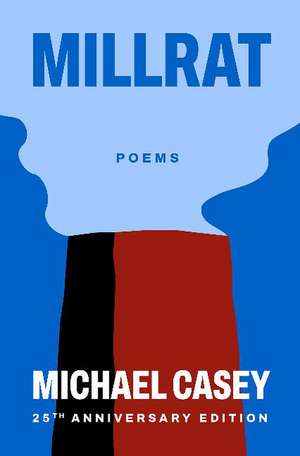
Millrat
Autor Michael Caseyen Limba Engleză Paperback – 22 feb 2022
Poet Michael Casey writes, “My writing about the mills stemmed from the jobs during summers from college, undergrad school at the Lowell Technological Institute (LTI, now University of Massachusetts, Lowell) and then later when on leave from the State University of New York in Buffalo. A friend told me not to give the phony impression that the jobs there were at that time my career. Mention that here in compliance. I did not always work at a textile mill but for a book’s setting in Lowell, the textile mill was appropriate. Lowell was where the other American revolution began. History. The Industrial Revolution. For any writer at any time you are apt to write about what you are doing. I have to say think of Robert Frost and apple picking or Fred Voss at the airplane factory and writing about factory work is not restricted to men. I can recommend here the wonderful books by Inez Holden.
Author Jeanne Schinto wrote in The Nation magazine: “In 1972, when Michael Casey was twenty-four, he won the Yale Younger Poets award with a book called Obscenities. Stanley Kunitz called it “the first significant book of poems written by an American to spring from the war in Vietnam.” . . . “Casey didn’t see action in Vietnam; he was in the military police, assigned to the highway patrol and gate-guard duty. So it’s no wonder that very little of Obscenities is about combat; instead, many of the poems illuminate the Army’s pecking order and its hyper-logical nonsense. In Millrat, Casey explores the mill hierarchy, at times even more complex than the military’s, since the rules there are less rigid and the consequences of disobeying them less certain. You may not lose your job, but you may lose face, which is often more valued. . . .”
Poet Helena Minton says, “Michael Casey’s Millrat, first published twenty-five years ago by Adastra Press in western Massachusetts, is a novel distilled, spoken in a series of distinctly American voices. These laconic, but visceral poems, with their blunt language, immerse us in the world of a textile mill, featuring characters whose mishaps, trials and escapades sometimes land them “on the outside lookin in.”
“In deceptively simple, yet startlingly original lines, Casey uses true sleight-of-hand. The job at the mill involves heavy machinery, dangerous chemicals and working with others who can’t be counted on for much of anything. Even moments of downtime—at the coffee truck, a softball game, a picnic, or signing up for the company betting pool, with its byzantine rules—are fraught with complications. On first reading, we might be tempted look at the world of the millrat as absurd, but it is all too real, and we laugh at our own peril. Thanks to Loom Press, Millrat will remain in print. It already has the feel of a classic, and should be widely read and re-read."
Preț: 135.88 lei
Preț vechi: 155.50 lei
-13%
Puncte Express: 204
Carte disponibilă
Livrare economică 16-30 noiembrie
Livrare prin curier în România Termenul estimat este afișat lângă disponibilitate.
Transport gratuit de la 400.00 lei Plată online sau ramburs, în funcție de opțiunile comenzii.
Retur gratuit în 14 zile Comandă securizată și suport în română.
Specificații
ISBN-13: 9781735168975
ISBN-10: 1735168971
Pagini: 88
Dimensiuni: 140 x 216 x 6 mm
Greutate: 0.12 kg
Editura: Loom Press
Colecția Loom Press
Locul publicării:United States
ISBN-10: 1735168971
Pagini: 88
Dimensiuni: 140 x 216 x 6 mm
Greutate: 0.12 kg
Editura: Loom Press
Colecția Loom Press
Locul publicării:United States