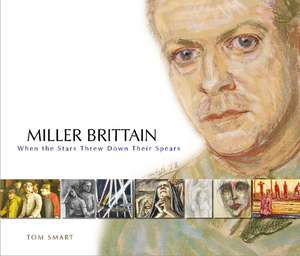
Miller Brittain: When the Stars Threw Down Their Spears
Autor Tom Smarten Limba Engleză Hardback – apr 2007
World War II interrupted Brittain's career and on his bombing missions he carried William Blake's Songs of Innocence and Experience with him. Blake's poetry, particularly "The Tyger," inspired the pervasive motif of Brittain's later career. At first a description of searchlights and shot-down aircraft, the star and spear motif later developed into iconic flowers and stems, heads and necks, sunbursts and smoke.
In this illuminating and provocative book, Tom Smart examines the sweep of Brittain's work, his progression from social realism to abstraction and surrealism, while Allen Bentley shows the profound influence of Blake's thought in Brittain's painting and drawings.
Preț: 376.07 lei
Preț vechi: 416.77 lei
-10%
Puncte Express: 564
Carte disponibilă
Livrare economică 11-25 noiembrie
Livrare prin curier în România Termenul estimat este afișat lângă disponibilitate.
Transport gratuit de la 400.00 lei Plată online sau ramburs, în funcție de opțiunile comenzii.
Retur gratuit în 14 zile Comandă securizată și suport în română.
Specificații
ISBN-13: 9780864924834
ISBN-10: 0864924836
Pagini: 180
Ilustrații: 44 Black & white 116 Colour
Dimensiuni: 248 x 292 x 22 mm
Greutate: 1.4 kg
Editura: Goose Lane Editions
Colecția Goose Lane Editions
Locul publicării:Canada
ISBN-10: 0864924836
Pagini: 180
Ilustrații: 44 Black & white 116 Colour
Dimensiuni: 248 x 292 x 22 mm
Greutate: 1.4 kg
Editura: Goose Lane Editions
Colecția Goose Lane Editions
Locul publicării:Canada
Recenzii
In Miller Brittain: When the Stars Threw Down Their Spears, Tom Smart demonstrates the cohesion of Brittain's imagery. For the first time, he reveals the links between Brittain's early social realism and his later figurative abstractions and surrealist-inspired compositions.
Miller Brittain burst upon the Canadian art scene in the late 1930s with masterful, emotion-filled drawings and paintings of the human form. While studying in New York at the Art Students' League, he had internalized a pivotal moment in American art. Breaking free of traditional realist modes, a radical new generation of artists claimed that art should reflect the life of the artist and the condition of the subjects depicted. At a time when Group of Seven landscapes defined Canadian painting, Brittain challenged the establishment with his unerring sense of line, composition, and engaging human narratives. Later, combining figuration and abstraction, he explored the limites of the body and the borderlands of sanity to express the depths of despair and the heights of ecstasy.
During World War II, Brittain joined the Royal Canadian Air Force, received the Distinguished Flying Cross, and became a Canadian war artist. During bombing missions, he carried William Blake's Songs of Innocence and Experience in his pocket.
In Miller Brittain: When the Stars Threw Down Their Spears, Smart illustrates how Blake's famous poem "The Tyger" inspired the pervasive motif of Brittain's post-war career: the combination of star and spear. Originally a depiction of searchlights and shot-down aircraft, it became, over the years, Brittain's iconic flowers and stems, heads and necks, sunbursts and smoke. Allen Bentley reinforces Smart's observations by showing the profound influence of Blake's theories on the entire body of Brittain's post-war work.
"Visually stunning."
"Elegant... Many excellent colour plates, accompanied by thoroughly researched biographical information."
"Skillfully written."
Miller Brittain burst upon the Canadian art scene in the late 1930s with masterful, emotion-filled drawings and paintings of the human form. While studying in New York at the Art Students' League, he had internalized a pivotal moment in American art. Breaking free of traditional realist modes, a radical new generation of artists claimed that art should reflect the life of the artist and the condition of the subjects depicted. At a time when Group of Seven landscapes defined Canadian painting, Brittain challenged the establishment with his unerring sense of line, composition, and engaging human narratives. Later, combining figuration and abstraction, he explored the limites of the body and the borderlands of sanity to express the depths of despair and the heights of ecstasy.
During World War II, Brittain joined the Royal Canadian Air Force, received the Distinguished Flying Cross, and became a Canadian war artist. During bombing missions, he carried William Blake's Songs of Innocence and Experience in his pocket.
In Miller Brittain: When the Stars Threw Down Their Spears, Smart illustrates how Blake's famous poem "The Tyger" inspired the pervasive motif of Brittain's post-war career: the combination of star and spear. Originally a depiction of searchlights and shot-down aircraft, it became, over the years, Brittain's iconic flowers and stems, heads and necks, sunbursts and smoke. Allen Bentley reinforces Smart's observations by showing the profound influence of Blake's theories on the entire body of Brittain's post-war work.
"Visually stunning."
"Elegant... Many excellent colour plates, accompanied by thoroughly researched biographical information."
"Skillfully written."