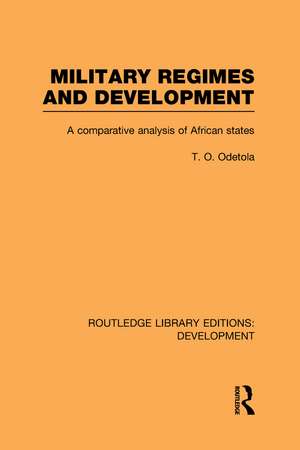
Military Regimes and Development: A Comparative Analysis in African Societies: Routledge Library Editions: Development
Autor Olatunde Odetolaen Limba Engleză Hardback – 26 noi 2010
Din seria Routledge Library Editions: Development
- 18%
 Preț: 1201.86 lei
 - 15%
 Preț: 399.94 lei
 -
 Preț: 303.88 lei
 - 15%
 Preț: 403.22 lei
 -
 Preț: 242.66 lei
 -
 Preț: 219.30 lei
 - 18%
 Preț: 1254.34 lei
 -
 Preț: 442.86 lei
 - 18%
 Preț: 1256.32 lei
 - 18%
 Preț: 1365.73 lei
 -
 Preț: 454.31 lei
 -
 Preț: 433.16 lei
 -
 Preț: 234.05 lei
 - 18%
 Preț: 1201.55 lei
 -
 Preț: 294.11 lei
 -
 Preț: 400.00 lei
 - 18%
 Preț: 1202.46 lei
 -
 Preț: 413.53 lei
 -
 Preț: 443.21 lei
 - 18%
 Preț: 1200.65 lei
 -
 Preț: 434.90 lei
 - 18%
 Preț: 1198.69 lei
 -
 Preț: 438.51 lei
 - 18%
 Preț: 1063.04 lei
 -
 Preț: 449.69 lei
 -
 Preț: 431.28 lei
 -
 Preț: 441.38 lei
 -
 Preț: 294.79 lei
 - 15%
 Preț: 400.24 lei
 -
 Preț: 464.08 lei
 -
 Preț: 442.68 lei
 -
 Preț: 298.29 lei
 -
 Preț: 434.90 lei
 -
 Preț: 439.34 lei
 -
 Preț: 341.13 lei
 -
 Preț: 441.75 lei
 -
 Preț: 436.37 lei
 -
 Preț: 453.08 lei
 -
 Preț: 443.41 lei
 -
 Preț: 444.52 lei
 - 15%
 Preț: 411.89 lei
 -
 Preț: 216.48 lei
 -
 Preț: 438.97 lei
 -
 Preț: 222.80 lei
 -
 Preț: 440.65 lei
 - 18%
 Preț: 1203.40 lei
Preț: 947.31 lei
Preț vechi: 1434.19 lei
-34%
Puncte Express: 1421
Carte indisponibilă temporar
Doresc să fiu notificat când acest titlu va fi disponibil:
Se trimite...
Specificații
ISBN-13: 9780415601849
ISBN-10: 0415601843
Pagini: 210
Dimensiuni: 156 x 234 mm
Greutate: 0.55 kg
Ediția:1
Editura: Taylor & Francis
Colecția Routledge
Seria Routledge Library Editions: Development
Locul publicării:Oxford, United Kingdom
ISBN-10: 0415601843
Pagini: 210
Dimensiuni: 156 x 234 mm
Greutate: 0.55 kg
Ediția:1
Editura: Taylor & Francis
Colecția Routledge
Seria Routledge Library Editions: Development
Locul publicării:Oxford, United Kingdom
V-ar putea interesa
-
 The Economic Theory of Agrarian InstitutionsPranab Bardhan-31%Preț: 433.13 lei626.74 lei
 -
 Managing the Global EconomyJonathan Michie-44%Preț: 187.72 lei335.85 lei
 -
 -24%Preț: 409.36 lei538.77 lei
 -
 -23%Preț: 432.16 lei557.90 lei
 -
 Development Strategy and Management of the Market Economy: Volume 1Edmond Malinvaud-22%Preț: 347.87 lei446.04 lei
 -
 -31%Preț: 375.75 lei542.79 lei
 -
 -19%Preț: 357.29 lei439.99 lei
 -
 African Development Report 2005: Public Sector Management in AfricaThe African Development Bank-23%Preț: 113.89 lei148.84 lei
 -
 -14%Preț: 323.90 lei374.86 lei
 -
 Development as FreedomAmartya SenPreț: 107.37 lei
 -
 Development FinanceStephen Spratt-15%Preț: 506.73 lei596.15 lei
 -
 Climate Change Mitigation and Development CooperationTomoyo Toyota-15%Preț: 420.53 lei494.75 lei
 -
 -15%Preț: 436.64 lei513.70 lei
 -
 -15%Preț: 416.43 lei489.91 lei
 -
 Sustainability Economics: An IntroductionPeter Bartelmus-15%Preț: 567.71 lei667.90 lei
Cuprins
1. Military Regimes and Development: Contrasting Viewpoints 2. Military Organisational Values and Skills as Modernising Instruments 3. Military and Social Classes 4. Military Nationalism and State Power 5. The Military and National Economy 6. Military Regimes and Political Change 7. Military Regimes, Social Policy and Planning 8. Conclusions
Notă biografică
T.O. Odetola, Senior Lecturer in Sociology, University of Ife.
Descriere
First published in 1982, this book aims to examine the role that ruling military governments have played in African development. Dr Odetola discusses military organisational values and skills in modernisation and argues that the evocation and application of these values and skills depends on the character of the leadership of individual ruling juntas, their degree of professional training, proximity to civilian society and so on. He also investigates the relationship between the ruling military and existing social classes.