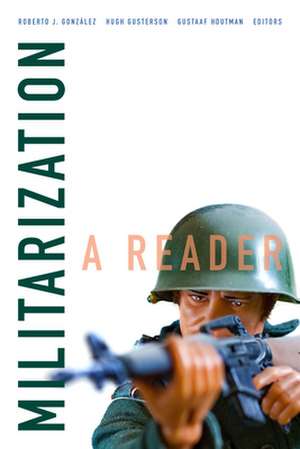
Militarization – A Reader: Global Insecurities
Autor Roberto J. González, Hugh Gusterson, Gustaaf Houtmanen Limba Engleză Paperback – 5 dec 2019
Considerăm că înțelegerea lumii contemporane necesită o analiză profundă a modului în care valorile militare pătrund în structurile civile. Militarization – A Reader este organizată metodic pentru a facilita această înțelegere, debutând cu o introducere teoretică solidă și continuând cu secțiuni ce analizează economia politică și munca militară. Notăm cu interes progresia logică a volumului: de la discursul istoric al lui Eisenhower până la analize moderne despre militarizarea sportului sau rolul femeilor în economia de război. Această structură transformă o temă complexă într-o serie de perspective accesibile, susținute de 26 de ilustrații care ancorează vizual argumentele teoretice.
Descoperim aici o abordare interdisciplinară rară, unde antropologia și științele politice se întâlnesc pentru a chestiona ideologiile care valorizează conflictul armat. Complementar lui The Marketing of War in the Age of Neo-Militarism: unde acela se concentrează pe mecanismele de marketing și intersecția dintre democrație și capitalism, volumul de față, Militarization – A Reader, explorează dimensiunea umană și socială, analizând fenomene precum călugării militari sau impactul asupra copiilor soldați.
Roberto J. González își continuă aici munca de deconstrucție a sferelor de influență militară, o temă centrală și în War Virtually, unde analiza se concentra pe armele autonome și Silicon Valley. În acest Reader, perspectiva se lărgește, oferind un context global care amintește de eforturile sale din Anthropologists in the Public Sphere de a educa publicul larg asupra dezbaterilor politice majore. Este o lucrare care nu se rezumă la teorie, ci demonstrează utilitatea antropologiei în descifrarea tensiunilor din viața cotidiană.



Preț: 278.00 lei
Carte tipărită la comandă
Livrare economică 19 noiembrie-03 decembrie
Specificații
ISBN-10: 1478006234
Pagini: 424
Ilustrații: 26 illustrations
Dimensiuni: 152 x 228 x 29 mm
Greutate: 0.57 kg
Editura: MD – Duke University Press
Seria Global Insecurities
De ce să citești această carte
Recomandăm această carte celor interesați de sociologie, politică și impactul ascuns al instituțiilor militare asupra culturii civile. Cititorul câștigă o perspectivă critică asupra modului în care deciziile de apărare modelează economia și identitatea națională. Este o resursă esențială pentru a înțelege de ce militarizarea nu este doar despre front, ci despre modul în care trăim, muncim și ne raportăm la patriotism în secolul XXI.
Despre autor
Roberto J. González este un antropolog recunoscut pentru analizele sale critice asupra militarismului și tehnologiei. Lucrările sale, precum Zapotec Science (premiată de American Anthropological Association), demonstrează o capacitate extraordinară de a lega cunoașterea locală de contextul global. Alături de Hugh Gusterson și Gustaaf Houtman, el aduce în acest volum o expertiză vastă în antropologia securității, continuând tradiția de a scoate cercetarea academică în sfera publică pentru a ilumina mecanismele puterii și ale conflictului în societatea modernă.
Descriere scurtă
Militarization: A Reader offers a range of critical perspectives on the dynamics of militarization as a social, economic, political, cultural, and environmental phenomenon. It portrays militarism as the condition in which military values and frameworks come to dominate state structures and public culture both in foreign relations and in the domestic sphere. Featuring short, readable essays by anthropologists, historians, political scientists, cultural theorists, and media commentators, the Reader probes militarism's ideologies, including those that valorize warriors, armed conflict, and weaponry. Outlining contemporary militarization processes at work around the world, the Reader offers a wide-ranging examination of a phenomenon that touches the lives of billions of people. In collaboration with Catherine Besteman, Andrew Bickford, Catherine Lutz, Katherine T. McCaffrey, Austin Miller, David H. Price, David Vine
Cuprins
Acknowledgments xv
Introduction / Roberto J. González and Hugh Gusterson 1
Section I. Militarization and Political Economy
Introduction / Catherine Lutz 27
1.1. The U.S. Imperial Triangle and Military Spending / John Bellamy Foster, Hannah Holleman, and Robert W. McChesney 29
1.2. Farewell Address to the Nation, January 17, 1961 / Dwight D. Eisenhower 36
1.3. The Militarization of Sports and the Redefinition of Patriotism / William Astore 38
1.4. Violence, Just in Time: War and Work in Contemporary West Africa / Daniel Hoffman 42
1.5. Women, Economy, War / Carolyn Nordstrom 51
Section II. Military Labor
2.1. Soldiering as Work: The All-Volunteer Force in the United States / Beth Bailey 59
2.2. Sexing the Globe / Sealing Cheng 62
2.3. Military Monks / Michael Jerryson 67
2.4. Child Soldiers after War / Brandon Kohrt and Robert Koenig 71
2.5. Asian Labor in the Wartime Japanese Empire / Paul H. Kratoska 73
2.6. Corporate Warriors: The Rise of the Privatized Military Industry / P. W. Singer 76
Section III. Gender and Militarism
Introduction / Katherine T. McCaffery 83
3.1. Gender in Transition: Common Sense, Women, and War / Kimberly Theidon 85
3.2. The Compassionate Warrior: Wartime Sacrifice / Jean Bethke Elshtain 91
3.3. Creating Citizens, Making Men: The Military and Masculinity in Bolivia / Lesley Gill 95
3.4. One of the Guys: Military Women and the Argentine Army / Máximo Badaró 101
Section IV. The Emotional Life of Militarism
Introduction / Catherine Lutz 109
4.1. Militarization and the Madness of Everyday Life / Nancy Scheper-Hughes 111
4.2. Fear as a Way of Life / Linda Green 118
4.3. Evil, the Self, and Survival / Robert Jay Lifton (Interviewed by Harry Kreisler) 127
4.4. Target Audience: The Emotional Impact of U.S. Governmental Films on Nuclear Testing / Joseph Masco 130
Section V. Rhetorics of Militarism
Introduction / Andrew Bickford 141
5.1. The Militarization of Cherry Blossoms / Emiko Ohnuki-Tierney 143
5.2. The "Old West" in the Middle East: U.S. Military Metaphors in Real and Imagined Indian Country / Stephen W. Silliman 148
5.3. Ideology, Culture, and the Cold War / Naoko Shidusawa 154
5.4. The Military Normal: Feeling at Home with Counterinsurgency in the United States / Catherine Lutz 157
5.5. Nuclear Orientalism / Hugh Gusterson 163
Section VI. Militarization, Place, and Territory
Introduction / Roberto J. González 167
6.1. Making War at Home / Catherine Lutz 168
6.2. Spillover: The U.S. Military's Sociospatial Impact / Mark L. Gillen 175
6.3. Nuclear Landscapes: The Marshall Islands and Its Radioactive Legacy / Barbara Rose Johnston 181
6.4. The War on Terror, Dismantling, and the Construction of Place: An Ethnographic Perspective from Palestine / Julie Peteet 186
6.5. The Border Wall Is a Metaphor / Jason de León (Interviewed by Micheline Aharöian Marcom) 192
Section VII. Militarized Humanitarianism
Introduction / Catherine Besteman 197
7.1. Laboratory of Intervention: The Humanitarian Governance of the Postcommunist Balkan Territories / Mariella Pandolfi 199
7.2. Armed for Humanity / Michael Barnett 203
7.3. The Passions of Protection: Sovereign Authority and Humanitarian War / Anne Orford 208
7.4. Responsibility to Protect or Right to Punish? / Mahmood Mamdani 212
7.5. Utopias of Power: From Human Security to the Presponsibility to Protect / Chowra Makaremi 218
Section VIII. Militarism and the Media
Introduction / Hugh Gusterson 223
8.1. Pentagon Pundits / David Barstow (Interview by Amy Goodman) 224
8.2. Operation Hollywood / David L. Robb (Interviewed by Jeff Fleischer) 230
8.3. Discipline and Publish / Mark Pedelty 234
8.4. The Enola Gay on Display / John Whittier Treat 239
8.5. War Porn: Hollywood and War, from World War II to American Sniper / Peter van Buren 243
Section IX. Militarizing Knowledge
Introduction / David H. Price 249
9.1. Boundary Displacement: The State, the Foundations, and International and Area Studies during and after the Cold War / Bruce Cumings 251
9.2. The Career of Cold War Psychology / Ellen Herman 254
9.3. Scientific Colonialism / Johan Galtung 259
9.4. Research ni Foreign Areas / Ralph L. Beals 265
9.5. Rethinking the Promise of Critical Education / Henry A. Giroux (Interviewed by Chronis Polychroniou) 270
Section X. Militarization and the Body
Introduction / Roberto J. González 275
10.1. Nuclear War, the Gulf War, and the Disappearing Body / Hugh Gusterson 276
10.2. The Structure of War: The Juxtaposition of Injuried Bodies and Unanchored Issues / Elaine Scarry 283
10.3. The Enhanced Warfighter / Kenneth Ford and Clark Glymour 291
10.4. Suffering Child: An Embodiment of War and Its Aftermath in Post-Sandinista Nicaragua / James Quesada 296
Section XI. Militarism and Technology
Introduction / Hugh Gusterson 303
11.1. Giving Up the Gun: Japan's Reversion to the Sword, 1543–1879 / Noel Perrin 305
11.2. Life Underground: Building the American Bunker Society / Joseph Masco 307
11.3. Militarizing Space / David H. Price 316
11.4. Embodiment and Affect in a Digital Age: Understanding Mental Illness among Military Drone Personnel / Alex Edney-Browne 319
11.5. Land Mines and Cluster Bombs: "Weapons of Mass Destruction in Slow Motion" / H. Patricia Hynes 324
11.6. Pledge of Non-Participation / Lisbeth Gronlund and David Wright 328
11.7. The Scientists' Call to Ban Autonomous Lethal Robots / International Committee for Robot Arms Control 329
Section XII. Alternatives to Militarization
Introduction / David Vine 333
12.1. War Is Only an Invention—Not a Biological Necessity / Margaret Mead 336
12.2. Reflections on the Possibility of a Nonkilling Society and a Nonkilling Anthropology / Leslie E. Sponsel 339
12.3. U.S. Bases, Empire, and Global Response / Catherine Lutz 344
12.4. Down Here / Julian Aguon 347
12.5. War, Culture, and Counterinsurgency / Roberto J. González, Hugh Gusterson, and David H. Price 349
12.6. Hope in the Dark: Untold Stories, Wild Possibilities / Rebecca Solnit 350
References 355
Contributors 383
Index 389
Credits 403
Descriere
Militarization: A Reader offers an anthropological perspective on militarization's origin and sustained presence as a cultural process in its full social, economic, political, cultural, environmental, and symbolic contexts throughout the world.