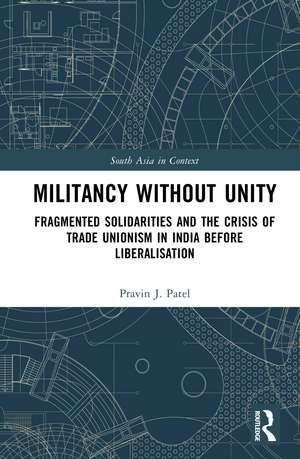
Militancy Without Unity: Fragmented Solidarities and the Crisis of Trade Unionism in India Before Liberalisation: South Asia in Context
Autor Pravin J. Patelen Limba Engleză Hardback – 21 dec 2026
Combining historical depth with sociological analysis, it provides fresh insight into why labour militancy repeatedly failed to generate durable organisational unity. The book will be of great interest to scholars and researchers of labour studies, especially trade unionism, development studies, politics, and South Asian studies.





Preț: 1127.82 lei
Preț vechi: 1485.30 lei
-24% Precomandă
Puncte Express: 1692
Carte nepublicată încă
Livrare prin curier în România Precomanda se expediază când titlul devine disponibil.
Transport gratuit pentru acest produs Plată online sau ramburs, în funcție de opțiunile comenzii.
Retur gratuit în 14 zile Comandă securizată și suport în română.
Doresc să fiu notificat când acest titlu va fi disponibil:
Se trimite...
Specificații
ISBN-13: 9781041428831
ISBN-10: 1041428839
Pagini: 242
Dimensiuni: 156 x 234 mm
Ediția:1
Editura: Taylor & Francis
Colecția Routledge
Seria South Asia in Context
Locul publicării:Oxford, United Kingdom
ISBN-10: 1041428839
Pagini: 242
Dimensiuni: 156 x 234 mm
Ediția:1
Editura: Taylor & Francis
Colecția Routledge
Seria South Asia in Context
Locul publicării:Oxford, United Kingdom
Public țintă
PostgraduateCuprins
Introduction: Explaining the Paradox of Militancy Without Unity
Part I – Historical Foundations: Forging Labour Consciousness in a Princely State, 1885–1985
Chapter 1 – Historical Foundations of Militancy Without Unity: Trade Unionism in the Princely State of Baroda, 1885–1949
Chapter 2 – Fragmented Solidarities: The Politics of Trade Unionism in Baroda, 1949–1985
Part II – Class Formation, Mobilisation, and Class Consciousness
Chapter 3 – Trade Unions, Social Polarisation, and Class Mobilisation: Anatomy of a Strike
Chapter 4 – Trade Union Participation and the Development of Class Consciousness
Part III – Leadership Stratification and Organisational Fragility: Authority and Fragmentation
Chapter 5 – Outsider Trade Union Leaders and the Societal Context: The Bosses and Deputies
Chapter 6 – Trade Union Leadership: The Prominent and Non-Prominent Insiders
Chapter 7 – Conclusion: Militancy Without Unity and the Fragility of Indian Trade Unionism
Part I – Historical Foundations: Forging Labour Consciousness in a Princely State, 1885–1985
Chapter 1 – Historical Foundations of Militancy Without Unity: Trade Unionism in the Princely State of Baroda, 1885–1949
Chapter 2 – Fragmented Solidarities: The Politics of Trade Unionism in Baroda, 1949–1985
Part II – Class Formation, Mobilisation, and Class Consciousness
Chapter 3 – Trade Unions, Social Polarisation, and Class Mobilisation: Anatomy of a Strike
Chapter 4 – Trade Union Participation and the Development of Class Consciousness
Part III – Leadership Stratification and Organisational Fragility: Authority and Fragmentation
Chapter 5 – Outsider Trade Union Leaders and the Societal Context: The Bosses and Deputies
Chapter 6 – Trade Union Leadership: The Prominent and Non-Prominent Insiders
Chapter 7 – Conclusion: Militancy Without Unity and the Fragility of Indian Trade Unionism
Notă biografică
Pravin J. Patel is the former Vice-Chancellor of Sardar Patel University and former Professor of Sociology at The M. S. University of Baroda. His research focuses on labour studies, industrial sociology, social movements, and political sociology. He has authored several books and numerous research articles.
Descriere
Why did India’s trade unions—once capable of dramatic strikes and sustained shop‑floor mobilisation—prove so vulnerable under economic liberalisation? Militancy Without Unity argues that this paradox stemmed less from the 1990s reforms than from organisational weaknesses accumulated over preceding decades.