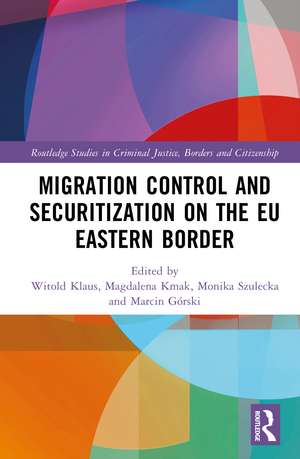
Migration Control and Securitization on the EU Eastern Border: Routledge Studies in Criminal Justice, Borders and Citizenship
Editat de Witold Klaus, Magdalena Kmak, Monika Szulecka, Marcin Górskien Limba Engleză Hardback – 15 feb 2027
The book analyses migratory paths, migration control and bordering practices, as well as responses to discourses, politics, perceptions and imaginations of migration on the Eastern border from legal, social, material, historical and discursive perspectives. It focuses on Eastern EU border countries, particularly those bordering Russia or Belarus. In addition, it examines Germany’s border externalisation policies, and Romania, which has so far been excluded from border studies.
The chapters critically examine the processes leading to border fortification, highlighting post-2021 events that accelerated warfare discourse in media and politics (on “hybrid war”) and the “weaponisation” of people on the move. The main analytical lines include the progressive securitisation and rapid militarisation of the EU’s Eastern border, and the criminalisation not only of migration and people on the move themselves, but also of solidarity, activism, and different forms of resistance to these developments.
This book will be a useful resource for students and scholars of criminology, border studies, migration and asylum law, as well as for policymakers and practitioners working in these areas.
Din seria Routledge Studies in Criminal Justice, Borders and Citizenship
-
 Preț: 469.80 lei
 - 18%
 Preț: 1156.90 lei
 -
 Preț: 360.45 lei
 -
 Preț: 353.92 lei
 -
 Preț: 458.47 lei
 -
 Preț: 420.28 lei
 -
 Preț: 443.89 lei
 -
 Preț: 416.79 lei
 -
 Preț: 468.60 lei
 - 21%
 Preț: 429.00 lei
 -
 Preț: 444.29 lei
 -
 Preț: 415.84 lei
 - 15%
 Preț: 419.20 lei
 -
 Preț: 412.48 lei
 -
 Preț: 476.01 lei
 -
 Preț: 385.82 lei
 -
 Preț: 457.50 lei
 - 18%
 Preț: 1117.60 lei
 - 15%
 Preț: 434.14 lei
 -
 Preț: 473.71 lei
 -
 Preț: 408.74 lei
 -
 Preț: 436.60 lei
 - 19%
 Preț: 447.80 lei
 - nou
 Preț: 1345.62 lei
 - 18%
 Preț: 1147.04 lei
 - 18%
 Preț: 1254.12 lei
 -
 Preț: 442.04 lei
 - 11%
 Preț: 360.31 lei
Preț: 1136.80 lei
Preț vechi: 1490.02 lei
-24% Precomandă
Puncte Express: 1705
Carte nepublicată încă
Livrare prin curier în România Precomanda se expediază când titlul devine disponibil.
Transport gratuit pentru acest produs Plată online sau ramburs, în funcție de opțiunile comenzii.
Retur gratuit în 14 zile Comandă securizată și suport în română.
Doresc să fiu notificat când acest titlu va fi disponibil:
Se trimite...
Specificații
ISBN-13: 9781041027775
ISBN-10: 104102777X
Pagini: 458
Ilustrații: 10
Dimensiuni: 156 x 234 mm
Ediția:1
Editura: Taylor & Francis
Colecția Routledge
Seria Routledge Studies in Criminal Justice, Borders and Citizenship
Locul publicării:Oxford, United Kingdom
ISBN-10: 104102777X
Pagini: 458
Ilustrații: 10
Dimensiuni: 156 x 234 mm
Ediția:1
Editura: Taylor & Francis
Colecția Routledge
Seria Routledge Studies in Criminal Justice, Borders and Citizenship
Locul publicării:Oxford, United Kingdom
Public țintă
Postgraduate and Undergraduate AdvancedCuprins
All Quiet on the Eastern Border? Bordering Practices at the EU Eastern Border: An Introduction Part I: History 1. The Margin at the Centre: The Long History of the Eastern Border in German Politics and Imagination 2. Buffer Zones: Migration Prevention in CEE Countries and Finland from the Cold War to Europeanisation 3. The Genesis of the German-Polish Borderscape since 1990: Outsourcing Racist Violence, Externalising Borders Part II: Law 4. Restricting Access to Asylum at the Eastern Borders of the European Union: How Existing Crises Expose Gaps in the EU Law 5. When Everything Else Fails: Interim Measures Concerning Pushbacks at the Polish-Belarusian Border as an Effective Form of Resistance 6. “Finland Kind of Blazed the Trail” – Finland and Poland’s Alliance in Instrumentalisation of Refugee Law and Limitation of the Right to Seek International Protection 7. Jurisprudence and Legal Resilience in Immigration Cases in Poland Part III: Processes of Bordering 8. Border Infrastructure: Militarigration along Europe’s Eastern Frontier 9. (Re)Bordering within the EU: The Polish-German Border in Motion 10. “Redrawing” EU External Eastern Borders? Potentials and Limits of Human Rights Monitoring 11. Romania and the Politicisation of EU Borders – Assessing the Crisis-led Transformations from a Passive “Bystander” to a Pivotal “Frontline Actor” Part IV: People 12. Trapped in a Circuit of Pushbacks: A Journey Across the Polish-Belarusian Border in Migrants' Testimonies 13. Criminal Justice Responses to People on the Move: The Lithuanian and Polish Experience 14. Hybrid Migrant Solidarities on the Eastern EU Borderlands: Notes from Poland, Lithuania, Latvia 15. The Criminalisation of Solidarity at the Belarusian Border: Intimidation, Disciplining and Punishment of Activists 16. Wounded Everyday Transnationalism on the Finnish-Russian Border through the Eyes of Russian Speakers
Notă biografică
Witold Klaus is a Professor at the Institute of Law Studies, Polish Academy of Sciences (head of the Department of Criminology and of the Migration Law Research Centre). He is a lawyer, criminologist, migration researcher and NGO activist; he was a co-founder and co-president (2022-2026) of the Migration Consortium. His main areas of academic interest include, inter alia, refugee and immigrant rights, deportation, critical border studies, and critical criminology.
Magdalena Kmak is Professor of Public International Law, with a specialisation in Migration and Minority Research at the School of Law, Åbo Akademi University. Her current research focuses on the multifaceted relationship between law and mobility, in particular in the context of global migration and minority regimes. Her research interests encompass new minorities, exile studies and history of migration, mobility studies, border studies, public international law, human rights and international and European refugee and migration law.
Monika Szulecka is an Assistant Professor at the Institute of Law Studies of the Polish Academy of Sciences and a collaborating researcher at the Centre of Migration Research at the University of Warsaw. She has extensive experience in interdisciplinary research on migration control and asylum policies, irregular migration, borders, and migration-related criminal phenomena.
Marcin Górski is a Professor at the University of Łódź, Poland, Chair of the Department of European Constitutional Law and member of the Migration Law Research Centre of the Polish Academy of Sciences.
Magdalena Kmak is Professor of Public International Law, with a specialisation in Migration and Minority Research at the School of Law, Åbo Akademi University. Her current research focuses on the multifaceted relationship between law and mobility, in particular in the context of global migration and minority regimes. Her research interests encompass new minorities, exile studies and history of migration, mobility studies, border studies, public international law, human rights and international and European refugee and migration law.
Monika Szulecka is an Assistant Professor at the Institute of Law Studies of the Polish Academy of Sciences and a collaborating researcher at the Centre of Migration Research at the University of Warsaw. She has extensive experience in interdisciplinary research on migration control and asylum policies, irregular migration, borders, and migration-related criminal phenomena.
Marcin Górski is a Professor at the University of Łódź, Poland, Chair of the Department of European Constitutional Law and member of the Migration Law Research Centre of the Polish Academy of Sciences.
Recenzii
“Europe’s Eastern border has long been the EU’s soft belly – a frontier for political struggles with both neighbouring countries and between Member States and EU law. This volume represents an indispensable resource for understanding not just contemporary border practices but also their wider significance for the EU project at large.”
Thomas Gammeltoft-Hansen, Professor and Director, Center of Excellence for Global Mobility Law, University of Copenhagen, Denmark
“An indispensable source on migration on the EU’s Eastern border, a setting that has much to teach us about humanitarian protection. This comprehensive and insightful collection includes first-rate thinking on the topic. It is an essential and unique complement to the attention that southern Europe and the Mediterranean have received.”
Hiroshi Motomura, Professor of law at the School of Law, University of California, Los Angeles (UCLA), Co-Director of Miñana Family Center for Immigration Law and Policy
“A landmark contribution to critical border studies, this collection reveals how the EU’s Eastern border has become a laboratory for militarised migration control. Its strength lies in connecting legal analysis with historical depth, empirical detail, and close attention to resistance and solidarity.”
Maartje van der Woude, Professor of Law & Society, Leiden Law School, The Netherlands
“As the center of gravity in European politics once again shifts eastward, this collection offers an indispensable contribution to our understanding of the dilemmas that the eastern border poses for human rights and the rule of law. We should all know more about the eastern border – and we should all be deeply concerned about what happens there. For these reasons, this book is essential reading for students, academics and other critical observers.”
Katja Franko, Professor of Criminology, University of Oslo, Norway
“This volume fills an important gap in border and migration studies by directing sustained attention to a frontier long overshadowed by the Mediterranean. Combining historical, legal, and ethnographic perspectives, the contributions show how the EU’s Eastern border has become a laboratory of securitisation, militarisation, and the criminalisation of both migrants and solidarity actors. Together, they offer a compelling account of the growing convergence between border control and defence logics, with implications extending far beyond Europe’s Eastern frontier. Essential reading for understanding how contemporary Europe is redrawing the line between migration control and warfare.”
Giuseppe Campesi, Professor in Law and Society at “Aldo Moro” University of Bari, Italy
Thomas Gammeltoft-Hansen, Professor and Director, Center of Excellence for Global Mobility Law, University of Copenhagen, Denmark
“An indispensable source on migration on the EU’s Eastern border, a setting that has much to teach us about humanitarian protection. This comprehensive and insightful collection includes first-rate thinking on the topic. It is an essential and unique complement to the attention that southern Europe and the Mediterranean have received.”
Hiroshi Motomura, Professor of law at the School of Law, University of California, Los Angeles (UCLA), Co-Director of Miñana Family Center for Immigration Law and Policy
“A landmark contribution to critical border studies, this collection reveals how the EU’s Eastern border has become a laboratory for militarised migration control. Its strength lies in connecting legal analysis with historical depth, empirical detail, and close attention to resistance and solidarity.”
Maartje van der Woude, Professor of Law & Society, Leiden Law School, The Netherlands
“As the center of gravity in European politics once again shifts eastward, this collection offers an indispensable contribution to our understanding of the dilemmas that the eastern border poses for human rights and the rule of law. We should all know more about the eastern border – and we should all be deeply concerned about what happens there. For these reasons, this book is essential reading for students, academics and other critical observers.”
Katja Franko, Professor of Criminology, University of Oslo, Norway
“This volume fills an important gap in border and migration studies by directing sustained attention to a frontier long overshadowed by the Mediterranean. Combining historical, legal, and ethnographic perspectives, the contributions show how the EU’s Eastern border has become a laboratory of securitisation, militarisation, and the criminalisation of both migrants and solidarity actors. Together, they offer a compelling account of the growing convergence between border control and defence logics, with implications extending far beyond Europe’s Eastern frontier. Essential reading for understanding how contemporary Europe is redrawing the line between migration control and warfare.”
Giuseppe Campesi, Professor in Law and Society at “Aldo Moro” University of Bari, Italy
Descriere
This collection responds to the renewed focus on the EU Eastern border and contributes to the developing scholarship on the Global East. The volume aims to understand and conceptualise the recent developments at that border that have so far gathered little academic attention beyond the legal analysis of pushbacks.