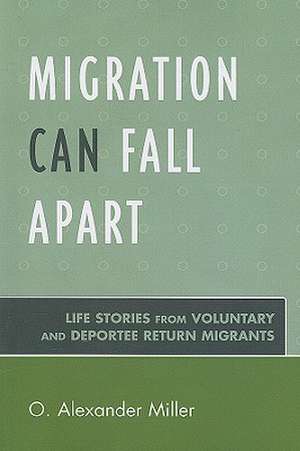
Migration Can Fall Apart: Life Stories from Voluntary and Deportee Return Migrants
Autor O. Alexander Milleren Limba Engleză Paperback – 14 feb 2008
Preț: 273.12 lei
Preț vechi: 378.32 lei
-28%
Puncte Express: 410
Carte tipărită la comandă
Livrare economică 03-17 decembrie
Livrare prin curier în România Termenul estimat este afișat lângă disponibilitate.
Transport gratuit de la 400.00 lei Plată online sau ramburs, în funcție de opțiunile comenzii.
Retur gratuit în 14 zile Comandă securizată și suport în română.
Specificații
ISBN-13: 9780761840008
ISBN-10: 0761840001
Pagini: 140
Dimensiuni: 154 x 229 x 12 mm
Greutate: 0.24 kg
Editura: Bloomsbury Publishing
Colecția University Press of America
Locul publicării:New York, United States
ISBN-10: 0761840001
Pagini: 140
Dimensiuni: 154 x 229 x 12 mm
Greutate: 0.24 kg
Editura: Bloomsbury Publishing
Colecția University Press of America
Locul publicării:New York, United States
Cuprins
Part 1 Foreword
Part 2 Preface
Chapter 3 Introduction
Chapter 4 Silly Me for Thinking Migration Would Overcome Colonial Prejudices
Chapter 5 You Look Like a Fool Returning with Nothing: Involuntary Return Migrants
Chapter 6 Colonial Capital matters: A Comparison of Voluntary & Involuntary Return Migrants
Chapter 7 Conclusion
Part 8 Appendices
Part 9 Bibliography
Part 10 Index
Part 11 About the Author
Part 2 Preface
Chapter 3 Introduction
Chapter 4 Silly Me for Thinking Migration Would Overcome Colonial Prejudices
Chapter 5 You Look Like a Fool Returning with Nothing: Involuntary Return Migrants
Chapter 6 Colonial Capital matters: A Comparison of Voluntary & Involuntary Return Migrants
Chapter 7 Conclusion
Part 8 Appendices
Part 9 Bibliography
Part 10 Index
Part 11 About the Author
Recenzii
This book is clearly written, the specific life stories of the interviewees are given strong representation so that the reader can make an independent judgment, and there are useful reflections on the part of the writer about his subject. It is important for migration scholars and researchers to read this short but very imaginative and suggestive work. It is a welcome addition to the growing body of research-based writings on an increasingly broadly shared global experience.
Miller explicates how it comes about that returnees who vary widely in their achievements abroad, and who vary in their Jamaican social origins, may face rejection by stay-at-home Jamaicans. Miller concludes that only a minority of return migrants can accurately be described as truly transnational migrants. With this finding he cautions against an overly zealous attribution of transnational explanations in the study of return migration.
Miller explicates how it comes about that returnees who vary widely in their achievements abroad, and who vary in their Jamaican social origins, may face rejection by stay-at-home Jamaicans. Miller concludes that only a minority of return migrants can accurately be described as truly transnational migrants. With this finding he cautions against an overly zealous attribution of transnational explanations in the study of return migration.