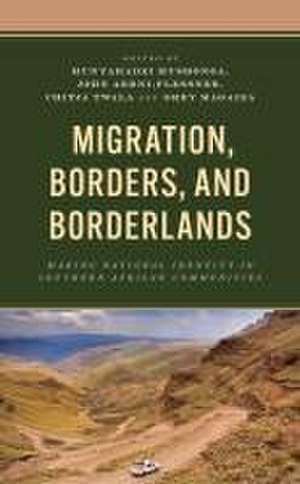
Migration, Borders, and Borderlands: Making National Identity in Southern African Communities
Editat de Munyaradzi Mushonga, John Aerni-Flessner, Chitja Twala, Grey Magaiza Contribuţii de Stephanie Cawood, Ana Guardião, Victor Simões Henrique, Teverayi Muguti, Francis Musoni, Nicholas Nyachega, Michael G. Panzer, Cristina Udelsmann Rodrigues, Mwaka Siluonde, Xolani Tshabalalaen Limba Engleză Hardback – 30 oct 2023
Preț: 598.08 lei
Preț vechi: 912.72 lei
-34%
Puncte Express: 897
Carte tipărită la comandă
Livrare economică 18 noiembrie-02 decembrie
Livrare prin curier în România Termenul estimat este afișat lângă disponibilitate.
Transport gratuit pentru acest produs Plată online sau ramburs, în funcție de opțiunile comenzii.
Retur gratuit în 14 zile Comandă securizată și suport în română.
Specificații
ISBN-13: 9781666942804
ISBN-10: 1666942804
Pagini: 324
Ilustrații: 14 b/w photos; 1 tables;
Dimensiuni: 158 x 236 x 24 mm
Greutate: 0.64 kg
Editura: Bloomsbury Publishing
Colecția Lexington Books
Locul publicării:New York, United States
ISBN-10: 1666942804
Pagini: 324
Ilustrații: 14 b/w photos; 1 tables;
Dimensiuni: 158 x 236 x 24 mm
Greutate: 0.64 kg
Editura: Bloomsbury Publishing
Colecția Lexington Books
Locul publicării:New York, United States
Cuprins
Acknowledgments
Introduction: Migration, Borders, and Borderlands in Southern Africa in Historical Perspective by Munyaradzi Mushonga, John Aerni-Flessner, Chitja Twala, and Grey Magaiza
Part 1: Bordermaking, Smuggling, and Contemporary Resonances
Chapter 1: "Putting Gunboats on the Lake": Frelimo's Guerrilla War and Malawi's Border Dispute with Tanzania in the 1960s by Michael G. Panzer
Chapter 2: Permit-less Crossing and Tourism: Constructing Border Regimes in the Drakensberg Mountains, 1950s-Present by John Aerni-Flessner
Chapter 3: Posted Passports and Fake Stamps: Documented Mobility, Invisibility, and the Informal Enforcement of South Africa's Border with Zimbabwe by Xolani Tshabalala
Chapter 4: Contested Borderscapes, Border Farms, and Guided Travels in Zimbabwe's Struggle for Self-Rule, 1960-1970s by Nicholas Nyachega
Part 2: (Im)Mobilities, Transnational Communities, and Settlement
Chapter 5: "The River is a Natural Resource, not a Border?" Understanding Tonga Borderland Community Res
Introduction: Migration, Borders, and Borderlands in Southern Africa in Historical Perspective by Munyaradzi Mushonga, John Aerni-Flessner, Chitja Twala, and Grey Magaiza
Part 1: Bordermaking, Smuggling, and Contemporary Resonances
Chapter 1: "Putting Gunboats on the Lake": Frelimo's Guerrilla War and Malawi's Border Dispute with Tanzania in the 1960s by Michael G. Panzer
Chapter 2: Permit-less Crossing and Tourism: Constructing Border Regimes in the Drakensberg Mountains, 1950s-Present by John Aerni-Flessner
Chapter 3: Posted Passports and Fake Stamps: Documented Mobility, Invisibility, and the Informal Enforcement of South Africa's Border with Zimbabwe by Xolani Tshabalala
Chapter 4: Contested Borderscapes, Border Farms, and Guided Travels in Zimbabwe's Struggle for Self-Rule, 1960-1970s by Nicholas Nyachega
Part 2: (Im)Mobilities, Transnational Communities, and Settlement
Chapter 5: "The River is a Natural Resource, not a Border?" Understanding Tonga Borderland Community Res
Recenzii
[The]... authors manage to clarify the complex and shifting factors and outcomes
of the unique border policies, histories, regulations, and cultures of the region, managing to
capture the complexity of borders and migration in the region, particularly both existential
but also tangible ramifications that state regulation of borders - typically in unequal, punitive,
and prejudicial policies - have on local communities around the borders.
Migration, Borders, and Borderlands is a distinctive work characterized by historical nuances of various aspects of borders and migrations. Most of the existing books on borders, migrations and attendant disputes and conflicts are largely pivoted on the present, but this volume takes us back to detailed historical case studies that are as enlightening as they are groundbreaking. This is a most welcomed addition to the studies of borders in Southern African historiography and will definitely appeal to a wide audience of readers across disciplines.
Mushonga, Aerni-Flessner, Twala, and Magaiza present a compelling collection of nuanced analyses of the complex and enduring legacies of borders in Southern Africa. In their robust critical engagement with several borderlands, the contributors provide novel insights into the agentic ways in which borders are traversed, manipulated, endured, and undermined by their constituent communities. It sets a new benchmark for historical and contemporary inquiry on borders and identity formation in the region and is likely to become a standard reference for future research.
The book provides interesting historical insights on borders and mobility in Southern Africa. This is a welcome contribution to the emerging scholarship on mobility and borders in countries of the south, away from the usual focus on Europe and North America.
of the unique border policies, histories, regulations, and cultures of the region, managing to
capture the complexity of borders and migration in the region, particularly both existential
but also tangible ramifications that state regulation of borders - typically in unequal, punitive,
and prejudicial policies - have on local communities around the borders.
Migration, Borders, and Borderlands is a distinctive work characterized by historical nuances of various aspects of borders and migrations. Most of the existing books on borders, migrations and attendant disputes and conflicts are largely pivoted on the present, but this volume takes us back to detailed historical case studies that are as enlightening as they are groundbreaking. This is a most welcomed addition to the studies of borders in Southern African historiography and will definitely appeal to a wide audience of readers across disciplines.
Mushonga, Aerni-Flessner, Twala, and Magaiza present a compelling collection of nuanced analyses of the complex and enduring legacies of borders in Southern Africa. In their robust critical engagement with several borderlands, the contributors provide novel insights into the agentic ways in which borders are traversed, manipulated, endured, and undermined by their constituent communities. It sets a new benchmark for historical and contemporary inquiry on borders and identity formation in the region and is likely to become a standard reference for future research.
The book provides interesting historical insights on borders and mobility in Southern Africa. This is a welcome contribution to the emerging scholarship on mobility and borders in countries of the south, away from the usual focus on Europe and North America.