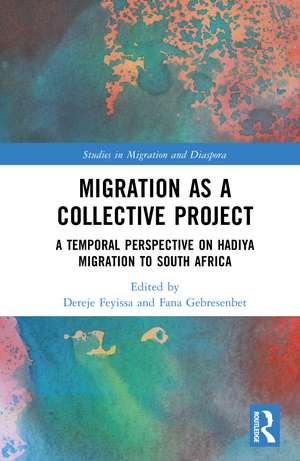
Migration as a Collective Project: A Temporal Perspective on Hadiya Migration to South Africa: Studies in Migration and Diaspora
Editat de Dereje Feyissa, Fana Gebresenbeten Limba Engleză Hardback – 30 apr 2026
Rather than presenting individualism and communalism as opposing forces, the authors conceptualize them as points on a continuum. At the starting end, communal ties are crucial, particularly in the early stages of the Hadiya migration, but over time, as migrants accumulate wealth and encounter increasing competition in South Africa’s informal economy, individualism begins to take precedence, gradually unravelling the social fabric that initially supported collective success. This temporal perspective offers a more nuanced understanding of migration, revealing how it transitions from a collective endeavour to an increasingly individualistic one as circumstances evolve.
A convincing and compelling new volume which highlights the transformation of the migration process from a predominantly collectivist endeavour to one characterized by increased individualism, and the resulting need for a temporal perspective to avoid the pitfalls of a binary framework, it will appeal to scholars and students of migration studies, development studies, sociology and African studies.
Din seria Studies in Migration and Diaspora
- 8%
 Preț: 545.44 lei
 -
 Preț: 460.73 lei
 - 15%
 Preț: 432.33 lei
 -
 Preț: 431.12 lei
 - 15%
 Preț: 462.55 lei
 -
 Preț: 442.89 lei
 - 18%
 Preț: 1118.04 lei
 -
 Preț: 460.39 lei
 - 18%
 Preț: 1117.81 lei
 - 18%
 Preț: 1113.27 lei
 - 18%
 Preț: 1255.33 lei
 -
 Preț: 351.06 lei
 - 18%
 Preț: 1252.16 lei
 - 15%
 Preț: 435.94 lei
 - 18%
 Preț: 1115.87 lei
 -
 Preț: 418.24 lei
 - 15%
 Preț: 434.24 lei
 -
 Preț: 462.43 lei
 -
 Preț: 421.21 lei
 -
 Preț: 444.29 lei
 - 15%
 Preț: 460.99 lei
 - 18%
 Preț: 1112.48 lei
 - 18%
 Preț: 1057.86 lei
 - 18%
 Preț: 1347.43 lei
 - 15%
 Preț: 434.24 lei
 - 15%
 Preț: 476.30 lei
 - 18%
 Preț: 1117.45 lei
 - 18%
 Preț: 1249.23 lei
 - 18%
 Preț: 1112.48 lei
 -
 Preț: 464.26 lei
 - 18%
 Preț: 1110.91 lei
 -
 Preț: 477.10 lei
 - 18%
 Preț: 1115.51 lei
 - 18%
 Preț: 1114.54 lei
 -
 Preț: 463.71 lei
 -
 Preț: 439.09 lei
 -
 Preț: 437.75 lei
Preț: 1300.31 lei
Preț vechi: 1585.75 lei
-18%
Puncte Express: 1950
Carte tipărită la comandă
Livrare economică 28 noiembrie-12 decembrie
Livrare prin curier în România Termenul estimat este afișat lângă disponibilitate.
Transport gratuit pentru acest produs Plată online sau ramburs, în funcție de opțiunile comenzii.
Retur gratuit în 14 zile Comandă securizată și suport în română.
Specificații
ISBN-13: 9781041017363
ISBN-10: 1041017367
Pagini: 234
Ilustrații: 2
Dimensiuni: 152 x 229 mm
Greutate: 0.52 kg
Ediția:1
Editura: Taylor & Francis
Colecția Routledge
Seria Studies in Migration and Diaspora
Locul publicării:Oxford, United Kingdom
ISBN-10: 1041017367
Pagini: 234
Ilustrații: 2
Dimensiuni: 152 x 229 mm
Greutate: 0.52 kg
Ediția:1
Editura: Taylor & Francis
Colecția Routledge
Seria Studies in Migration and Diaspora
Locul publicării:Oxford, United Kingdom
Public țintă
Academic and PostgraduateNotă biografică
Dereje Feyissa Dori holds a PhD in social anthropology from Martin-Luther University, Halle. He has been a fellow at Osaka University, the Max Planck Institute for Social Anthropology, and the Alexander von Humboldt Stiftung. Currently, he serves as Associate Professor at Addis Ababa University and Research & Policy Advisor at the Life and Peace Institute. His research spans ethnicity, conflict, borders, religion, and migration. He is the author or co-editor of several books and peer reviewed journal articles, including Borders and Borderlands as Resources in the Horn of Africa (2010), Playing Different Games (2011), and Ethiopia in the Wake of Political Reform (2020).
Fana Gebresenbet (PhD) is an associate professor of development and peacebuilding, and former Director of the Institute for Peace and Security Studies (IPSS), Addis Ababa University. His research interest primarily focuses on politics of development, political economy, migration, and security studies in Ethiopia and the Horn. He published articles and book chapters on these topics.
Fana Gebresenbet (PhD) is an associate professor of development and peacebuilding, and former Director of the Institute for Peace and Security Studies (IPSS), Addis Ababa University. His research interest primarily focuses on politics of development, political economy, migration, and security studies in Ethiopia and the Horn. He published articles and book chapters on these topics.
Recenzii
'Hadiya Migration to South Africa as a Collective Project offers a strikingly original rethinking of migration. Moving beyond dominant individual‑centered models, it reveals migration as a profoundly collective, culturally grounded, and historically shaped enterprise. Through rich ethnography and an inventive multi‑method approach, the authors illuminate how spiritual narratives, social networks, communal aspirations, and shared capabilities drive one of the most significant South–South migration flows of the past three decades.
Methodologically bold and theoretically generative, this book reframes migration as a dynamic continuum between collective and individual action—challenging entrenched paradigms and opening new directions in Global South migration research.
A must‑read for scholars, practitioners, and policymakers interested in re-examining concepts of mobility, inequality, and collective futures.'
Louis Herns Marcelin, Professor of Anthropology at the University of Maimi and Interuniversity Institute for Research and Development (INURED), Haiti
Dereje and Fana, together with their co-contributors, have produced a remarkable book. It challenges the notion, prevalent in a great deal of academic and policy literature, that migration decisions are undertaken individually, and which tend to favour economic drivers as explanations for decisions to move. Instead, through careful ethnographic and historical analysis they show how Hadiya migration decisions form a continuum between collective and individual, where even a single person’s decisions are always conditioned by the collective values, stigmas, and meanings associated with movement. This is a strong contribution to the literature on migration decision-making, the anthropology of Ethiopia and South Africa, and the dynamics that underly historical processes of social change. Beautifully written, meticulously evidenced, it is a masterpiece from some of the best migration scholars anywhere.
Laura Hammond, Deputy Vice Chancellor Research & Knowledge Exchange, SOAS University of London.
This is an excellent and much needed book, challenging dominant theories in migration studies that conceptualise migration as an individualistic and primarily economically motivated endeavour. Drawing on research undertaken by Global South scholars in the context of migration between Ethiopia and South Africa, this book foregrounds the importance of social networks and collective capability as factors shaping both the decision to migrate but also how the 'migration project' unfolds. Highly recommended.
Heaven Crawley, Professor of International Migration at Centre for Trust, Peace and Social Relations, Coventry University.
This scholarly work offers a comprehensive and critical analysis of contemporary African migration, with a particular emphasis on the transformative experiences of Ethiopian migrants in South Africa. Utilizing a multidisciplinary approach that includes extensive interviews and a critical examination of existing migration concepts and theories, the authors present a refreshingly insightful and systematic study. The book challenges conventional wisdom regarding African migration, particularly the assumption that it is profoundly individualistic or predominantly economic in nature or origin. It emphasizes the circular nature of migration, linking home and host countries in a web of relationships, and the significant role collective social networks play in shaping migrants’ decisions and the outcomes of their migration. This valuable resource is recommended for general readers and students of migration.
Shimelis Bonsa Gulema, PhD, Associate Professor of Modern African Affairs, Stony Brook University, New York.
Methodologically bold and theoretically generative, this book reframes migration as a dynamic continuum between collective and individual action—challenging entrenched paradigms and opening new directions in Global South migration research.
A must‑read for scholars, practitioners, and policymakers interested in re-examining concepts of mobility, inequality, and collective futures.'
Louis Herns Marcelin, Professor of Anthropology at the University of Maimi and Interuniversity Institute for Research and Development (INURED), Haiti
Dereje and Fana, together with their co-contributors, have produced a remarkable book. It challenges the notion, prevalent in a great deal of academic and policy literature, that migration decisions are undertaken individually, and which tend to favour economic drivers as explanations for decisions to move. Instead, through careful ethnographic and historical analysis they show how Hadiya migration decisions form a continuum between collective and individual, where even a single person’s decisions are always conditioned by the collective values, stigmas, and meanings associated with movement. This is a strong contribution to the literature on migration decision-making, the anthropology of Ethiopia and South Africa, and the dynamics that underly historical processes of social change. Beautifully written, meticulously evidenced, it is a masterpiece from some of the best migration scholars anywhere.
Laura Hammond, Deputy Vice Chancellor Research & Knowledge Exchange, SOAS University of London.
This is an excellent and much needed book, challenging dominant theories in migration studies that conceptualise migration as an individualistic and primarily economically motivated endeavour. Drawing on research undertaken by Global South scholars in the context of migration between Ethiopia and South Africa, this book foregrounds the importance of social networks and collective capability as factors shaping both the decision to migrate but also how the 'migration project' unfolds. Highly recommended.
Heaven Crawley, Professor of International Migration at Centre for Trust, Peace and Social Relations, Coventry University.
This scholarly work offers a comprehensive and critical analysis of contemporary African migration, with a particular emphasis on the transformative experiences of Ethiopian migrants in South Africa. Utilizing a multidisciplinary approach that includes extensive interviews and a critical examination of existing migration concepts and theories, the authors present a refreshingly insightful and systematic study. The book challenges conventional wisdom regarding African migration, particularly the assumption that it is profoundly individualistic or predominantly economic in nature or origin. It emphasizes the circular nature of migration, linking home and host countries in a web of relationships, and the significant role collective social networks play in shaping migrants’ decisions and the outcomes of their migration. This valuable resource is recommended for general readers and students of migration.
Shimelis Bonsa Gulema, PhD, Associate Professor of Modern African Affairs, Stony Brook University, New York.
Cuprins
INTRODUCTION: Hadiya Migration to South Africa as a Collective Project: A Temporal Perspective [Dereje Feyissa and Fana Gebresenbet] PART I: ASSEMBLING MIGRATION AS A COLLECTIVE PROJECT Chapter 1: Marginalization and Migration: Sociopolitical Roots of Hadiya Mobility to South Africa [Dereje Feyissa] Chapter 2: Collectivising Imagination and Aspiration among the Hadiya [Fana Gebresenbet, Temesgen Yaecob and Abraham Abebe] Chapter 3: Sacred Imagination and Capability: The Spirituality of Hadiya Migration to South Africa [Dereje Feyissa] Chapter 4: Between Autonomy and Assistance: The Dynamics of Decision-Making Regarding Child Migration [Meron Zeleke] PART II: RIDING THE PERKS OF COLLECTIVE MIGRATION PROJECTS Chapter 5: Hadiya Migrant Businesses in South Africa: The Price of Success [Tanja Zack and Abraham Abebe] Chapter 6: Transnational Flow of Finance in the Hadiya-South Africa Corridor [Dereje Feyissa] Chapter 7: Migration and Urbanization: South Africa in Hosanna [Fana Gebresenbet and Dereje Feyissa] PART III: PROCESSES OF INDIVIDUALIZATION OF A COLLECTIVE MIGRATION PROJECT Chapter 8: Migration from a Blessing into a Curse: Impact on Education, Rural Economy and Governance [Fana Gebresenbet and Abraham Abebe] Chapter 9: Hadiya Migration to South Africa: An Increasingly Violent Corridor [Dereje Feyissa and Abraham Abebe]
Descriere
This book seeks to broaden the conversation in migration studies by incorporating a collective perspective, as illustrated by the case study of Hadiya migration from Southern Ethiopia to South Africa.