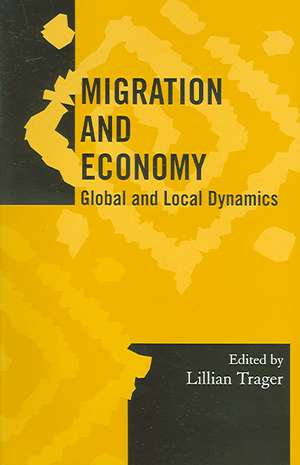
Migration and Economy: Global and Local Dynamics: Society for Economic Anthropology Monograph Series
Editat de Lillian Trager Contribuţii de Ricardo Perez, Dolores Koenig, Jeffrey Cohen, Meltem Sancak, Peter Finke, Sasha Newell, Silvia Grigolini, Stephen Lubkemann, Robyn Eversoleen Limba Engleză Paperback – 5 oct 2005




Preț: 318.61 lei
Preț vechi: 391.45 lei
-19%
Puncte Express: 478
Carte tipărită la comandă
Livrare economică 07-21 decembrie
Livrare prin curier în România Termenul estimat este afișat lângă disponibilitate.
Transport gratuit de la 400.00 lei Plată online sau ramburs, în funcție de opțiunile comenzii.
Retur gratuit în 14 zile Comandă securizată și suport în română.
Specificații
ISBN-13: 9780759107755
ISBN-10: 0759107750
Pagini: 332
Dimensiuni: 188 x 226 x 21 mm
Greutate: 0.53 kg
Editura: Bloomsbury Publishing
Colecția AltaMira Press
Seria Society for Economic Anthropology Monograph Series
Locul publicării:New York, United States
ISBN-10: 0759107750
Pagini: 332
Dimensiuni: 188 x 226 x 21 mm
Greutate: 0.53 kg
Editura: Bloomsbury Publishing
Colecția AltaMira Press
Seria Society for Economic Anthropology Monograph Series
Locul publicării:New York, United States
V-ar putea interesa
-
 -27%Preț: 496.76 lei681.64 lei
 -
 -27%Preț: 407.53 lei558.33 lei
 -
 The Devil's Highway: A True StoryLuis Alberto Urrea-26%Preț: 84.75 lei114.52 lei
 -
 Asylum Seekers and Refugees in the Contemporary WorldDavid J. WhittakerPreț: 390.32 lei
 -
 Growing SeasonGary HarwoodPreț: 196.34 lei
 -
 Forced Migration and Global PoliticsAlexander BettsPreț: 339.15 lei
 -
 Trafficking and Global Crime ControlMaggy LeePreț: 438.26 lei
 -
 -27%Preț: 1023.88 lei1396.02 lei
 -
 Fortress EuropeMatthew Carr-17%Preț: 85.67 lei103.59 lei
 -
 -18%Preț: 150.90 lei184.66 lei
 -
 -22%Preț: 231.83 lei297.72 lei
Cuprins
Chapter 1 Introduction: The Dynamics of Migration
Part 2 Part I. Migration, Households, and Stratification
Chapter 3 1. Unbound Households: Trajectories of Labor, Migration, and Transnational Livelihoods in (and from) Southern Puerto Rico
Chapter 4 2. Multilocality and Social Stratification in Kita, Mali
Chapter 5 3. Non-migrant Households in Oaxaca, Mexico: Why Some People Stay While Others Leave
Chapter 6 4. Migration and Risk-Taking: A Case Study from Kazakstan
Chapter 7 5. Migratory Modernity and the Cosmology of Consumption in Côte d'Ivoire
Part 8 Part II. Remittances and Beyond
Chapter 9 6. When Houses Provide More than Shelter: Analyzing the Uses of Remittances within their Socio-cultural Context
Chapter 10 7. Women Migrants and Hometown Linkages in Nigeria: Status, Economic Roles and Contributions to Community Development
Chapter 11 8. The Moral Economy of Non-Return Among Socially-Diverted Labor Migrants from Portugal and Mozambique
Chapter 12 9. "Direct to the Poor" Revisted: Migrant Remittances and Development Assistance
Part 2 Part I. Migration, Households, and Stratification
Chapter 3 1. Unbound Households: Trajectories of Labor, Migration, and Transnational Livelihoods in (and from) Southern Puerto Rico
Chapter 4 2. Multilocality and Social Stratification in Kita, Mali
Chapter 5 3. Non-migrant Households in Oaxaca, Mexico: Why Some People Stay While Others Leave
Chapter 6 4. Migration and Risk-Taking: A Case Study from Kazakstan
Chapter 7 5. Migratory Modernity and the Cosmology of Consumption in Côte d'Ivoire
Part 8 Part II. Remittances and Beyond
Chapter 9 6. When Houses Provide More than Shelter: Analyzing the Uses of Remittances within their Socio-cultural Context
Chapter 10 7. Women Migrants and Hometown Linkages in Nigeria: Status, Economic Roles and Contributions to Community Development
Chapter 11 8. The Moral Economy of Non-Return Among Socially-Diverted Labor Migrants from Portugal and Mozambique
Chapter 12 9. "Direct to the Poor" Revisted: Migrant Remittances and Development Assistance
Recenzii
This volume is an important addition to the literature on migration. It makes a valuable claim for the contributions of anthropology to an understanding of economic dimensions of migration. Several essays also contribute to a growing literature on the meaning and impact of return migration and remittances on sending communities. Above all else the essays in this volume are clearly written and well-grounded in rich ethnographic data from a number of places around the world.
This volume is a much-needed contribution to our understanding of migration dynamics. It is especially valuable for providing detailed case studies from across the globe that highlight how local contexts profoundly shape a given migrant process. It includes extremely well grounded ethnographic data from extremely diverse cases (Kazakhstan, Puerto Rico, African nations, Latin America), not just the countries we usually hear about in discussions of migration. In particular the strength of the articles on African cases add a completely new picture to migration studies, as this region is so often left out. Yet, reading the entire collection of articles illuminates ways to explore migration from a comparative perspective, and to find issues that echo cross-culturally without losing the insights gained from each case study. The volume is a genuinely new and different contribution with far-reaching implications for migration studies. Important themes revealed throughout the volume include 1) the negotiation processes between migrants and home communities - whether it's negotiation over material, social or symbolic systems, 2) the context-specific potential for beneficial outcomes to sending communities of migration and 3) the need to examine a variety of types o
This volume is a much-needed contribution to our understanding of migration dynamics. It is especially valuable for providing detailed case studies from across the globe that highlight how local contexts profoundly shape a given migrant process. It includes extremely well grounded ethnographic data from extremely diverse cases (Kazakhstan, Puerto Rico, African nations, Latin America), not just the countries we usually hear about in discussions of migration. In particular the strength of the articles on African cases add a completely new picture to migration studies, as this region is so often left out. Yet, reading the entire collection of articles illuminates ways to explore migration from a comparative perspective, and to find issues that echo cross-culturally without losing the insights gained from each case study. The volume is a genuinely new and different contribution with far-reaching implications for migration studies. Important themes revealed throughout the volume include 1) the negotiation processes between migrants and home communities - whether it's negotiation over material, social or symbolic systems, 2) the context-specific potential for beneficial outcomes to sending communities of migration and 3) the need to examine a variety of types of mobility (internal, international, long term, short term, external incentives, internal incentives, etc) in order to better grasp this profoundly important phenomenon of our contemporary world. The volume is an excellent source for researchers and scholars on recent research on migration, and will also be extremely useful in the classroom for courses on globalization, migration, economic development, and economic anthropology.
This volume is a much-needed contribution to our understanding of migration dynamics. It is especially valuable for providing detailed case studies from across the globe that highlight how local contexts profoundly shape a given migrant process. It includes extremely well grounded ethnographic data from extremely diverse cases (Kazakhstan, Puerto Rico, African nations, Latin America), not just the countries we usually hear about in discussions of migration. In particular the strength of the articles on African cases add a completely new picture to migration studies, as this region is so often left out. Yet, reading the entire collection of articles illuminates ways to explore migration from a comparative perspective, and to find issues that echo cross-culturally without losing the insights gained from each case study. The volume is a genuinely new and different contribution with far-reaching implications for migration studies. Important themes revealed throughout the volume include 1) the negotiation processes between migrants and home communities - whether it's negotiation over material, social or symbolic systems, 2) the context-specific potential for beneficial outcomes to sending communities of migration and 3) the need to examine a variety of types o
This volume is a much-needed contribution to our understanding of migration dynamics. It is especially valuable for providing detailed case studies from across the globe that highlight how local contexts profoundly shape a given migrant process. It includes extremely well grounded ethnographic data from extremely diverse cases (Kazakhstan, Puerto Rico, African nations, Latin America), not just the countries we usually hear about in discussions of migration. In particular the strength of the articles on African cases add a completely new picture to migration studies, as this region is so often left out. Yet, reading the entire collection of articles illuminates ways to explore migration from a comparative perspective, and to find issues that echo cross-culturally without losing the insights gained from each case study. The volume is a genuinely new and different contribution with far-reaching implications for migration studies. Important themes revealed throughout the volume include 1) the negotiation processes between migrants and home communities - whether it's negotiation over material, social or symbolic systems, 2) the context-specific potential for beneficial outcomes to sending communities of migration and 3) the need to examine a variety of types of mobility (internal, international, long term, short term, external incentives, internal incentives, etc) in order to better grasp this profoundly important phenomenon of our contemporary world. The volume is an excellent source for researchers and scholars on recent research on migration, and will also be extremely useful in the classroom for courses on globalization, migration, economic development, and economic anthropology.