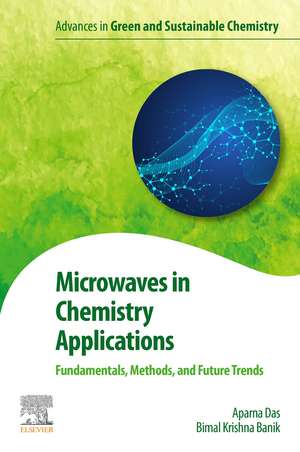
Microwaves in Chemistry Applications: Fundamentals, Methods and Future Trends: Advances in Green and Sustainable Chemistry
Autor Aparna Das, Bimal Baniken Limba Engleză Paperback – 12 mai 2021
Beginning with an introduction to microwave chemistry, Part One discusses foundational principles, equipment and approaches for modeling reactions and assessing the outputs of those models. Methods in microwave chemistry are then the focus of Part Two, with microwave-assisted synthesis, catalysis, reduction and reactions all explored in detail. Part Three reflects on the practical usage of these methods to address specific issues, covering a number of interesting applications.
- Provides guidance on the modeling and interpretation of microwave effects
- Discusses microwave chemistry in the context of green chemistry principles
- Outlines a range of important microwave methods, including microwave-assisted synthesis, catalysis, reactions and reductions
Din seria Advances in Green and Sustainable Chemistry
- 25%
 Preț: 1174.19 lei
 - 25%
 Preț: 1277.18 lei
 - 9%
 Preț: 635.84 lei
 - 26%
 Preț: 1124.37 lei
 - 26%
 Preț: 1060.22 lei
 - 26%
 Preț: 1062.30 lei
 - 26%
 Preț: 1037.68 lei
 - 26%
 Preț: 1248.84 lei
 - 26%
 Preț: 1125.31 lei
 - 31%
 Preț: 1125.91 lei
 - 26%
 Preț: 991.37 lei
 - 26%
 Preț: 994.16 lei
 - 26%
 Preț: 1011.48 lei
 - 31%
 Preț: 1010.31 lei
 - 26%
 Preț: 1259.46 lei
 - 26%
 Preț: 1121.98 lei
 - 30%
 Preț: 1291.73 lei
 - 24%
 Preț: 1026.22 lei
 - 26%
 Preț: 1001.40 lei
 - 30%
 Preț: 1013.13 lei
 - 9%
 Preț: 994.53 lei
 - 30%
 Preț: 1037.42 lei
Preț: 1008.81 lei
Preț vechi: 1454.28 lei
-31%
Puncte Express: 1513
Carte tipărită la comandă
Livrare economică 01-15 decembrie
Livrare prin curier în România Termenul estimat este afișat lângă disponibilitate.
Transport gratuit pentru acest produs Plată online sau ramburs, în funcție de opțiunile comenzii.
Retur gratuit în 14 zile Comandă securizată și suport în română.
Specificații
ISBN-13: 9780128228951
ISBN-10: 0128228954
Pagini: 410
Ilustrații: Approx. 100 illustrations
Dimensiuni: 152 x 229 mm
Greutate: 0.55 kg
Editura: ELSEVIER SCIENCE
Seria Advances in Green and Sustainable Chemistry
ISBN-10: 0128228954
Pagini: 410
Ilustrații: Approx. 100 illustrations
Dimensiuni: 152 x 229 mm
Greutate: 0.55 kg
Editura: ELSEVIER SCIENCE
Seria Advances in Green and Sustainable Chemistry
Cuprins
1. Foundational principles of microwave chemistry
2. Microwave equipment for chemistry
3. Modelling and interpreting microwave effects
4. Microwave-assisted synthesis of oxygen and sulphur heterocycles
5. Microwave-assisted synthesis of nitrogen heterocycles
6. Microwave-Assisted Oxidation and Reduction Reactions
7. Microwave-Assisted Enzymatic Reactions
8. Microwave-Assisted Sterilization
9. Microwave-enhanced CVD processes for diamond synthesis
10. Future trends in microwave chemistry and biology
2. Microwave equipment for chemistry
3. Modelling and interpreting microwave effects
4. Microwave-assisted synthesis of oxygen and sulphur heterocycles
5. Microwave-assisted synthesis of nitrogen heterocycles
6. Microwave-Assisted Oxidation and Reduction Reactions
7. Microwave-Assisted Enzymatic Reactions
8. Microwave-Assisted Sterilization
9. Microwave-enhanced CVD processes for diamond synthesis
10. Future trends in microwave chemistry and biology
Notă biografică
Aparna Das obtained her PhD degree in Material science/nanophysics from¿Joseph Fourier University based upon the¿work on "Semiconductor Quantum Dots for Opto-chemical Sensor Application? at French Alternative Energies and Atomic Energy Commission (CEA), France. Her postdoctoral experiences include working as a research scientist at the California Nano Systems Institute and Electric Engineering Department, University of California, Los Angeles (UCLA), USA, and as an experienced researcher at the Nanowiring-Marie Curie Initial Training Network, Georg August Universität Göttingen, Germany. Dr Das's research interests include Computer-assisted Physico-chemical methods, quantum mechanical calculations, interdisciplinary science (Biology, Chemistry, and Physics) for drug development,¿computer-aided drug design, microwave applications, photochemical reactions, III-Nitride based chemical sensors, solar cells, optoelectronic devices, synthesis of thin layers and nanostructures including Quantum wells, quantum dots, and nanowires. She is the author of two books and received the young women researcher award, European microscopy society (EMS) outstanding paper awards, and several international fellowships such as the Marie-Curie fellowship, CEA-CNRS research fellowship, and Brain Korea 21 fellowship.