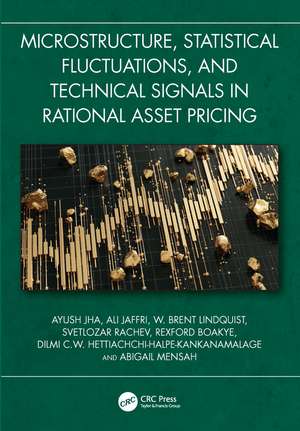
Microstructure, Statistical Fluctuations, and Technical Signals in Rational Asset Pricing
Autor Ayush Jha, Ali Jaffri, W. Brent Lindquist, Svetlozar Rachev, Rexford Boakye, Dilmi C. W. Hettiachchi-Halpe-Kankanamalage, Abigail Mensahen Limba Engleză Hardback – 25 ian 2027
The organizing claim of the book is not that markets are ‘irrational’, but that standard rational finance is frequently implemented with empirically incomplete statistical structure and with an overly idealized information-transmission mechanism.
This book is primarily intended for advanced graduate (Ph.D. and strong M.S.) students and research-oriented practitioners. It is also accessible to advanced undergraduates in mathematics, statistics, financial engineering, and economics, provided they have prior exposure to probability, regression, and basic asset pricing.
Features
- Numerous illustrative examples and worked proofs
- Comprehensive, in-depth coverage of topics
Preț: 907.45 lei
Preț vechi: 1185.94 lei
-23% Precomandă
Puncte Express: 1361
Carte nepublicată încă
Livrare prin curier în România Precomanda se expediază când titlul devine disponibil.
Transport gratuit pentru acest produs Plată online sau ramburs, în funcție de opțiunile comenzii.
Retur gratuit în 14 zile Comandă securizată și suport în română.
Doresc să fiu notificat când acest titlu va fi disponibil:
Se trimite...
Specificații
ISBN-13: 9781041370031
ISBN-10: 1041370032
Pagini: 816
Dimensiuni: 178 x 254 mm
Ediția:1
Editura: CRC Press
Colecția Chapman and Hall/CRC
ISBN-10: 1041370032
Pagini: 816
Dimensiuni: 178 x 254 mm
Ediția:1
Editura: CRC Press
Colecția Chapman and Hall/CRC
Public țintă
Postgraduate and Professional ReferenceCuprins
Section 1: Foundations of Rational Finance with Information Frictions 1. Rational Expectations, No-Arbitrage, and Market Equilibrium 2. Information, Signals, and State Variables in Finance 3. Asset Pricing with Frictions, Constraints, and Incomplete Markets Section 2: Price Formation and Market Microstructure 4. Order Flow, Liquidity, and Information Revelation 5. Price Impact, Trading Costs, and Expected Returns 6. Microstructure Noise and Econometric Bias 7. Intraday Dynamics and the Transition to Long Horizon Prices Section 3: Statistical Fluctuations and Econophysics 8. Stylized Facts: Heavy Tails, Scaling, and Volatility Clustering 9. Levy Processes, Long Memory, and Regime Switching 10. Endogenous Risk and Feedback Effects 11. Statistical Physics versus Econometric Identification Section 4: Technical Indicators as Rational Information Filters 12. Trends, Momentum, and State Estimation 13. Volatility Indicators and Risk Forecasting 14. Mean Reversion, Oscillators, and Market Regimes 15. When Technical Predictability Is Spurious Section 5: Financial Econometrics and Learning 16. Filtering, State-Space Models, and Signal Extraction 17. Model Uncertainty, Robust Estimation, and Misspecification 18. Linking Signals to Risk Premia 19. Forecast Evaluation and Economic Significance Section 6: Portfolio Theory with Endogenous Dynamics 20. Portfolio Choice with Time-Varying Risk Premia 21. Dynamic Allocation, Timing, and Rebalancing 22. Liquidity-Aware and Volatility-Targeted Portfolios 23. Stress Testing and Scenario Analysis Section 7: Synthesis and Implications 24. Unified Information-Based Asset Pricing: Introduction 25. What Survives Rationally from Microstructure, Physics, and Technical Analysis 26. Open Problems and Research Frontiers
Notă biografică
Ayush Jha is a Postdoctoral Scholar in Quantitative Finance in the Department of Mathematics and Statistics at Texas Tech University. He received his PhD in Economics from Texas Tech University in 2026. His research interests include financial economics, covering empirical asset pricing, modern portfolio theory, risk management, and topics in macro-finance, time series econometrics, and market microstructure. Ayush's recent publications are featured in the Journal of Behavioral and Experimental Finance, Frontiers of Mathematical Finance, Journal of Fixed Income, the Journal of Portfolio Management, and the Journal of Risk and Financial Management. He is also a co-author of several monographs covering Market Microstructure, Rational Asset Pricing, Behavioral Finance, and Financial Intermediation.
Ali Muqadas Jaffri is an Assistant Professor of Practice in Finance at the College of Business, North Dakota State University (NDSU). He holds a Ph.D. in Economics from Texas Tech University, specializing in Financial Economics, and is a Chartered Financial Analyst (CFA) Charterholder. Before joining academia, Dr. Jaffri built a strong foundation in the financial industry through leadership roles in risk management and financial institutions. He served as Associate Manager of Market Risk at Allied Bank and Manager of Financial Institutions Risk Management at MCB Bank Limited, where he specialized in market, credit, and operational risk frameworks and spearheaded the automation of regulatory reporting systems.
Brent Lindquist is a professor of mathematical finance in the Department of Mathematics and Statistics at Texas Tech University, and co-director of the mathematical finance program. Prior to joining Texas Tech, Dr. Lindquist served as professor in the Department of Applied Mathematics and Statistics at Stony Brook University where he helped lead the transition of that department to one of the top 10 applied math programs in the country. Brent has developed numerical methods for: computational finance; flow in porous media; automated 3D image analyses for porous media, neurons, and fiber mats; Riemann problems in 2D; hierarchy formation in social animal groups; and the numerical solution of Feynman diagrams. He is a co-recipient of the Lee Segal prize from the Society of Mathematical Biology. He is the principal architect of the 3DMA-Rock code which has been commercially licensed. Dr. Lindquist has over 120 publications, has presented his research in 25 countries on five continents, and participated as PI or co-PI in $20M of grant funding. He has supervised 10 postdoctoral fellows and over 40 PhD students.
Svetlozar (Zari) T. Rachev is Professor in the Department of Mathematics and Statistics at Texas Tech University. He earned his Ph.D. in Mathematics from Lomonosov University in Moscow (1979) and his Doctor of Science from the Steklov Mathematical Institute (1986), and has previously held the Frey Family Foundation Chair of Quantitative Finance at Stony Brook University, the Endowed Chair of Statistics, Econometrics and Mathematical Finance at the Karlsruhe Institute of Technology, and a professorship at the University of California, Santa Barbara. He is the author of more than two dozen books and several hundred articles on probability metrics, mass transportation, heavy-tailed and stable Paretian models, option pricing, and risk management, and is the named inventor on five U.S. patents in derivative valuation and portfolio optimization. A Fellow of the Institute of Mathematical Statistics, elected member of the International Statistical Institute, and recipient of the Senior Humboldt Professor Award, he has supervised more than sixty Ph.D. students over the course of his career.
Rexford Boakye is a PhD student in Mathematical Finance at the Department of Mathematics and Statistics, Texas Tech University.
Dilmi C. W. Hettiachchi-Halpe-Kankanamalage is a PhD student in Mathematical Finance at the Department of Mathematics and Statistics, Texas Tech University.
Abigail Mensah is a PhD student in Mathematical Finance at the Department of Mathematics and Statistics, Texas Tech University.
Ali Muqadas Jaffri is an Assistant Professor of Practice in Finance at the College of Business, North Dakota State University (NDSU). He holds a Ph.D. in Economics from Texas Tech University, specializing in Financial Economics, and is a Chartered Financial Analyst (CFA) Charterholder. Before joining academia, Dr. Jaffri built a strong foundation in the financial industry through leadership roles in risk management and financial institutions. He served as Associate Manager of Market Risk at Allied Bank and Manager of Financial Institutions Risk Management at MCB Bank Limited, where he specialized in market, credit, and operational risk frameworks and spearheaded the automation of regulatory reporting systems.
Brent Lindquist is a professor of mathematical finance in the Department of Mathematics and Statistics at Texas Tech University, and co-director of the mathematical finance program. Prior to joining Texas Tech, Dr. Lindquist served as professor in the Department of Applied Mathematics and Statistics at Stony Brook University where he helped lead the transition of that department to one of the top 10 applied math programs in the country. Brent has developed numerical methods for: computational finance; flow in porous media; automated 3D image analyses for porous media, neurons, and fiber mats; Riemann problems in 2D; hierarchy formation in social animal groups; and the numerical solution of Feynman diagrams. He is a co-recipient of the Lee Segal prize from the Society of Mathematical Biology. He is the principal architect of the 3DMA-Rock code which has been commercially licensed. Dr. Lindquist has over 120 publications, has presented his research in 25 countries on five continents, and participated as PI or co-PI in $20M of grant funding. He has supervised 10 postdoctoral fellows and over 40 PhD students.
Svetlozar (Zari) T. Rachev is Professor in the Department of Mathematics and Statistics at Texas Tech University. He earned his Ph.D. in Mathematics from Lomonosov University in Moscow (1979) and his Doctor of Science from the Steklov Mathematical Institute (1986), and has previously held the Frey Family Foundation Chair of Quantitative Finance at Stony Brook University, the Endowed Chair of Statistics, Econometrics and Mathematical Finance at the Karlsruhe Institute of Technology, and a professorship at the University of California, Santa Barbara. He is the author of more than two dozen books and several hundred articles on probability metrics, mass transportation, heavy-tailed and stable Paretian models, option pricing, and risk management, and is the named inventor on five U.S. patents in derivative valuation and portfolio optimization. A Fellow of the Institute of Mathematical Statistics, elected member of the International Statistical Institute, and recipient of the Senior Humboldt Professor Award, he has supervised more than sixty Ph.D. students over the course of his career.
Rexford Boakye is a PhD student in Mathematical Finance at the Department of Mathematics and Statistics, Texas Tech University.
Dilmi C. W. Hettiachchi-Halpe-Kankanamalage is a PhD student in Mathematical Finance at the Department of Mathematics and Statistics, Texas Tech University.
Abigail Mensah is a PhD student in Mathematical Finance at the Department of Mathematics and Statistics, Texas Tech University.
Descriere
This book develops a research-level framework for rational asset pricing under realistic information frictions, connecting three literatures that are often treated separately: market microstructure, statistical fluctuation models (including scaling, heavy tails, and dependence), and technical signals used in empirical practice.