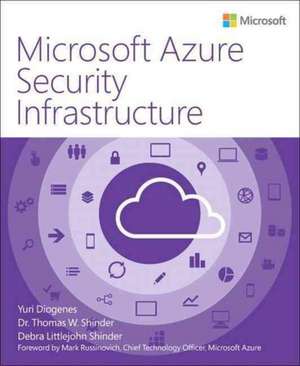
Microsoft Azure Security Infrastructure
Autor Yuri Diogenes, Tom Shinder, Debra Shinderen Limba Engleză Paperback – 28 sep 2024
Recomandăm acest volum profesioniștilor IT și arhitecților de sistem care dețin deja cunoștințe fundamentale de cloud și caută o metodologie riguroasă pentru securizarea infrastructurilor enterprise. Lectura presupune o familiaritate cu conceptele de virtualizare și administrare de sistem, concentrându-se pe implementarea proceselor de conformitate și control în mediul Microsoft Azure. Structura cărții este concepută pentru o progresie logică, pornind de la definirea bazei de responsabilitate partajată și a arhitecturii de apărare în profunzime, continuând cu protecția identității (Azure AD, RBAC) și finalizând cu tehnici avansate de monitorizare și răspuns la incidente. Ca și Marshall Copeland în Cyber Security on Azure, autorii distilează experiență reală în principii acționabile, oferind strategii pentru atenuarea amenințărilor și izolarea breșelor de securitate. Merită menționat că, spre deosebire de lucrarea sa anterioară, Exam Ref Az-500 Microsoft Azure Security Technologies, care este un ghid strict pentru examenul de certificare, Microsoft Azure Security Infrastructure se concentrează pe operațiunile de zi cu zi și pe designul unei infrastructuri reziliente. Reținem abordarea practică a unor servicii critice precum Azure Key Vault pentru gestionarea cheilor criptografice și utilizarea Azure Security Center pentru protecția resurselor hibride. De asemenea, integrarea unor scenarii specifice pentru Internet of Things (IoT) și investigații digitale oferă o perspectivă completă asupra peisajului modern de securitate cibernetică, transformând conceptele teoretice în fluxuri de lucru operaționale.
Preț: 180.60 lei
Preț vechi: 225.74 lei
-20%
Carte disponibilă
Livrare economică 07-21 noiembrie
Livrare express 24-30 octombrie pentru 28.50 lei
Specificații
ISBN-10: 150930357X
Pagini: 224
Dimensiuni: 195 x 235 x 13 mm
Greutate: 0.44 kg
Ediția:1. Auflage
Editura: Microsoft Press
V-ar putea interesa
-
 Exam Ref AZ-500 Microsoft Azure Security TechnologiesYuri Diogenes-20%Preț: 261.89 lei327.37 lei
 -
 Exam Ref AZ-103 Microsoft Azure AdministratorJonathan Tuliani-20%Preț: 240.20 lei300.26 lei
 -
 -20%Preț: 236.79 lei295.98 lei
 -
 -20%Preț: 205.04 lei256.30 lei
 -
 Microsoft Azure Monitoring & Management: The Definitive GuideAvinash Valiramani-20%Preț: 237.84 lei297.30 lei
 -
 -20%Preț: 241.79 lei302.24 lei
 -
 Designing and Developing Secure Azure SolutionsMichael Howard-20%Preț: 261.63 lei327.03 lei
 -
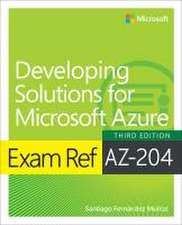 Exam Ref Az-204 Developing Solutions for Microsoft AzureSantiago Munoz-20%Preț: 294.38 lei367.98 lei
 -
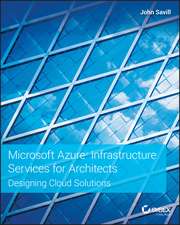 -20%Preț: 303.98 lei379.98 lei
 -
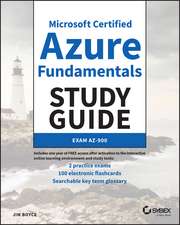 -20%Preț: 237.67 lei297.09 lei
 -
 Threat Hunting in the CloudChris Peiris-20%Preț: 250.68 lei313.35 lei
 -
 Preț: 308.19 lei
 -
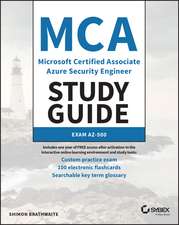 MCA Microsoft Certified Associate Azure Security Engineer Study GuideShimon Brathwaite-20%Preț: 303.92 lei379.90 lei
 -
 Microsoft Azure For DummiesJack A. Hyman-20%Preț: 179.03 lei223.79 lei
 -
 -33%Preț: 178.37 lei267.71 lei
 -
 Securing Microsoft Azure OpenAIKarl Ots-20%Preț: 330.15 lei412.69 lei
 -
 -20%Preț: 202.86 lei253.58 lei
 -
 Azure SecurityBojan Magusic-20%Preț: 340.41 lei425.52 lei
De ce să citești această carte
Această carte este esențială pentru inginerii care trebuie să asigure conformitatea și securitatea datelor într-un mediu cloud public sau hibrid. Cititorul câștigă competențe directe în configurarea mecanismelor de control al accesului, criptare și protecție a rețelelor. Este un ghid tehnic care oferă soluții concrete pentru protejarea sarcinilor de lucru critice, fiind ideal pentru trecerea de la administrarea tradițională la SecOps în Azure.
Despre autor
Yuri Diogenes este un expert recunoscut în securitatea informației, deținător al unei diplome de master și autor a peste zece cărți tehnice publicate internațional. Cu o experiență vastă ca instructor certificat și fost profesor universitar, Diogenes s-a specializat în tehnologiile Microsoft, fiind o prezență constantă la conferințele de profil. Portofoliul său include ghiduri de referință pentru certificările Azure, precum Exam Ref Az-500 Microsoft Azure Security Technologies, dar și resurse pentru dezvoltarea carierei în domeniu, cum este Building a Career in Cybersecurity.
Descriere scurtă
Notă biografică
DR. THOMAS SHINDER is a program manager in Azure Security Engineering and a 20-year veteran in IT security. Tom is best known for his work with ISA Server and TMG, publishing nine books on those topics. He was also the leading voice at ISAserver.org. After joining Microsoft in 2009, Tom spent time on the UAG DirectAccess team and then took a 3-year vacation from security to be a cloud infrastructure specialist and architect. He's now back where he belongs in security, and spends a good deal of time hugging his Azure Security Center console and hiding his secrets in Azure Key Vault.
DEBRA LITTLEJOHN SHINDER, MCSE, is a former police officer and police academy instructor who is self-employed as a technol�ogy consultant, trainer, and writer, specializing in network and cloud security. She has authored a number of books, including Scene of the Cybercrime: Computer Forensics Handbook (Syngress Publishing, 2002) and Computer Networking Essentials (Cisco Press, 2001). She has co-authored more than 20 additional books and worked as a tech editor, developmental editor, and contributor to more than 15 books. Deb is a lead author for WindowSecurity.com and WindowsNetworking.com, and a long-time contributor to the GFI Software blog and other technology publications, with more than 1,500 published articles in print magazines and on websites. Deb focuses on Microsoft products, and has been awarded the Microsoft MVP (Most Valuable Professional) award in the field of enterprise security for 14 years in a row. She lives and works in the Dallas-Fort Worth area and has taught law enforcement, computer networking, and security courses at Eastfield College in Mesquite, Texas. She currently sits on the advisory board of the Eastfield Criminal Justice Training Center Police Academy.
Cuprins
Cloud security considerations
Compliance
Risk management
Identity and access management
Operational security
Endpoint protection
Data protection
Shared responsibility
Cloud computing
Distributed responsibility in public cloud computing
Assume breach and isolation
Azure security architecture
Azure design principles
Chapter 2 Identity protection in Azure
Authentication and authorization
Azure hierarchy
Role-Based Access Control
On-premises integration
Azure AD Connect
Federation
Suspicious activity identification
Identity protection
User risk policy
Sign-in risk policy
Notification enabling
Vulnerabilities
Multi-Factor Authentication
Azure Multi-Factor Authentication implementation
Azure Multi-Factor Authentication option configuration
Chapter 3 Azure network security
Anatomy of Azure networking
Virtual network infrastructure
Network access control
Routing tables
Remote access (Azure gateway/point-to-site VPN/ RDP/Remote PowerShell/SSH)
Cross-premises connectivity
Network availability
Network logging
Public name resolution
Network security appliances
Reverse proxy
Azure Network Security best practices
Subnet your networks based on security zones
Use Network Security Groups carefully
Use site-to-site VPN to connect Azure Virtual Networks
Configure host-based firewalls on IaaS virtual machines
Configure User Defined Routes to control traffic
Require forced tunneling
Deploy virtual network security appliances
Create perimeter networks for Internet-facing devices
Use ExpressRoute
Optimize uptime and performance
Disable management protocols to virtual machines
Enable Azure Security Center
Extend your datacenter into Azure
Chapter 4 Data and storage security
Virtual machine encryption
Azure Disk Encryption
Storage encryption
File share wire encryption
Hybrid data encryption
Authentication
Wire security
Data at rest
Rights management
Database security
Azure SQL Firewall
SQL Always Encrypted
Row-level security
Transparent data encryption
Cell-level encryption
Dynamic data masking
Chapter 5 Virtual machine protection with Antimalware
Understanding the Antimalware solution
Antimalware deployment
Antimalware deployment to an existing VM
Antimalware deployment to a new VM n