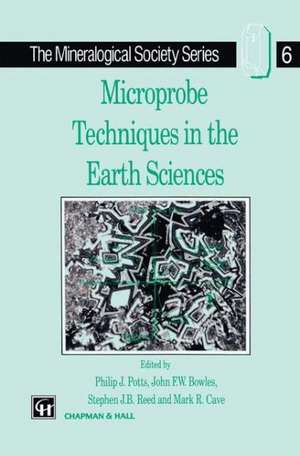
Microprobe Techniques in the Earth Sciences: The Mineralogical Society Series, cartea 6
Editat de Philip J. Potts, J.F. Bowles, Stephen.J. Reed, R. Caveen Limba Engleză Paperback – 31 dec 1995
This text covers the range of microanalytical techniques available for the analysis of geological samples, principally in research applications. Each chapter is written in a clear, informative style and has a tutorial element, designed to introduce each technique for the beginning and experienced researcher alike.


Preț: 913.32 lei
Preț vechi: 1113.81 lei
-18%
Puncte Express: 1370
Carte tipărită la comandă
Livrare economică 07-21 decembrie
Livrare prin curier în România Termenul estimat este afișat lângă disponibilitate.
Transport gratuit pentru acest produs Plată online sau ramburs, în funcție de opțiunile comenzii.
Retur gratuit în 14 zile Comandă securizată și suport în română.
Specificații
ISBN-13: 9780412551000
ISBN-10: 0412551004
Pagini: 419
Ilustrații: XII, 419 p. 47 illus.
Dimensiuni: 155 x 235 x 23 mm
Greutate: 0.58 kg
Ediția:1995
Editura: Springer Us
Colecția Springer
Seria The Mineralogical Society Series
Locul publicării:New York, NY, United States
ISBN-10: 0412551004
Pagini: 419
Ilustrații: XII, 419 p. 47 illus.
Dimensiuni: 155 x 235 x 23 mm
Greutate: 0.58 kg
Ediția:1995
Editura: Springer Us
Colecția Springer
Seria The Mineralogical Society Series
Locul publicării:New York, NY, United States
V-ar putea interesa
-
 -28%Preț: 539.19 lei744.55 lei
 -
 Non-Marine Organic GeochemistryFrederick M. SwainPreț: 458.46 lei
 -
 Geochemical and Biogeochemical Reaction ModelingCraig M. Bethke-9%Preț: 363.21 lei398.68 lei
 -
 The Evolution of MatterIgor Tolstikhin-11%Preț: 507.67 lei570.42 lei
 -
 GeochemistryFrancis Albarède-19%Preț: 501.95 lei619.69 lei
 -
 Using Geochemical Data: Evaluation, Presentation, InterpretationHugh R. Rollinson-15%Preț: 625.22 lei735.55 lei
 -
 Chemistry and the EnvironmentSven E. Harnung-19%Preț: 523.41 lei646.19 lei
 -
 Introduction to GeochemistryKula C. Misra-19%Preț: 427.18 lei527.38 lei
 -
 Gemstones of the World: Newly Revised Fifth EditionWalter Schumann-34%Preț: 137.34 lei207.67 lei
 -
 Analyzing Compositional Data with RK. Gerald van den Boogaart-15%Preț: 472.79 lei556.22 lei
Public țintă
ResearchCuprins
1 Microanalysis from 1950 to the 1990s.- 1.1 Introduction.- 1.2 Microscope methods with image-plane selection.- 1.3 Microprobe methods.- 1.4 The possibilities: primary and secondary beams.- 1.5 Some history.- 1.6 Quantitative analysis.- 1.7 Precision, accuracy and resolution.- 1.8 Other techniques using electrons and/or X-rays.- 1.9 Selected-area mass spectrometry with direct excitation.- 1.10 Selected-area mass spectrometry with indirect excitation.- 1.11 Laser heating.- 1.12 Detection of molecular species.- 1.13 Which technique? Analytical strategy and tactics.- References.- 2 Electron microprobe microanalysis.- 2.1 Introduction.- 2.2 X-ray spectroscopy.- 2.3 Wavelength-dispersive spectrometers.- 2.4 Energy-dispersive spectrometers.- 2.5 The electron column.- 2.6 Scanning and mapping.- 2.7 Qualitative analysis.- 2.8 Quantitative analysis — experimental.- 2.9 Quantitative analysis — data reduction.- References.- Further reading.- 3 Analytical electron microscopy.- 3.1 Introduction.- 3.2 The X-ray analysis of thin specimens.- 3.3 Electron energy-loss spectroscopy.- 3.4 EDS versus EELS.- 3.5 Future directions of AEM instrumentation.- Acknowledgements.- References.- he nuclear microprobe — PIXE, PIGE, RBS, NRA and 141 ERDA.- 4.1 Introduction.- 4.2 The proton microprobe.- 4.3 The PIXE technique.- 4.4 Geological applications of PIXE.- 4.5 Nuclear reaction analysis (NRA) and PIGE.- 4.6 Rutherford backscattering (RBS).- 4.7 Elastic recoil detection analysis (ERDA).- 4.8 Conclusions.- Acknowledgements.- References.- 5 Synchrotron X-ray microanalysis.- 5.1 Introduction.- 5.2 Synchrotron storage rings.- 5.3 Beamline and experimental stations.- 5.4 Specimen preparation.- 5.5 Analysis.- 5.6 Illustrative applications and future advances.- Acknowledgements.- Invitation.-Appendix 5A Notation and abbreviations.- References.- Further reading.- 6 Ion microprobe analysis in geology.- 6.1 Introduction.- 6.2 Instrumentation.- 6.3 Secondary ion production.- 6.4 Analytical procedures.- 6.5 Applications: elemental analysis.- 6.6 Applications: isotopic analysis.- 6.7 Future developments.- Acknowledgements.- References.- 7 Mineral microanalysis by laserprobe inductively coupled plasma mass spectrometry.- 7.1 Introduction.- 7.2 Inductively coupled plasma mass spectrometry.- 7.3 Laser ablation and ICP-MS.- 7.4 Analytical rationale.- 7.5 History of laser ablation analysis.- 7.6 Bulk sampling with LA-ICP-MS: an alternative to solution preparation.- 7.7 Analytical methodology.- 7.8 Detection limits.- 7.9 Applications.- 7.10 Future trends.- 7.11 Conclusions.- References.- 8 Ar-Ar dating by laser microprobe.- 8.1 Introduction.- 8.2 The 40Ar-39Ar dating technique.- 8.3 Estimation of errors.- 8.4 Instrumentation.- 8.5 Methodology.- 8.6 Applications of the laser microprobe technique.- References.- 9 Stable isotope ratio measurement using a laser microprobe.- 9.1 Introduction.- 9.2 Stable isotope geochemistry.- 9.3 Conventional preparation of gases for stable isotope studies.- 9.4 Stable isotope ratio mass spectrometry.- 9.5 Historical development of the laser microprobe.- 9.6 Application of the laser microprobe to stable isotope studies.- 9.7 Instrumentation.- 9.8 Carbon and oxygen isotopic analyses of carbonates.- 9.9 Sulphur isotopic measurements of sulphides.- 9.10 Oxygen isotopic analyses of silicates and oxides.- 9.11 Nitrogen isotope analyses.- 9.12 Conclusions.- 382 Acknowledgements.- References.- 10 Micro-Raman spectroscopy in the Earth Sciences.- 10.1 Introduction.- 10.2 Principles.- 10.3 Instrumentation.- 10.4 Sample handling and routine operation.- 10.5 Advantages and disadvantages of the Raman technique.- 10.6 Some applications of micro-Raman spectroscopy in the Earth Sciences.- 10.7 Other applications of micro-Raman spectroscopy in the Earth Sciences.- 10.8 Other Raman techniques and closing remarks.- Acknowledgements.- References.
Recenzii
...an invaluable research reference and a much needed text for final year undergraduates. - Aslib Book Guide