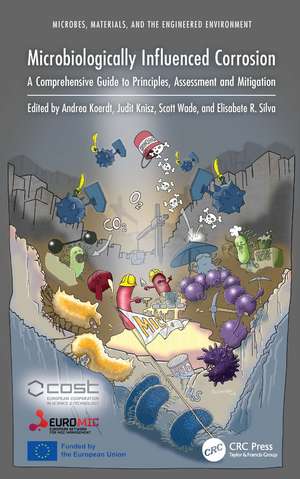
Microbiologically Influenced Corrosion: A Comprehensive Guide to Principles, Assessment and Mitigation: Microbes, Materials, and the Engineered Environment
Editat de Andrea Koerdt, Judit Knisz, Scott Wade, Elisabete R. Silvaen Limba Engleză Hardback – 3 apr 2026
• Addresses the latest findings, methodologies, standards, gaps, and potential improvements.
• Highlights current barriers that need to be overcome and offers solutions to situations not yet found in the literature.
• Explores a variety of sectors affected by MIC.
• Provides guidance on lab-to-field and field-to-lab knowledge transfer to design sustainable solutions.
Written by and aimed at an interdisciplinary audience, this work serves as an essential reference for readers across the materials, chemical, environmental, energy, and related engineering fields as well as microbiologists and biotechnologists seeking to mitigate the negative impact of MIC on industry and livelihoods.
The Open Access version of this book, available at http://www.taylorfrancis.com, has been made available under a Creative Commons Attribution-Non Commercial-No Derivatives (CC-BY-NC-ND) 4.0 license.



Preț: 1210.93 lei
Preț vechi: 1599.52 lei
-24%
Puncte Express: 1816
Carte indisponibilă temporar
Doresc să fiu notificat când acest titlu va fi disponibil:
Se trimite...
Specificații
ISBN-13: 9781032707990
ISBN-10: 1032707992
Pagini: 444
Ilustrații: 142
Dimensiuni: 156 x 234 mm
Greutate: 0.98 kg
Ediția:1
Editura: CRC Press
Colecția CRC Press
Seria Microbes, Materials, and the Engineered Environment
ISBN-10: 1032707992
Pagini: 444
Ilustrații: 142
Dimensiuni: 156 x 234 mm
Greutate: 0.98 kg
Ediția:1
Editura: CRC Press
Colecția CRC Press
Seria Microbes, Materials, and the Engineered Environment
Public țintă
Postgraduate and Professional ReferenceCuprins
0. Front Matter 1. A Brief History of Microbiologically Influenced Corrosion Research with Personal Reflections 2. Microbiologically Influenced Corrosion Principles and Current Perspectives 3. Integrated Analysis and Diagnosis of Corrosion Causes: A Comprehensive Approach Informed by Latest Research and Analytical Techniques 4. Feasibility and Sustainability of MIC Monitoring Methods 5. Methods in MIC Mitigation and Prevention 6. Standardization – What Is the Status of MIC, What is Missing and How Can We Improve It 7. Sector-Specific Insights into Methods for Monitoring and Management of Microbiologically Influenced Corrosion 8. A Case Study Approach - Bridging the Gap between Theory and Practice in Microbiologically Influenced Corrosion Management 9. Current Challenges and the Future of MIC Research End Matter I. Conclusion
Notă biografică
Andrea Koerdt is Senior Scientist and project leader of the MIC project at Bundesanstalt für Materialforschung und –prüfung (BAM), Germany. Since 2016 she has been conducting research at BAM on corrosive methanogenic archaea and sulfate reducing bacteria. She coordinates a team of scientists on MIC and collaborates with industrial and academic partners. She received her PhD from the Max Planck Institute for Terrestrial Microbiology.
Judit Knisz is Senior Research Scientist at the Faculty of Water Sciences, Ludovika University of Public Service, Hungary, where she leads the Environmental Microbiology Research Group. Her research focuses on MIC in drinking water and industrial cooling water systems, applying molecular and microbiological methods and advocating the multiple lines of evidence (MLOE) approach to improve diagnostics and mitigation. She holds a PhD in Biology from the University of Pécs, Hungary.
Scott Wade is Professor in the School of Engineering at Swinburne University of Technology, Australia. Prior to joining Swinburne University he held research positions at a number of universities in the UK and Australia where he worked on applied research including the development of sensing techniques and corrosion studies. He leads a research team investigating various aspects of corrosion, including microbiologically influenced corrosion, accelerated low water corrosion, corrosion sensing, and novel coating development.
Elisabete Silva is an Assistant Professor in the Department of Chemistry and Biochemistry, Faculty of Sciences, University of Lisbon, and head of the Bioactive and Multifunctional Materials Laboratory. She holds a PhD in Chemical Engineering from the University of Lisbon/Instituto Superior Técnico (December 2009). Since 2018, she has founded and leads the Bioactive and Multifunctional Materials Laboratory at FCUL, where, with her team develops multifunctional materials for environmental remediation, biofouling, and MIC prevention/control.
Judit Knisz is Senior Research Scientist at the Faculty of Water Sciences, Ludovika University of Public Service, Hungary, where she leads the Environmental Microbiology Research Group. Her research focuses on MIC in drinking water and industrial cooling water systems, applying molecular and microbiological methods and advocating the multiple lines of evidence (MLOE) approach to improve diagnostics and mitigation. She holds a PhD in Biology from the University of Pécs, Hungary.
Scott Wade is Professor in the School of Engineering at Swinburne University of Technology, Australia. Prior to joining Swinburne University he held research positions at a number of universities in the UK and Australia where he worked on applied research including the development of sensing techniques and corrosion studies. He leads a research team investigating various aspects of corrosion, including microbiologically influenced corrosion, accelerated low water corrosion, corrosion sensing, and novel coating development.
Elisabete Silva is an Assistant Professor in the Department of Chemistry and Biochemistry, Faculty of Sciences, University of Lisbon, and head of the Bioactive and Multifunctional Materials Laboratory. She holds a PhD in Chemical Engineering from the University of Lisbon/Instituto Superior Técnico (December 2009). Since 2018, she has founded and leads the Bioactive and Multifunctional Materials Laboratory at FCUL, where, with her team develops multifunctional materials for environmental remediation, biofouling, and MIC prevention/control.
Descriere
This book offers an interdisciplinary investigation of the interaction between materials science and microbiology to find solutions to adverse effects of MIC. It includes the state of the field, advances in technologies, and guidance for future challenges.