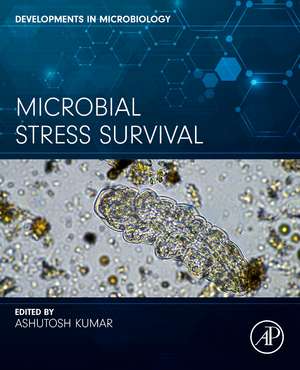
Microbial Stress Survival: Developments in Microbiology
Editat de Ashutosh Kumaren Limba Engleză Paperback – 8 dec 2025
- Discusses the adaptive mechanisms of microbes that allow them to cross the defensive barrier of their host
- Covers the proteins responsible for growth regulation of bacteria during unfavorable conditions
- Examines microbial stress response and adaption to extreme environments
- Explores different bioremediation strategies for the degradation of various types of pollutants
Din seria Developments in Microbiology
- 31%
 Preț: 728.43 lei
 - 27%
 Preț: 914.36 lei
 - 28%
 Preț: 903.40 lei
 - 31%
 Preț: 871.07 lei
 - 9%
 Preț: 870.58 lei
 - 30%
 Preț: 877.87 lei
 - 31%
 Preț: 816.78 lei
 - 5%
 Preț: 779.83 lei
 - 26%
 Preț: 846.87 lei
 - 22%
 Preț: 763.28 lei
 - 30%
 Preț: 885.25 lei
 - 26%
 Preț: 913.90 lei
 - 30%
 Preț: 887.22 lei
 - 26%
 Preț: 853.15 lei
 - 26%
 Preț: 728.80 lei
 - 27%
 Preț: 888.43 lei
 - 5%
 Preț: 923.40 lei
 - 28%
 Preț: 921.83 lei
 - 30%
 Preț: 949.62 lei
 - 31%
 Preț: 895.15 lei
Preț: 904.33 lei
Preț vechi: 1290.00 lei
-30%
Puncte Express: 1356
Carte tipărită la comandă
Livrare economică 25 noiembrie-09 decembrie
Livrare prin curier în România Termenul estimat este afișat lângă disponibilitate.
Transport gratuit pentru acest produs Plată online sau ramburs, în funcție de opțiunile comenzii.
Retur gratuit în 14 zile Comandă securizată și suport în română.
Specificații
ISBN-13: 9780443276224
ISBN-10: 0443276226
Pagini: 612
Dimensiuni: 191 x 235 mm
Greutate: 1.29 kg
Editura: ELSEVIER SCIENCE
Colecția Developments in Microbiology
Seria Developments in Microbiology
ISBN-10: 0443276226
Pagini: 612
Dimensiuni: 191 x 235 mm
Greutate: 1.29 kg
Editura: ELSEVIER SCIENCE
Colecția Developments in Microbiology
Seria Developments in Microbiology
Cuprins
1. Two-component systems of pathogens (Mycobacterium tuberculosis/ Streptococcus pneumoniae/ Salmonella enterica / Helicobacter Pylori etc.) in stress sensing and adaptations
2. Role of lipoproteins in the pathogenesis of Mycobacterium tuberculosis
3. PhoPR two-component system mycobacterial virulence
4. SenX3–regX3 two-component regulatory System proteins in the pathogenesis of Mycobacterium tuberculosis
5. Mycobacterial membrane vesicles in host-pathogen interactions and pathogenesis
6. Different growth regulation strategies of microbes for survival and reactivation during stress
7. Microbial secretion system and quorum sensing
8. Bacteria and biofilms as natural inhabitants of our body and biofilms in chronic infections
9. Molecular level drug tolerance and resistant strategies in a diverse group of pathogenic microbes and the uses of different antimicrobial agents
10. Adaptation to various antimicrobial agent (resistance) stress in diverse pathogenic microbes
11. Adaptation mechanisms in the initiation factors involved in the translation process of thermophilic bacteria
12. Structural adaptations in the of valine--tRNA ligases of different halophiles
13. Molecular evolution steered adaptations in the phosphoglycerate and pyruvate kinase of piezophilic bacteria
14. Recent advances in the survival and adaptation strategies of microbes in extreme radiation
15. Cold dwelling microorganisms – A theory on psychrophilic adaptation
16. Structural adaptations in the CRISPR-Cas of different thermophiles
2. Role of lipoproteins in the pathogenesis of Mycobacterium tuberculosis
3. PhoPR two-component system mycobacterial virulence
4. SenX3–regX3 two-component regulatory System proteins in the pathogenesis of Mycobacterium tuberculosis
5. Mycobacterial membrane vesicles in host-pathogen interactions and pathogenesis
6. Different growth regulation strategies of microbes for survival and reactivation during stress
7. Microbial secretion system and quorum sensing
8. Bacteria and biofilms as natural inhabitants of our body and biofilms in chronic infections
9. Molecular level drug tolerance and resistant strategies in a diverse group of pathogenic microbes and the uses of different antimicrobial agents
10. Adaptation to various antimicrobial agent (resistance) stress in diverse pathogenic microbes
11. Adaptation mechanisms in the initiation factors involved in the translation process of thermophilic bacteria
12. Structural adaptations in the of valine--tRNA ligases of different halophiles
13. Molecular evolution steered adaptations in the phosphoglycerate and pyruvate kinase of piezophilic bacteria
14. Recent advances in the survival and adaptation strategies of microbes in extreme radiation
15. Cold dwelling microorganisms – A theory on psychrophilic adaptation
16. Structural adaptations in the CRISPR-Cas of different thermophiles