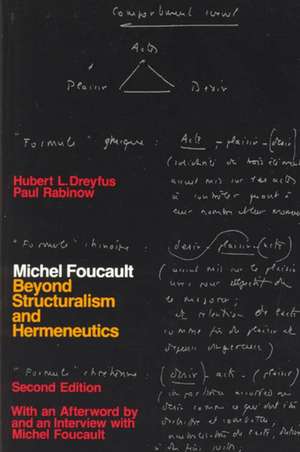
Michel Foucault: Beyond Structuralism and Hermeneutics
Autor Hubert L. Dreyfus, Paul Rabinowen Limba Engleză Paperback – 15 dec 1983
În peisajul academic contemporan, studiul operei lui Michel Foucault ocupă un loc central în programele de filosofie post-structuralistă, sociologie și istoria ideilor. Volumul semnat de Hubert L. Dreyfus și Paul Rabinow, Michel Foucault: Beyond Structuralism and Hermeneutics, se impune ca o resursă fundamentală, fiind prima lucrare care oferă o analiză susținută și coerentă a întregului parcurs foucauldian. Găsim în această carte o tentativă reușită de a demonstra cum gândirea lui Foucault a depășit limitările obiectivismului științific și ale hermeneuticii tradiționale. Autorii propun o nouă metodă, „analitica interpretativă”, capabilă să explice logica structurilor fără a sacrifica înțelegerea profundă a subiectului.
Descoperim aici o structură riguroasă, organizată în jurul evoluției metodologice a lui Foucault. Partea întâi investighează „iluzia discursului autonom”, trecând prin arheologia medicinii și a științelor umane, pentru a culmina cu o analiză critică a eșecului metodologic al arheologiei. Această a doua ediție aduce un plus de valoare prin includerea interviului „On the Genealogy of Ethics”, pe care critica de specialitate îl consideră cea mai bună sursă pentru a înțelege cum și-a configurat Foucault proiectul asupra istoriei sexualității.
Ca alternativă la The Cambridge Companion to Foucault de Gary Gutting pentru cursurile de filosofie contemporană, lucrarea lui Dreyfus și Rabinow are avantajul unei perspective analitice unitare, spre deosebire de caracterul fragmentat al unei colecții de eseuri. În contextul operei lui Hubert L. Dreyfus, care în lucrări precum Background Practices a explorat aplicarea fenomenologiei în studiul minții, acest volum reprezintă o extindere naturală a interesului său pentru modul în care practicile de fundal modelează cunoașterea umană.
Preț: 251.04 lei
Carte tipărită la comandă
Livrare economică 10-24 iulie
Specificații
ISBN-10: 0226163121
Pagini: 256
Dimensiuni: 150 x 226 x 23 mm
Greutate: 0.41 kg
Ediția:Second Edition
Editura: University of Chicago Press
Colecția University of Chicago Press
V-ar putea interesa
-
 Entity and Identity: And other essaysP. F. Strawson-14%Preț: 328.38 lei382.31 lei
 -
 Intermediate LogicDavid Bostock-11%Preț: 384.07 lei431.53 lei
 -
 -11%Preț: 327.66 lei366.34 lei
 -
 Objectivity and InsightMark Sacks-14%Preț: 355.83 lei414.59 lei
 -
 Vagueness and ContradictionRoy Sorensen-15%Preț: 373.89 lei439.24 lei
 -
 Spinoza and SpinozismStuart Hampshire-19%Preț: 378.38 lei465.83 lei
 -
 -12%Preț: 366.38 lei417.16 lei
 -
 -22%Preț: 375.18 lei483.15 lei
 -
 On the Heights of DespairE. M. CioranPreț: 204.64 lei
 -
 The Jealous PotterClaude Lévi-StraussPreț: 225.44 lei
 -
 Understanding Wittgenstein's on CertaintyD. Moyal-Sharrock-15%Preț: 625.45 lei735.83 lei
 -
 What Is Philosophy?Gilles DeleuzePreț: 138.59 lei
 -
 The History of Sexuality: 1Michel Foucault-33%Preț: 60.31 lei90.51 lei
 -
 The History of Sexuality: 2Michel Foucault-21%Preț: 72.57 lei91.61 lei
 -
 The History of Sexuality: 3Michel Foucault-21%Preț: 72.33 lei91.45 lei
 -
 The History of Sexuality: 4Michel Foucault-36%Preț: 136.43 lei211.68 lei
 -
 Irrational ManWilliam BarrettPreț: 94.36 lei
 -
 Critical Realism: Essential ReadingsMargaret Archer-15%Preț: 528.77 lei622.08 lei
 -
 On the InternetHubert L. Dreyfus-20%Preț: 221.77 lei277.21 lei
 -
 Reflections on Fieldwork in MoroccoPaul RabinowPreț: 207.60 lei
 -
 The Cambridge Companion to CarnapMichael FriedmanPreț: 285.04 lei
 -
 Preț: 228.42 lei
 -
 Sources of the SelfCharles TaylorPreț: 287.52 lei
 -
 Pragmatic TurnRichard J BernsteinPreț: 182.54 lei
 -
 Practices of the Self and Spiritual PracticesSergey S. HorujyPreț: 150.36 lei
 -
 The Visible and the InvisibleMaurice Merleau-PontyPreț: 194.82 lei
 -
 Genesis and Structure of Hegel's "Phenomenology of Spirit"Jean HyppolitePreț: 238.10 lei
 -
 The Intellectual LifeA G SertillangesPreț: 119.17 lei
De ce să citești această carte
Această carte este esențială pentru studenții și cercetătorii care doresc să descifreze complexitatea lui Foucault dincolo de etichetele simpliste de „structuralist”. Cititorul câștigă o hartă clară a tranziției de la arheologie la genealogie, beneficiind de un text validat de Foucault însuși. Este un instrument critic care transformă o operă fragmentată într-un sistem coerent de înțelegere a puterii și a subiectivității.
Despre autor
Hubert L. Dreyfus a fost profesor de filosofie la University of California, Berkeley, fiind recunoscut la nivel mondial pentru expertiza sa în fenomenologie și criticile aduse inteligenței artificiale. În lucrări precum Mind Over Machine sau On the Internet, el a analizat impactul tehnologiei asupra educației și comunității umane. În volumul dedicat lui Michel Foucault, Dreyfus își folosește vasta cunoaștere a tradiției europene — de la Heidegger la Merleau-Ponty — pentru a ancora ideile lui Foucault într-un context filosofic accesibil și riguros.
Descriere scurtă
To demonstrate the sense in which Foucault's work is beyond structuralism and hermeneutics, the authors unfold a careful, analytical exposition of his oeuvre. They argue that during the of Foucault's work became a sustained and largely successful effort to develop a new method—"interpretative analytics"—capable fo explaining both the logic of structuralism's claim to be an objective science and the apparent validity of the hermeneutical counterclaim that the human sciences can proceed only by understanding the deepest meaning of the subject and his tradition.
"There are many new secondary sources [on Foucault]. None surpass the book by Hubert Dreyfus and Paul Rabinow. . . . The American paperback edition contains Foucault's 'On the Genealogy of Ethics,' a lucid interview that is now our best source for seeing how he construed the whole project of the history of sexuality."—David Hoy, London Review of Books
Cuprins
List of Abbreviations
Introduction
Part I: The Illusion of Autonomous Discourse
1. Practices and Discourse in Foucault's Early Writings
The History of Madness
The Archaeology of Medicine
2. The Archaeology of the Human Sciences
The Rise of Representation in the Classical Age
Man and His Doubles: The Analytic of Finitude
The Empirical and the Transcendental
The Cogito and the Unthought
The Retreat and Return of the Origin
Conclusion to the Doubles
3. Towards a Theory of Discursive Practice
A Phenomenology to End All Phenomenologies
Beyond Structuralism: From Conditions of Possibility to Conditions of Existence
The Analysis of Discursive Formations
Objects
Enunciative Modalities
The Formation of Concepts
The Formation of Strategies
Historical Transformation: Disorder as a Type of Order
Discursive Strategies and the Social Background
4. The Methodological Failure of Archaeology
Explanatory Power
Beyond Seriousness and Meaning
Conclusion: Double Trouble
Part II: The Genealogy of the Modern Individual: The Interpretive Analytics of Power, Truth, and the Body
5. Interpretive Analytics
Genealogy
History of the Present and Interpretive Analytics
6. From the Repressive Hypothesis to Bio-Power
The Repressive Hypothesis
Bio-Power
7. The Genealogy of the Modern Individual as Object
Three Figures of Punishment
Sovereign Torture
Humanist Reform
Normalizing Detention
Disciplinary Technology
The Objectifying Social Sciences
8. The Genealogy of the Modern Individual as Subject
Sex and Bio-Power
Confessional Technology
The Subjectifying Social Sciences
9. Power and Truth
Power
Meticulous Rituals of Power
Paradigms and Practices
Power and Truth
Conclusion
Questions
Truth
Resistance
Power
Afterword by Michael Foucault:
The Subject and Power
Why Study Power: The Question of the Subject
How Is Power Exercised?
Afterword (1983)
1. On the Genealogy of Ethics: An Overview of Work in Progress
History of the Project
Why the Ancient World Was Not a Golden Age, but What We Can Learn from It Anyway
The Structure of Genealogical Interpretation
From the Classical Self to the Modern Subject
2. Foucault's Interpretive Analytic of Ethics
Methodological Refinements
Interpretive Diagnosis
Genealogy
Archeology
Norms, Reasons, and Bio-Power
Beyond Foucault
Index