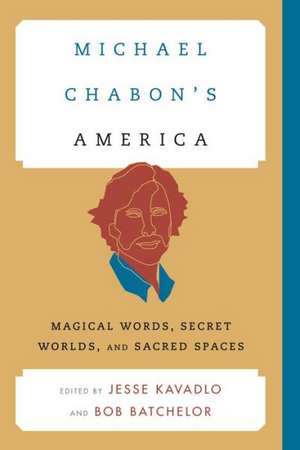
Michael Chabon's America: Magical Words, Secret Worlds, and Sacred Spaces: Contemporary American Literature
Editat de Jesse Kavadlo, Bob Batcheloren Limba Engleză Hardback – 8 iul 2014
Michael Chabon's America: Magical Words, Secret Worlds, and Sacred Spaces is the first scholarly collection of essays analyzing the work of the acclaimed author. This book demonstrates how Chabon uses a broad range of styles and genres, including detective and comic book fiction, to define the American experience. These essays assess and analyze Chabon's complete oeuvre, demonstrating his deep connection to the contemporary world and his place as a literary force.
Providing a context for understanding the author's work from cultural, historical, and stylistic perspectives, Michael Chabon's America is a valuable study of a celebrated author whose work deserves close examination.


Preț: 526.05 lei
Preț vechi: 791.72 lei
-34%
Puncte Express: 789
Carte tipărită la comandă
Livrare economică 08-22 iunie
Specificații
ISBN-13: 9781442236042
ISBN-10: 1442236043
Pagini: 264
Dimensiuni: 161 x 239 x 24 mm
Greutate: 0.54 kg
Editura: Bloomsbury Publishing
Colecția Rowman & Littlefield
Seria Contemporary American Literature
Locul publicării:New York, United States
ISBN-10: 1442236043
Pagini: 264
Dimensiuni: 161 x 239 x 24 mm
Greutate: 0.54 kg
Editura: Bloomsbury Publishing
Colecția Rowman & Littlefield
Seria Contemporary American Literature
Locul publicării:New York, United States
Cuprins
Acknowledgements
Introduction: Bob Batchelor and Jesse Kavadlo
1: Real Maps of Imaginary Worlds; or, Michael Chabon, Shadowtail - Jesse Kavadlo
Chronicling Popular Culture
2: The Dudes Abide: Examining Clinton-Era Identity in Wonder Boys and The Big Lebowski - Bob Batchelor
3: Quentin Tarantino and the Paradox of Popular Culture in Michael Chabon's Telegraph Avenue - John Joseph Hess
4: Driving Away: Muscle Cars, Loss, and Unrequited Travels with Chabon - Charli Valdez
5: "Guess Who I am Now": On Communication and Childhood in Michael Chabon's 'Lost World' Stories - Mike Witcombe
Chabon's Mysteries: Comics and Genre
6: Comix Remix, or, The Strange Case of Mr. Chabon - Stephen Hock
7: "An American Golem:" The Necessity of Myth in The Amazing Adventures of Kavalier & Clay - Seth Johnson
8: The Chatter of an African Gray Parrot: The Final Solution as Postmodern Detective Fiction - Marjorie Worthington
9: Genre for Justice: The Final Solution and The Yiddish Policemen's Union as Reflections of Golden Age Detective Fiction Texts - Monica Lott
Ethnicity, Gender, and Masculinity in Chabon's Oeuvre
10: Michael Chabon's Gentlemen of the Road and the Rejection of Communal Identity as Heroic Quest - Eric Sandberg
11: Solving the Jewish Case: Metaphorical Detection in Michael Chabon's The Final Solution and The Yiddish Policemen's Union - Inbar Kaminsky
12: Not Growing Old but Growing Up: Appropriate Masculine Identity in Michael Chabon's Wonder Boys - Alex Hobbs
13: Queer Masculinities in The Mysteries of Pittsburgh and Manhood for Amateurs - Josef Benson
Chabon's American Expression
14: Michael Chabon's Wonder Boys and Therapeutic Creativity - David McKay Powell
15: American Prowess Deconstructed: Michael Chabon and the Merger of Naturalism and Fantasy - Jake Sudderth
16: "Hope Unfulfilled, Not Yet Betrayed": Michael Chabon's Nostalgia for the Future - Matt Kavanagh
Index
About the Contributors
About the Editors
Introduction: Bob Batchelor and Jesse Kavadlo
1: Real Maps of Imaginary Worlds; or, Michael Chabon, Shadowtail - Jesse Kavadlo
Chronicling Popular Culture
2: The Dudes Abide: Examining Clinton-Era Identity in Wonder Boys and The Big Lebowski - Bob Batchelor
3: Quentin Tarantino and the Paradox of Popular Culture in Michael Chabon's Telegraph Avenue - John Joseph Hess
4: Driving Away: Muscle Cars, Loss, and Unrequited Travels with Chabon - Charli Valdez
5: "Guess Who I am Now": On Communication and Childhood in Michael Chabon's 'Lost World' Stories - Mike Witcombe
Chabon's Mysteries: Comics and Genre
6: Comix Remix, or, The Strange Case of Mr. Chabon - Stephen Hock
7: "An American Golem:" The Necessity of Myth in The Amazing Adventures of Kavalier & Clay - Seth Johnson
8: The Chatter of an African Gray Parrot: The Final Solution as Postmodern Detective Fiction - Marjorie Worthington
9: Genre for Justice: The Final Solution and The Yiddish Policemen's Union as Reflections of Golden Age Detective Fiction Texts - Monica Lott
Ethnicity, Gender, and Masculinity in Chabon's Oeuvre
10: Michael Chabon's Gentlemen of the Road and the Rejection of Communal Identity as Heroic Quest - Eric Sandberg
11: Solving the Jewish Case: Metaphorical Detection in Michael Chabon's The Final Solution and The Yiddish Policemen's Union - Inbar Kaminsky
12: Not Growing Old but Growing Up: Appropriate Masculine Identity in Michael Chabon's Wonder Boys - Alex Hobbs
13: Queer Masculinities in The Mysteries of Pittsburgh and Manhood for Amateurs - Josef Benson
Chabon's American Expression
14: Michael Chabon's Wonder Boys and Therapeutic Creativity - David McKay Powell
15: American Prowess Deconstructed: Michael Chabon and the Merger of Naturalism and Fantasy - Jake Sudderth
16: "Hope Unfulfilled, Not Yet Betrayed": Michael Chabon's Nostalgia for the Future - Matt Kavanagh
Index
About the Contributors
About the Editors
Recenzii
Kovadlo and Batchelor have edited a thoughtful, worthwhile volume on novelist and essayist Michael Chabon. The book is divided into sections that situate Chabon in relationship to popular culture; genre conventions; ethnicity and gender; and Chabon as a writer, noting training and earlier literary movements that influenced him. The editors' lucid introduction points out the paucity of scholarship on Chabon in comparison to such contemporaries as David Foster Wallace, Junot Diaz, and Jonathan Franzen, as well as to such forebears as Updike, Mailer, and Roth 'at similar points in their careers.' The volume is illuminating throughout. Batchelor, for instance, makes a persuasive comparison of Chabon's flawed but likable protagonist Grady Tripp, from Wonder Boys, with counterparts in film (the Coen Brothers' Jeff Lebowski) and in politics (Bill Clinton). Stephen Hock traces the pervasive influence of comic books on Chabon's subject matter. Josef Benson examines 'queer masculinities' in Chabon's fiction and nonfiction. David McKay Powell supplies a careful, close reading of Chabon's Wonder Boys that locates possible parallels in the novel to Chabon's development as a gifted writer with an expansive imagination. Summing Up: Recommended. Lower-division undergraduates through faculty.