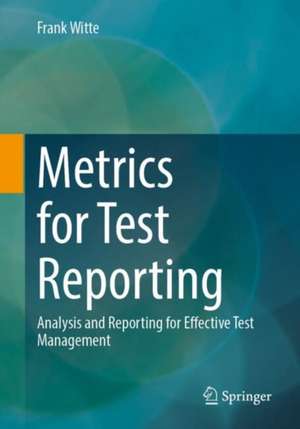
Metrics for Test Reporting
Autor Frank Witteen Limba Engleză Paperback – 29 iun 2024
În domeniul dezvoltării software, raportarea precisă către management reprezintă coloana vertebrală a succesului oricărui proiect. În Metrics for Test Reporting, remarcăm o abordare riguroasă și tehnică a modului în care datele brute de testare sunt transformate în indicatori de performanță acționabili. Frank Witte construiește un cadru analitic ce permite identificarea rapidă a necesarului de intervenție în ciclul de viață al produsului.
Pe linia practică a lucrării Applied Software Measurement, dar cu focus pe procesele specifice de raportare și monitorizare a testelor, autorul detaliază parametri esențiali precum densitatea defectelor și evoluția acestora în timp. Apreciem structura logică a volumului, care debutează cu fundamentul istoric al metricilor, avansând progresiv către clasificări complexe: măsuri de complexitate, standarde de măsurare și metrici bazate pe cerințe sau pe obiectul testat. Un aspect distinctiv față de alte titluri, precum Software Metrics, este analiza critică a limitărilor fiecărei metrici în parte, oferind soluții pentru problemele ce pot apărea în interpretarea datelor.
Această lucrare completează organic opera anterioară a autorului, Strategy, Planning and Organization of Test Processes. Dacă volumul precedent se concentra pe arhitectura procesului de testare, titlul de față rafinează execuția prin instrumente de măsurare. Ne-a atras atenția includerea unor capitole dedicate metricilor pentru testarea de performanță și load testing, precum și pentru testarea automatizată, reflectând cerințele actuale ale industriei. Textul este organizat pentru a servi atât ca referință rapidă pentru managerii de proiect, cât și ca suport de curs pentru mediul academic, acoperind integral spectrul de la estimarea efortului până la productivitatea testării.
Preț: 335.82 lei
Preț vechi: 419.78 lei
-20%
Carte disponibilă
Livrare economică 07-21 noiembrie
Specificații
ISBN-10: 3658440058
Pagini: 252
Ilustrații: XIV, 237 p. 67 illus., 57 illus. in color.
Dimensiuni: 168 x 240 x 13 mm
Greutate: 0.57 kg
Ediția:2024
Editura: Springer
Locul publicării:Wiesbaden, Germany
V-ar putea interesa
-
 -18%Preț: 187.26 lei227.31 lei
 -
 Software Test AutomationDorothy Graham-20%Preț: 644.47 lei805.58 lei
 -
 Key Performance Indicators (KPI)Bernard MarrPreț: 260.25 lei
 -
 -20%Preț: 363.08 lei453.85 lei
 -
 Lessons Learned in Software Testing - A Context- Driven ApproachBret Pettichord-20%Preț: 258.03 lei322.54 lei
 -
 Preț: 204.99 lei
 -
 -19%Preț: 498.12 lei614.97 lei
 -
 25 Need-To-Know Key Performance IndicatorsBernard MarrPreț: 132.67 lei
 -
 How to Measure Anything in Project ManagementDouglas W. HubbardPreț: 357.24 lei
 -
 Taking Testing SeriouslyJames BachPreț: 481.30 lei
 -
 Dashboards That DeliverAndy CotgreavePreț: 213.30 lei
 -
 Agile Project Management For DummiesMark C LaytonPreț: 171.30 lei
 -
 Automated Software Testing Interview Questions You'll Most Likely Be AskedVirbrant Publishers-20%Preț: 79.42 lei99.28 lei
 -
 Foundations of Software Testing ISTQB CertificationDorothy Graham-34%Preț: 333.75 lei502.01 lei
 -
 Keeping Score: Using the Right Metrics to Drive World Class PerformanceMark Graham BrownPreț: 241.61 lei
 -
 Software Testing with Generative AIMark Winteringham-20%Preț: 339.03 lei423.79 lei
 -
 Testing in ScrumTilo Linz-20%Preț: 264.61 lei330.77 lei
 -
 -20%Preț: 315.66 lei394.58 lei
 -
 -20%Preț: 321.81 lei402.26 lei
De ce să citești această carte
Recomandăm această carte profesioniștilor din testare și managerilor IT care doresc să implementeze un sistem de raportare bazat pe date, nu pe intuiție. Cititorul câștigă o metodologie clară pentru selectarea și adaptarea metricilor în funcție de specificul proiectului, învățând să comunice progresul tehnic într-un limbaj inteligibil pentru business. Este un instrument esențial pentru optimizarea proceselor de asigurare a calității și pentru fundamentarea deciziilor de release.
Despre autor
Frank Witte este un specialist recunoscut în domeniul ingineriei software, cu o expertiză consolidată în organizarea și automatizarea proceselor de testare. Portofoliul său de lucrări, publicat în mare parte sub egida Springer, include titluri fundamentale precum Strategie, Planung und Organisation von Testprozessen și Konzeption und Umsetzung automatisierter Softwaretests. Autorul se remarcă prin capacitatea de a sintetiza concepte teoretice complexe în ghiduri aplicative, fiind o voce influentă în comunitatea IT pentru promovarea standardelor de calitate și eficiență în dezvoltarea software.
Descriere scurtă
Starting with the historical development of test reporting, the author explains the fundamental benefits of metrics and provides an overview of the different types of metrics and how they can be used effectively in software testing. He shows how a particular metric can be individually adapted to the software to be tested, starting with the test specification and test execution through to the development of test coverage, and how this can lead to test automation. He also presents the advantages and disadvantages of those test metrics that are based on defects, i.e. that measure the number of defects, the defect density and the development of defects over time.
With this detailed examination of test reporting, the author provides an optimal basis for evaluation, which not only allows the assessment of which test metric should be used for which purpose or which individual project situation, but also what the particular problems of an individual metric for test reporting may be and how these problems can best be solved. This practical guide is therefore primarily aimed at employees in IT projects, such as project managers, software testers and developers, but business and technology consultants as well as lecturers at colleges and universities will also find an exciting insight into various software testing methods.