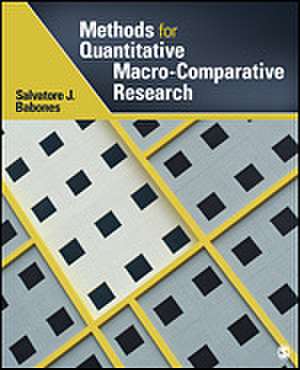
Methods for Quantitative Macro-Comparative Research
Autor Salvatore J. Babonesen Limba Engleză Electronic book text – 22 aug 2013
Preț: 401.65 lei
Preț vechi: 472.53 lei
-15%
Puncte Express: 602
Indisponibil temporar
Doresc să fiu notificat când acest titlu va fi disponibil:
Se trimite...
Specificații
ISBN-13: 9781483309613
ISBN-10: 1483309614
Pagini: 296
Dimensiuni: 187 x 232 mm
Ediția:1
Editura: SAGE Publications
Colecția Sage Publications, Inc
Locul publicării:Thousand Oaks, United States
ISBN-10: 1483309614
Pagini: 296
Dimensiuni: 187 x 232 mm
Ediția:1
Editura: SAGE Publications
Colecția Sage Publications, Inc
Locul publicării:Thousand Oaks, United States
V-ar putea interesa
-
 Analysis of Multiple Dependent VariablesPatrick Dattalo-14%Preț: 351.70 lei408.99 lei
 -
 Using Complexity Theory for Research and Program EvaluationMichael Wolf-Branigin-18%Preț: 323.73 lei394.48 lei
 -
 Ethics and Values in Social ResearchPaul Ransome-26%Preț: 277.44 lei376.09 lei
 -
 Using Photographs in Social and Historical ResearchPenny TinklerPreț: 433.28 lei
 -
 The Myth of Research-Based Policy and PracticeMartyn Hammersley-15%Preț: 424.95 lei499.94 lei
 -
 Doing Research in Further Education and TrainingSusan WallacePreț: 320.46 lei
 -
 The SAGE Handbook of Case-Based MethodsDavid ByrnePreț: 413.72 lei
 -
 The SAGE Handbook of Educational Action ResearchSusan E. NoffkePreț: 424.00 lei
 -
 Preț: 217.27 lei
Recenzii
“There
isn’t
any
text
I
am
aware
of
like
this,
and
as
the
author
notes,
there
is
an
increasing
amount
of
interest
in
this
area,
so
a
text
is
needed.”
—Richard York,University of Oregon
“All too often statistical analysis texts lose sight of the reasons for conducting the research in the first place, but that is certainly not the case here…The chapters thus far actually go far beyond much of the current work by both synthesizing a wide variety of material and explicitly dealing with many of the taken for granted assumptions…All of the writing is quite clear, even when it verges into quite complex methodological territory. The examples are well chosen.”
—Buster Smith,Catawba College
“This should be required reading for World Bank, OECD and U.N. researchers and data collectors as well as applied and academic sociologists, economists, political scientists and others who conduct cross country comparisons using publicly available large datasets.
—Ernesto Castañeda,University of Texas at El Paso
“I really don’t know how the author has managed it, but he covers complex material in an incredibly clear way…I think students who have a weaker background in statistics will learn a lot from the text and students with an advanced background in statistics will look at their analyses in a different way (from the point of planning analyses to actually interpreting results).”
—Lesley Williams Reid,Georgia State University
“I suspect this book will greatly enhance the teaching and practice of rigorous macro-level comparative analysis. It is a welcome addition to the teaching and training of future comparativists…I like very much the author’s courage in directly assessing and sometimes challenging the existing literature…This book must be taken seriously by all students of comparative politics. One can learn a great deal from it—it is a “big picture” book, covering well and widely the current state of research and analysis utilizing macro-approaches to the study of comparative politics.”
—Thomas Lancaster,Emory University
“The author explains complex concepts very well. Indeed, I found this far easier to read than most discussions of statistical methods.”
—Laura Hatcher,Southern Illinois University
“This is a book of PRIZE WINNING quality…It is also a profoundly original, highly convincing and very innovative attempt to reformulate macro methods to avoid the pitfalls of the clichéd solutions that have filled macro journals with sloppy unconvincing pseudo-scientific analyses for the last twenty years.”
—Samuel Cohn,Texas A&M University
—Richard York,University of Oregon
“All too often statistical analysis texts lose sight of the reasons for conducting the research in the first place, but that is certainly not the case here…The chapters thus far actually go far beyond much of the current work by both synthesizing a wide variety of material and explicitly dealing with many of the taken for granted assumptions…All of the writing is quite clear, even when it verges into quite complex methodological territory. The examples are well chosen.”
—Buster Smith,Catawba College
“This should be required reading for World Bank, OECD and U.N. researchers and data collectors as well as applied and academic sociologists, economists, political scientists and others who conduct cross country comparisons using publicly available large datasets.
—Ernesto Castañeda,University of Texas at El Paso
“I really don’t know how the author has managed it, but he covers complex material in an incredibly clear way…I think students who have a weaker background in statistics will learn a lot from the text and students with an advanced background in statistics will look at their analyses in a different way (from the point of planning analyses to actually interpreting results).”
—Lesley Williams Reid,Georgia State University
“I suspect this book will greatly enhance the teaching and practice of rigorous macro-level comparative analysis. It is a welcome addition to the teaching and training of future comparativists…I like very much the author’s courage in directly assessing and sometimes challenging the existing literature…This book must be taken seriously by all students of comparative politics. One can learn a great deal from it—it is a “big picture” book, covering well and widely the current state of research and analysis utilizing macro-approaches to the study of comparative politics.”
—Thomas Lancaster,Emory University
“The author explains complex concepts very well. Indeed, I found this far easier to read than most discussions of statistical methods.”
—Laura Hatcher,Southern Illinois University
“This is a book of PRIZE WINNING quality…It is also a profoundly original, highly convincing and very innovative attempt to reformulate macro methods to avoid the pitfalls of the clichéd solutions that have filled macro journals with sloppy unconvincing pseudo-scientific analyses for the last twenty years.”
—Samuel Cohn,Texas A&M University
Cuprins
PART
I:
MACRO-COMPARATIVE
DATA
STRUCTURES
1. The Logic of Macro-Comparative Research
2. The International Data Infrastructure
3. Variable Operationalization
4. The Structure of Country Data
PART II: STATISTICAL ANALYSIS OF MACRO-COMPARATIVE DATA
5. Statistical Modeling with Cross-Sectional Designs
6. Structured and Longitudinal Designs for Establishing Causality
7. Repeated Measures and Multilevel Modeling
8. An Interpretive Research and Policy Framework
Conclusion: The Political Economy of Quantitative Macro-Comparative Research
1. The Logic of Macro-Comparative Research
2. The International Data Infrastructure
3. Variable Operationalization
4. The Structure of Country Data
PART II: STATISTICAL ANALYSIS OF MACRO-COMPARATIVE DATA
5. Statistical Modeling with Cross-Sectional Designs
6. Structured and Longitudinal Designs for Establishing Causality
7. Repeated Measures and Multilevel Modeling
8. An Interpretive Research and Policy Framework
Conclusion: The Political Economy of Quantitative Macro-Comparative Research
Descriere
Will
a
one-child
policy
increase
economic
growth?
Does
globalization
contribute
to
global
warming?
Are
unequal
societies
less
healthy
than
more
egalitarian
societies?
It
is
questions
like
these
that
social
scientists
turn
to
quantitative
macro-comparative
research
(QMCR)
to
answer.