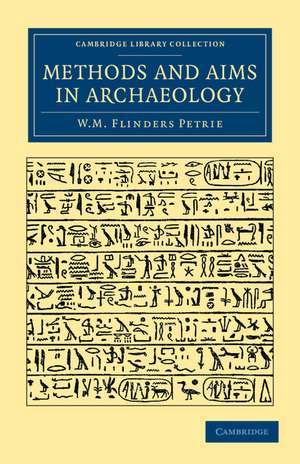
Methods and Aims in Archaeology
Autor William Matthew Flinders Petrieen Limba Engleză Paperback – 6 aug 2013
Preț: 304.11 lei
Puncte Express: 456
Carte tipărită la comandă
Livrare economică 30 noiembrie-14 decembrie
Livrare prin curier în România Termenul estimat este afișat lângă disponibilitate.
Transport gratuit de la 400.00 lei Plată online sau ramburs, în funcție de opțiunile comenzii.
Retur gratuit în 14 zile Comandă securizată și suport în română.
Specificații
ISBN-13: 9781108065979
ISBN-10: 110806597X
Pagini: 274
Ilustrații: 40 b/w illus.
Dimensiuni: 140 x 216 x 16 mm
Greutate: 0.39 kg
Editura: Cambridge University Press
Locul publicării:Cambridge, United Kingdom
ISBN-10: 110806597X
Pagini: 274
Ilustrații: 40 b/w illus.
Dimensiuni: 140 x 216 x 16 mm
Greutate: 0.39 kg
Editura: Cambridge University Press
Locul publicării:Cambridge, United Kingdom
V-ar putea interesa
-
 The Tears of Re: Beekeeping in Ancient EgyptGene Kritsky-12%Preț: 272.68 lei310.25 lei
 -
 Ancient Egyptian Materials and TechnologyPaul T. Nicholson-19%Preț: 609.28 lei752.20 lei
 -
 Religion and Ritual in Ancient EgyptEmily TeeterPreț: 244.24 lei
 -
 The Archaeology of Ancient EgyptDouglas J. BrewerPreț: 210.72 lei
 -
 The Material World of Ancient EgyptWilliam H. PeckPreț: 175.35 lei
 -
 The Cat in Ancient EgyptJaromir Malek-15%Preț: 69.53 lei82.20 lei
 -
 Taylor, J: Mummy: The Inside StoryJohn H. Taylor-19%Preț: 73.13 lei90.45 lei
 -
 Amenhotep IIIArielle P. KozloffPreț: 290.98 lei
 -
 The Tomb of Tut-Ankh-AmenHoward CarterPreț: 435.56 lei
 -
 -25%Preț: 173.62 lei230.79 lei
 -
 The Obelisk and the EnglishmanDorothy U SeylerPreț: 212.20 lei
 -
 Egypt in EnglandChris ElliottPreț: 315.15 lei
 -
 The World of Ancient Egypt: "Essays in Honor of Ahmed Abd El-Qader El-Sawi Cahier"KHALED ABDALLA DAOUDPreț: 169.93 lei
Cuprins
Preface; 1. The excavator; 2. Discrimination; 3. The labourers; 4. Arrangement of work; 5. Recording in the field; 6. Copying; 7. Photographing; 8. Preservation of objects; 9. Packing; 10. Publication; 11. Systematic archaeology; 12. Archaeological evidence; 13. Ethics of archaeology; 14. The fascination of history; Index.
Descriere
Petrie's classic work of 1904 outlines his rigorous archaeological processes, including excavation techniques and the management of workers.