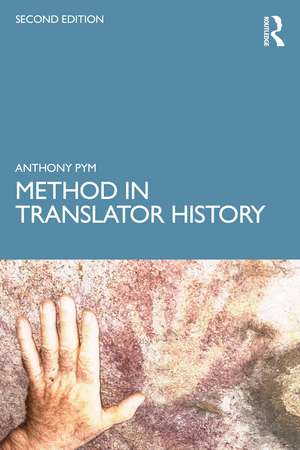
Method in Translator History: A Plea for Reflexive Empiricism
Autor Anthony Pymen Limba Engleză Paperback – 28 aug 2026
A toolbox approach breaks issues down into commonsense questions, to which short, clear answers are provided. Examples are drawn from European and Asian cultures, as well as Australian Indigenous translation practices. Features include clear definitions of key terms, both in the initial glossary and throughout; an accessible academic style able to explain, and at the same time provoke, an overall structure that follows the research process, dealing with the selection of questions, data gathering, modes of analysis, considerations of how to present the completed research, and who is likely to listen to history; lists of questions that the historian could or should ask at each stage; examples of common traps to be avoided and examples of methodological mistakes made in previous research.
This text is suitable for translation studies researchers, graduate students, educators, professional translators, cultural historians, and digital humanities scholars seeking methodological guidance for historical research on translation practices.
Preț: 443.26 lei
Nou
Puncte Express: 665
Carte tipărită la comandă
Livrare economică 07-21 decembrie
Livrare prin curier în România Termenul estimat este afișat lângă disponibilitate.
Transport gratuit pentru acest produs Plată online sau ramburs, în funcție de opțiunile comenzii.
Retur gratuit în 14 zile Comandă securizată și suport în română.
Specificații
ISBN-13: 9781041239161
ISBN-10: 1041239165
Pagini: 214
Dimensiuni: 156 x 234 mm
Greutate: 0.31 kg
Ediția:2
Editura: Taylor & Francis
Colecția Routledge
Locul publicării:Oxford, United Kingdom
ISBN-10: 1041239165
Pagini: 214
Dimensiuni: 156 x 234 mm
Greutate: 0.31 kg
Ediția:2
Editura: Taylor & Francis
Colecția Routledge
Locul publicării:Oxford, United Kingdom
Public țintă
PostgraduateCuprins
Acknowledgements
Glossary
Preface
References
Glossary
Preface
- What is Translator History?
- Why Do Translator History?
- What Do Technologies Do?
- What Do Translators Do?
- What Price Big Data?
- What Are Translation Flows?
- What Happens in Translator Networks?
- How Do Translators Differ?
- How Complex Is Translator History?
- Who Trusts Translators?
- What are Translation Policies and Institutions?
- Do Translators Alter Cultures?
References
Recenzii
"This is a refreshing contribution to the analysis of what translators and translations have been in human history. Pym’s questions and answers are extremely helpful tools for both novice and veteran researchers. Rather than a set of arguments, the book presents rich perspectives drafted in a systematic and highly readable way. It is a succinct summary of decades of work."
Itamar Even-Zohar, Emeritus Professor, Tel Aviv University
"Despite the apparent narrowing to translator history, this thoroughly reworked version of Method in Translation History remains impressively wide-ranging. Pym’s contribution is both original and challenging, inviting the reader into a sustained act of self-reflexivity. Such historiographical openness is rare, adding to the qualities of a book that deserves the attention of every translation historian."
Lieven D’hulst, Emeritus Professor, KU Leuven
"Anthony Pym’s new version of his seminal text is rich in his own and others' experiences, and generous in its openness to other studies and disciplinary debates. Provoking with questions rather than providing recipes, Method in Translator History will be a very useful guide for anyone interested in seeking out the explanatory power of past translation events."
Gertrudis Payàs, Lecturer, Universidad Católica de Temuco
"Method in Translator History is an engaging, provocative, and meticulously researched study of the issues raised in analysing and assessing the role played by translators throughout human history. Pym's deft discussions of the nature of translational influence in social, cultural and political contexts are deeply insightful and richly persuasive. A book that no scholar in the field can afford to ignore."
Michael Cronin, Professor at Trinity College Dublin, Ireland
"Anthony Pym's seminal work has long provided essential grounding for any serious engagement with translation history. This thoroughly reworked version is even more valuable than the original, combining reflexive empiricism with a critical reassessment of recent developments in the field. With its sustained attention to technologies, big data, and translator agency, alongside a remarkably comprehensive global scope that now spans Asian and Indigenous contexts, this book offers the precise methodological scaffolding that students and researchers have been waiting for."
Zhang Xu, Professor at Guangxi Minzu University, China
"Engaging critically with contemporary debates in digital humanities, big data, and cultural mediation, the book updates its original reflexive empiricist approach to address current research practices across the humanities. This new edition positions translation as a key site for analyzing cultural circulation, historical change, and intercultural relations. A must-read for anyone interested in the Humanities."
Gisele Wolkoff, Associate Professor at Fluminense Federal University, Brazil
"Most resourceful and perceptive in providing guidance, directions, and insights to researchers of translation histories."
Rachel Lung, Professor at Lingnan University, Hong Kong, China
Itamar Even-Zohar, Emeritus Professor, Tel Aviv University
"Despite the apparent narrowing to translator history, this thoroughly reworked version of Method in Translation History remains impressively wide-ranging. Pym’s contribution is both original and challenging, inviting the reader into a sustained act of self-reflexivity. Such historiographical openness is rare, adding to the qualities of a book that deserves the attention of every translation historian."
Lieven D’hulst, Emeritus Professor, KU Leuven
"Anthony Pym’s new version of his seminal text is rich in his own and others' experiences, and generous in its openness to other studies and disciplinary debates. Provoking with questions rather than providing recipes, Method in Translator History will be a very useful guide for anyone interested in seeking out the explanatory power of past translation events."
Gertrudis Payàs, Lecturer, Universidad Católica de Temuco
"Method in Translator History is an engaging, provocative, and meticulously researched study of the issues raised in analysing and assessing the role played by translators throughout human history. Pym's deft discussions of the nature of translational influence in social, cultural and political contexts are deeply insightful and richly persuasive. A book that no scholar in the field can afford to ignore."
Michael Cronin, Professor at Trinity College Dublin, Ireland
"Anthony Pym's seminal work has long provided essential grounding for any serious engagement with translation history. This thoroughly reworked version is even more valuable than the original, combining reflexive empiricism with a critical reassessment of recent developments in the field. With its sustained attention to technologies, big data, and translator agency, alongside a remarkably comprehensive global scope that now spans Asian and Indigenous contexts, this book offers the precise methodological scaffolding that students and researchers have been waiting for."
Zhang Xu, Professor at Guangxi Minzu University, China
"Engaging critically with contemporary debates in digital humanities, big data, and cultural mediation, the book updates its original reflexive empiricist approach to address current research practices across the humanities. This new edition positions translation as a key site for analyzing cultural circulation, historical change, and intercultural relations. A must-read for anyone interested in the Humanities."
Gisele Wolkoff, Associate Professor at Fluminense Federal University, Brazil
"Most resourceful and perceptive in providing guidance, directions, and insights to researchers of translation histories."
Rachel Lung, Professor at Lingnan University, Hong Kong, China
Notă biografică
Anthony Pym is Distinguished Professor of Translation and Intercultural Studies at Universitat Rovira i Virgili in Spain. His publications include Exploring Translation Theories (third edition, Routledge 2023) and How to Augment Language Skills: Generative AI and Machine Translation in Language Learning and Translator Training (with Hu Yao, Routledge 2025).
Descriere
Method in Translator History is a reworked classic explaining reflexive empiricism and critically assessing recent developments. New chapters cover technology, big data, translation flows, and translator agency. A toolbox approach provides clear answers with global examples. Suitable for researchers, students, and professional