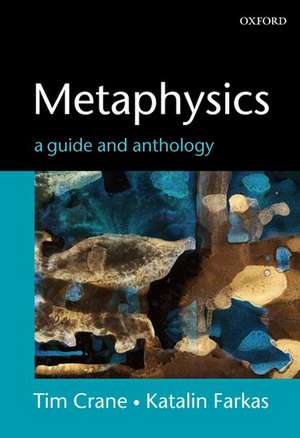
Metaphysics: A Guide and Anthology
Editat de Tim Crane, Katalin Farkasen Limba Engleză Paperback – 15 ian 2004
Preț: 390.93 lei
Preț vechi: 424.48 lei
-8%
Puncte Express: 586
Carte disponibilă
Livrare economică 13-18 noiembrie
Livrare express 28 octombrie-03 noiembrie pentru 108.51 lei
Livrare prin curier în România Termenul estimat este afișat lângă disponibilitate.
Transport gratuit de la 400.00 lei Plată online sau ramburs, în funcție de opțiunile comenzii.
Retur gratuit în 14 zile Comandă securizată și suport în română.
Specificații
ISBN-13: 9780199261970
ISBN-10: 0199261970
Pagini: 792
Ilustrații: illustrations
Dimensiuni: 171 x 246 x 40 mm
Greutate: 1.36 kg
Editura: OUP OXFORD
Colecția OUP Oxford
Locul publicării:Oxford, United Kingdom
ISBN-10: 0199261970
Pagini: 792
Ilustrații: illustrations
Dimensiuni: 171 x 246 x 40 mm
Greutate: 1.36 kg
Editura: OUP OXFORD
Colecția OUP Oxford
Locul publicării:Oxford, United Kingdom
V-ar putea interesa
-
 The Conscious Mind: In Search of a Fundamental TheoryDavid J. Chalmers-17%Preț: 144.70 lei174.98 lei
 -
 -31%Preț: 892.45 lei1285.88 lei
 -
 -8%Preț: 385.86 lei421.07 lei
 -
 A Brief History of the Philosophy of TimeAdrian Bardon-6%Preț: 211.07 lei225.54 lei
 -
 The Self and Self-KnowledgeAnnalisa Coliva-31%Preț: 727.16 lei1054.57 lei
 -
 The Subject's Point of ViewKatalin Farkas-13%Preț: 300.04 lei345.53 lei
 -
 The Nature of TimeUlrich Meyer-31%Preț: 535.66 lei778.21 lei
 -
 The Law-Governed UniverseJohn T. Roberts-21%Preț: 513.47 lei652.26 lei
 -
 Metaphysics: A Very Short IntroductionStephen Mumford-20%Preț: 56.90 lei70.90 lei
 -
 Oxford Studies in Metaphysics volume 7Karen Bennett-12%Preț: 320.90 lei364.83 lei
 -
 Rethinking ResponsibilityK. E. Boxer-29%Preț: 521.99 lei732.11 lei
 -
 -20%Preț: 456.13 lei571.14 lei
 -
 Without Hierarchies: The Scale Freedom of the UniverseMariam Thalos-31%Preț: 629.80 lei914.72 lei
 -
 Examined LifeRobert NozickPreț: 106.65 lei
 -
 Against CapitalismDavid Schweickart-15%Preț: 477.32 lei561.56 lei
 -
 Debates in the Metaphysics of TimeL. Nathan Oaklander-22%Preț: 265.52 lei342.37 lei
 -
 Silvio BerlusconiPaul GinsborgPreț: 164.36 lei
 -
 Chess and the Art of Enterprise ArchitectureGerben WierdaPreț: 158.59 lei
Recenzii
This is the best anthology of metaphysics that I know of. It covers all the right topics with a good mix of classic and contemporary articles. Especially useful are the simple, elegant introductions to the various sections of the anthology
An excellent volume. Impressive editorial skill is displayed in introducing the student to all of the venerable and central elements of metaphysics. Concise and elegant introductory essays for each theme guide the reader deftly through a judicious selection of over 50 classic readings. It is difficult to imagine a contemporary course in metaphysics that would not benefit from making substantial use of this most welcome resource
An excellent volume. Impressive editorial skill is displayed in introducing the student to all of the venerable and central elements of metaphysics. Concise and elegant introductory essays for each theme guide the reader deftly through a judicious selection of over 50 classic readings. It is difficult to imagine a contemporary course in metaphysics that would not benefit from making substantial use of this most welcome resource
Notă biografică
Tim Crane has taught philosophy at University College London since 1990. He took his PhD at the University of Cambridge in 1989.Katalin Farkas graduated in mathematics and philosophy from the Eötvös Loránd University, Budapest, and she took her PhD in philosophy from the Hungarian Academy of Sciences in 1998.