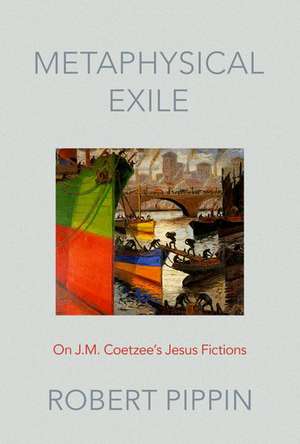
Metaphysical Exile: On J.M. Coetzee's Jesus Fictions
Autor Robert Pippinen Limba Engleză Hardback – 5 oct 2021
Preț: 532.98 lei
Preț vechi: 760.89 lei
-30%
Puncte Express: 799
Carte disponibilă
Livrare economică 19-25 noiembrie
Livrare prin curier în România Termenul estimat este afișat lângă disponibilitate.
Transport gratuit pentru acest produs Plată online sau ramburs, în funcție de opțiunile comenzii.
Retur gratuit în 14 zile Comandă securizată și suport în română.
Specificații
ISBN-13: 9780197565940
ISBN-10: 0197565948
Pagini: 152
Dimensiuni: 213 x 142 x 18 mm
Greutate: 0.3 kg
Editura: Oxford University Press
Colecția OUP USA
Locul publicării:New York, United States
ISBN-10: 0197565948
Pagini: 152
Dimensiuni: 213 x 142 x 18 mm
Greutate: 0.3 kg
Editura: Oxford University Press
Colecția OUP USA
Locul publicării:New York, United States
Recenzii
Robert Pippin's Metaphysical Exile is a quite exceptionally thought-provoking and astute account of these fictions. Beautifully articulated and deeply informed, its value first and foremost is that of a set of lucid and searching commentaries on specific details and difficulties.
Robert Pippin's Metaphysical Exile is a quite exceptionally thought-provoking and astute account of [the Jesus fictions]... Beautifully articulated and deeply informed, its value first and foremost is that of a set of lucid and searching commentaries on specific details and difficulties. Many of the philosophical, theological, and literary allusions which form the texture of the books and which tug constantly and often uncomfortably at the flagging memory of the reader—allusions to Plato, the Bible, Augustine, Cervantes, Kleist, Nietzsche and Wittgenstein among many others—are chased down here and cogently explained. What makes Pippin's book particularly illuminating is that he is fully alive to what flummoxed the many talented and insightful reviewers who had a go at the first of the Jesus fiction ..
As one of Coetzee's foremost philosophical commentators, Pippin is well placed to separate the profound from the perplexing, notably by drawing on frameworks and ideas from Nietzsche, Heidegger, and Hegel. However, a key strength of his book is the way it registers the trilogy's uniquely literary engagement with its ideas.... Pippin is an adept (and accessible) surveyor, and there is no doubting the solidity of the foundations he lays out... the book is testament to Pippin not only as a thinker but as a reader of distinguished quality.
Pippin has written a concise, cogent analysis of Coetzee's recent trilogy ... Perhaps the greatest strength of Pippin's analysis is his attention to intertextuality. He finds resonance with the New Testament, Plato, Wittgenstein, Nietzsche, Goethe, Kafka, Proust, and Cervantes, among others.
Coetzee's three Jesus novels have provoked much bafflement and consternation, but Pippin's lucid and probing appraisal makes a substantial contribution to our understanding of their complexities and appreciation of their importance. The book's style is clear and engaging, and in no way inaccessible to readers without a philosophical background. Pippin writes not as a philosopher who turns to literature for examples but as one who understands literature's singular contribution to the problems philosophy addresses.
This first book on Coetzee's trilogy of Jesus novels is criticism of the finest order, criticism that creates intimacy with its subject matter, that provides genuine disclosure of a major mind still at the peak of its powers. What results is an exegetical tour de force and something like 'cosmic' philosophy (Heidegger): reflection on first and last things, on art and its value, on human passion, on what it means to be alive with true understanding of the terms of living. Pippin's wise and compelling book sets the benchmark for all future attempts to comprehend Coetzee's Jesus novels and indeed Coetzee's later fiction as a whole.
J.M. Coetzee's trilogy of Jesus novels is one of the more enigmatic achievements of contemporary world fiction. In a series of assured readings that are as generous to the reader as they are to the novels, Robert Pippin rises to the challenge, showing how Coetzee manages to be both disarming and philosophically profound.
Robert Pippin's Metaphysical Exile is a quite exceptionally thought-provoking and astute account of [the Jesus fictions]... Beautifully articulated and deeply informed, its value first and foremost is that of a set of lucid and searching commentaries on specific details and difficulties. Many of the philosophical, theological, and literary allusions which form the texture of the books and which tug constantly and often uncomfortably at the flagging memory of the reader—allusions to Plato, the Bible, Augustine, Cervantes, Kleist, Nietzsche and Wittgenstein among many others—are chased down here and cogently explained. What makes Pippin's book particularly illuminating is that he is fully alive to what flummoxed the many talented and insightful reviewers who had a go at the first of the Jesus fiction ..
As one of Coetzee's foremost philosophical commentators, Pippin is well placed to separate the profound from the perplexing, notably by drawing on frameworks and ideas from Nietzsche, Heidegger, and Hegel. However, a key strength of his book is the way it registers the trilogy's uniquely literary engagement with its ideas.... Pippin is an adept (and accessible) surveyor, and there is no doubting the solidity of the foundations he lays out... the book is testament to Pippin not only as a thinker but as a reader of distinguished quality.
Pippin has written a concise, cogent analysis of Coetzee's recent trilogy ... Perhaps the greatest strength of Pippin's analysis is his attention to intertextuality. He finds resonance with the New Testament, Plato, Wittgenstein, Nietzsche, Goethe, Kafka, Proust, and Cervantes, among others.
Coetzee's three Jesus novels have provoked much bafflement and consternation, but Pippin's lucid and probing appraisal makes a substantial contribution to our understanding of their complexities and appreciation of their importance. The book's style is clear and engaging, and in no way inaccessible to readers without a philosophical background. Pippin writes not as a philosopher who turns to literature for examples but as one who understands literature's singular contribution to the problems philosophy addresses.
This first book on Coetzee's trilogy of Jesus novels is criticism of the finest order, criticism that creates intimacy with its subject matter, that provides genuine disclosure of a major mind still at the peak of its powers. What results is an exegetical tour de force and something like 'cosmic' philosophy (Heidegger): reflection on first and last things, on art and its value, on human passion, on what it means to be alive with true understanding of the terms of living. Pippin's wise and compelling book sets the benchmark for all future attempts to comprehend Coetzee's Jesus novels and indeed Coetzee's later fiction as a whole.
J.M. Coetzee's trilogy of Jesus novels is one of the more enigmatic achievements of contemporary world fiction. In a series of assured readings that are as generous to the reader as they are to the novels, Robert Pippin rises to the challenge, showing how Coetzee manages to be both disarming and philosophically profound.
Notă biografică
Robert B. Pippin is the Evelyn Stefansson Nef Distinguished Service Professor at the University of Chicago. He is the author of several books on modern German philosophy, a book on philosophy and literature, Henry James and Modern Moral Life (Cambridge University Press, 2001); a book on modernist art, After the Beautiful (University of Chicago Press, 2013), and five books on film and philosophy. He is a past winner of the Mellon Distinguished Achievement Award in the Humanities, a Guggenheim Fellowship, is a fellow of the American Academy of Arts and Sciences, of the American Philosophical Society, and is a member of the German National Academy of Sciences, Leopoldina. His latest books are Hegel's Realm of Shadows: Logic as Metaphysics in The Science of Logic (University of Chicago Press, 2018), and Filmed Thought: Cinema as Reflective Form (University of Chicago Press, 2020).