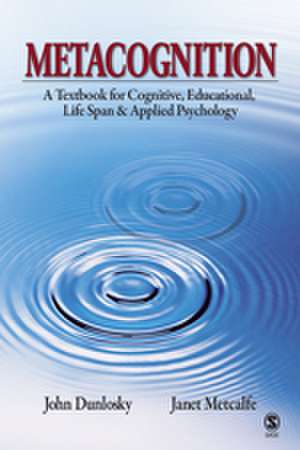
Metacognition
Autor John Dunlosky, Janet Metcalfeen Limba Engleză Electronic book text – 18 mar 2014
Lucrarea Metacognition reprezintă o premieră în literatura de specialitate, fiind primul manual universitar care se concentrează exclusiv pe capacitatea umană de a monitoriza și regla propriile procese cognitive. Într-un domeniu în care informația este adesea fragmentată, John Dunlosky și Janet Metcalfe propun o sinteză riguroasă ce unește cercetarea teoretică de cea empirică. Considerăm că volumul reușește să umple un gol pedagogic important, oferind studenților nu doar teorii consacrate, ci și o privire asupra „misterelor” nerezolvate de la frontiera psihologiei cognitive.
Structura cărții este concepută pentru a ghida cititorul de la fundamentele istorice — explorând paradoxul lui Comte și introspecționismul — către mecanismele complexe ale judecăților metacognitive. Autorii dedică capitole extinse unor fenomene specifice, precum stările de „vârful limbii” (tip-of-the-tongue) și încrederea retrospectivă, analizând bazele neurologice și funcțiile acestora. Față de alte lucrări ale lui John Dunlosky, cum este Metacognition in Educational Theory and Practice, care se concentrează strict pe mediul școlar, acest manual are o deschidere mult mai largă, incluzând perspective din psihologia dezvoltării și psihologia aplicată.
Ca alternativă la Applied Metacognition de Timothy J. Perfect pentru cursurile de psihologie cognitivă, acest manual aduce avantajul unei structuri didactice superioare. Integrarea casetelor „Application” și a celor trei demonstrații practice permite studenților să experimenteze direct concepte abstracte, transformând lectura într-un proces interactiv. Ritmul este cel specific unui text academic dens, dar extrem de bine organizat, fiecare capitol încheindu-se cu un rezumat general care consolidează informația.
Preț: 516.96 lei
Preț vechi: 561.91 lei
-8%
Indisponibil temporar
Specificații
ISBN-10: 148336223X
Pagini: 344
Dimensiuni: 152 x 229 mm
Ediția:1
Editura: SAGE Publications
Colecția Sage Publications, Inc
Locul publicării:Thousand Oaks, United States
V-ar putea interesa
-
 The Missing Link in Cognition: Origins of self-reflective consciousnessHerbert S. Terrace-32%Preț: 744.57 lei1102.87 lei
 -
 -31%Preț: 506.09 lei733.07 lei
 -
 The Oxford Handbook of MetamemoryJohn Dunlosky-32%Preț: 1165.22 lei1724.63 lei
 -
 Agency and Joint AttentionJanet Metcalfe-14%Preț: 904.26 lei1051.47 lei
 -
 Sensation, Perception and Action: An Evolutionary PerspectiveJohannes ZankerPreț: 338.83 lei
 -
 The Aging IntellectDouglas H. Powell-18%Preț: 1062.29 lei1295.48 lei
 -
 How to Be a Brilliant ThinkerPaul SloanePreț: 129.97 lei
 -
 Metacognition in Educational Theory and PracticeDouglas J. Hacker-15%Preț: 615.88 lei724.56 lei
 -
 Handbook of Metamemory and MemoryJohn Dunlosky-18%Preț: 1708.06 lei2082.99 lei
 -
 The SAGE Handbook of Social CognitionSusan T Fiske-18%Preț: 1247.01 lei1520.74 lei
 -
 Taking Appearance SeriouslyHenri BortoftPreț: 141.58 lei
 -
 Critical FeelingRolf ReberPreț: 285.51 lei
 -
 Does Your Family Make You Smarter?James R. FlynnPreț: 193.35 lei
 -
 Mindful LearningCraig HassedPreț: 159.86 lei
 -
 The Little Mindfulness WorkbookGary Hennessey-28%Preț: 50.64 lei69.94 lei
 -
 New Developments in Expressive Arts Therapy: The Play of PoiesisStephen K. Levine-28%Preț: 233.33 lei323.73 lei
 -
 -25%Preț: 217.47 lei290.12 lei
 -
 The Little CBT WorkbookDr Michael Sinclair-28%Preț: 65.23 lei90.60 lei
De ce să citești această carte
Recomandăm această carte studenților și cercetătorilor care doresc să înțeleagă mecanismele din spatele învățării eficiente. Cititorul câștigă o bază teoretică solidă și instrumente practice de evaluare a propriei memorii. Este o resursă esențială deoarece transformă metacogniția dintr-un concept abstract într-o disciplină aplicabilă, oferind demonstrații pas cu pas pe care oricine le poate testa pentru a-și îmbunătăți controlul cognitiv.
Despre autor
John Dunlosky este profesor de psihologie la Kent State University, având un doctorat obținut la University of Washington. Cu o experiență de peste 15 ani în cercetarea metacognitivă, acesta este o figură centrală în domeniu, contribuind la numeroase volume de referință, inclusiv The Oxford Handbook of Metamemory. Expertiza sa acoperă atât aspecte teoretice, cât și aplicate, fiind susținută de granturi de la National Institute on Aging. Janet Metcalfe, co-autoarea sa, completează această viziune prin cercetări fundamentale asupra controlului monitorizării, transformând acest parteneriat academic într-un etalon pentru studiul psihologiei cognitive moderne.
Descriere scurtă
Cuprins
Chapter 1. Introduction
Chapter 2. History
Comte's Paradox and Turn-of-the-20th-Century Introspection
Some Shortcomings of Introspectionism
The Cognitive Renaissance
The Return of Introspection and the Rise of the Metacognitive School of Psychology
SECTION 1: Basic Metacognitive Judgments
Chapter 3. Methods and Analyses
Metamemory: Measures and Questions
Metamemory: Collecting, Analyzing, and Interpreting Data
Overview of the Remaining Chapters on Basic Metacognitive Judgments
Chapter 4. Feelings of Knowing and Tip-of-the-Tongue States
Theories About Feeling-of-Knowing Judgments
Tip-of-the-Tongue States
Brain Bases of FOK States
Functions of Feelings of Knowing
Chapter 5. Judgments of Learning
Do All Monitoring Judgments Tap the Same Information?
Variables Influencing JOL Accuracy
Theories About Judgments of Learning
Function of Judgments of Learning
Chapter 6. Confidence Judgments
Factors Influencing RC Accuracy
Theories About Retrospective Confidence
Function of Retrospective Judgments
Chapter 7. Source Judgments
Factors That Influence Source-Monitoring Accuracy
The Source-Monitoring Framework
Breakdowns of Source and Reality Monitoring
Brain Bases of Source-Monitoring Judgments
SECTION 2: Applications
Chapter 8. Law and Eyewitness Accuracy
Confidence and False Memories
Does Witness Confidence Matter to Jurors?
Lying
Hindsight Bias
Chapter 9. Education
General Models of Student Self-Regulated Learning
Student Metacognition in Specific Domains
SECTION 3: Life-Span Development
Chapter 10. Childhood Development
Development of Theory of Mind
Development of Metamemory
Relationship Between ToM and Metamemory
Chapter 11. Older Adulthood
What Do Older Adults Believe About Memory?
Aging and Memory Monitoring
Aging and Control of Learning and Retrieval
References
Index
About the Authors