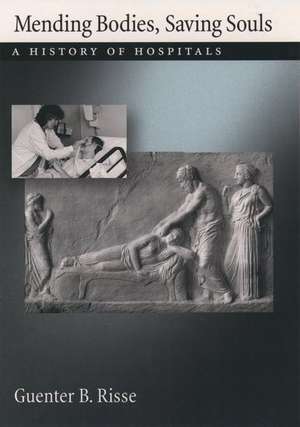
Mending Bodies, Saving Souls: A History of Hospitals
Autor Guenter B. Risseen Limba Engleză Hardback – 29 iul 1999
Preț: 731.08 lei
Preț vechi: 1033.30 lei
-29%
Puncte Express: 1097
Carte tipărită la comandă
Livrare economică 10-16 decembrie
Livrare prin curier în România Termenul estimat este afișat lângă disponibilitate.
Transport gratuit pentru acest produs Plată online sau ramburs, în funcție de opțiunile comenzii.
Retur gratuit în 14 zile Comandă securizată și suport în română.
Specificații
ISBN-13: 9780195055238
ISBN-10: 0195055233
Pagini: 752
Dimensiuni: 170 x 244 x 44 mm
Greutate: 1.22 kg
Editura: Oxford University Press
Colecția OUP USA
Locul publicării:New York, United States
ISBN-10: 0195055233
Pagini: 752
Dimensiuni: 170 x 244 x 44 mm
Greutate: 1.22 kg
Editura: Oxford University Press
Colecția OUP USA
Locul publicării:New York, United States
V-ar putea interesa
-
 Blood and GutsRoy Porter-34%Preț: 61.02 lei92.93 lei
 -
 -27%Preț: 426.34 lei585.76 lei
 -
 Pandemics: A Very Short IntroductionChristian W. McMillen-25%Preț: 56.29 lei74.98 lei
 -
 -25%Preț: 1097.11 lei1453.62 lei
 -
 -26%Preț: 233.16 lei314.93 lei
 -
 Medicine's 10 Greatest DiscoveriesMeyer Friedman-5%Preț: 312.80 lei329.26 lei
 -
 -30%Preț: 64.50 lei92.20 lei
 -
 DoctorsSherwin B. NulandPreț: 127.17 lei
 -
 How Shakespeare Cleaned His Teeth and Cromwell Treated His WartsKatherine KnightPreț: 93.74 lei
 -
 Medical Muses: Hysteria in Nineteenth-Century ParisAsti Hustvedt-30%Preț: 75.68 lei107.94 lei
 -
 The History of MedicineMark Jackson-5%Preț: 74.63 lei78.55 lei
Recenzii
The author takes his readers from Greek and Roman times through the pangs of suffering in the early Christian era, the surge of the Enlightenment as exemplified by Edinburgh, Vienna, and Paris, to surgeons such as Warren and Lister and the modern research giants of municipal mercy. Just to review this immense background of our ere is a great treat; Dr. Risse's abundant research and sophisticated interpretation makes this book an intellectual triumph.
Dr. Risse brings the patient, pilgrim to the "foreign land" of hospitals, to the center of this magnificent, poignant history of medicine. Telling the experiences of actual patients, doctors, and others in hospitals at different times and in different places, Risse brings the hospital to life, vividly, as a place of rituals where some human beings struggle to live; others do the best they can in the face of available medical knowledge and often dangerous social conditions. A remarkable, moving, humane book -- a major contribution to the history of medicine, and highly recommended for the general reader.
Dr. Risse brings the patient, pilgrim to the "foreign land" of hospitals, to the center of this magnificent, poignant history of medicine. Telling the experiences of actual patients, doctors, and others in hospitals at different times and in different places, Risse brings the hospital to life, vividly, as a place of rituals where some human beings struggle to live; others do the best they can in the face of available medical knowledge and often dangerous social conditions. A remarkable, moving, humane book -- a major contribution to the history of medicine, and highly recommended for the general reader.