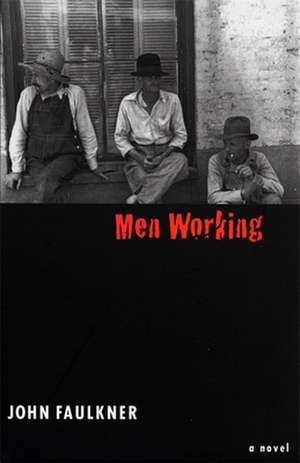
Men Working
Autor John Faulkneren Limba Engleză Paperback – iun 1996
John Faulkner, a one-time WPA project engineer, has much to satirize in this broadly comic novel. First and foremost are the Taylors: exasperating and unemployable, they are unaccountably abiding; hopelessly destitute, they place a higher premium on a new radio than on food and shelter. Faulkner also casts a sardonic eye on the town merchants, who extend credit to WPA workers as quickly as they inflate prices, and, of course, on the WPA itself, an agency that entices naive, desperate country folk with the promise of a dole--only to lay them off and then ignore them.
In his foreword, Trent Watts establishes the singularity of "Men Working" while noting in it echoes of "Tobacco Road," "As I Lay Dying," and "The Grapes of Wrath." Watts also identifies in John Faulkner's tone an ambivalence shared by many southerners who witnessed the changes wrought by "progress" upon their traditional way of life.
Preț: 206.50 lei
Puncte Express: 310
Carte disponibilă
Livrare economică 10-24 noiembrie
Livrare prin curier în România Termenul estimat este afișat lângă disponibilitate.
Transport gratuit de la 400.00 lei Plată online sau ramburs, în funcție de opțiunile comenzii.
Retur gratuit în 14 zile Comandă securizată și suport în română.
Specificații
ISBN-13: 9780820318271
ISBN-10: 0820318272
Pagini: 328
Dimensiuni: 136 x 204 x 21 mm
Greutate: 0.38 kg
Editura: University of Georgia Press
ISBN-10: 0820318272
Pagini: 328
Dimensiuni: 136 x 204 x 21 mm
Greutate: 0.38 kg
Editura: University of Georgia Press
V-ar putea interesa
-
 God's Little AcreErskine CaldwellPreț: 133.43 lei
 -
 YoungbloodJohn Oliver KillensPreț: 269.59 lei
 -
 The Dangerous Lives of Altar BoysChris FuhrmanPreț: 148.93 lei
 -
 Daughter of My PeopleJames KilgoPreț: 175.55 lei
 -
 The Theory of Light and MatterAndrew PorterPreț: 270.86 lei
 -
 The Necessary Grace to FallGina OchsnerPreț: 129.71 lei
 -
 The Dance BootsLinda Legarde GroverPreț: 123.45 lei
 -
 Break Any Woman DownDana JohnsonPreț: 122.77 lei
 -
 Kill or be Killed Volume 1Ed BrubakerPreț: 107.69 lei
 -
 The Gustav SonataRose Tremain-19%Preț: 58.67 lei72.11 lei
Notă biografică
John Faulkner (1901-1963) was a native and lifetime resident of the Mississippi hill country and Delta region. A writer and accomplished, self-taught painter, he also worked, at various times, as an engineer, airplane pilot, World War II naval officer, and farmer. Of the number of books Faulkner wrote, he is best remembered for the novels "Men Working" and "Dollar Cotton," and the memoir "My Brother Bill," about William Faulkner.
Textul de pe ultima copertă
This novel of Mississippi hill country life depicts some of the more troubling and unpublicized aspects of the New Deal by tracing the fortunes of the Taylor family, sharecroppers who move to town to work for the "WP and A", the Works Progress Administration. John Faulkner, a one-time WPA project engineer, has much to satirize in this broadly comic novel. First and foremost are the Taylors: exasperating and unemployable, they are unaccountably abiding; hopelessly destitute, they place a higher premium on a new radio than on food and shelter. Faulkner also casts a sardonic eye on the town merchants, who extend credit to WPA workers as quickly as they inflate prices, and, of course, on the WPA itself, an agency that entices naive, desperate country folk with the promise of a dole - only to lay them off and then ignore them. In his foreword, Trent Watts establishes the singularity of Men Working while noting in it echoes of Tobacco Road, As I Lay Dying, and The Grapes of Wrath. Watts also identifies in John Faulkner's tone an ambivalence shared by many southerners who witnessed the changes wrought by "progress" upon their traditional way of life.