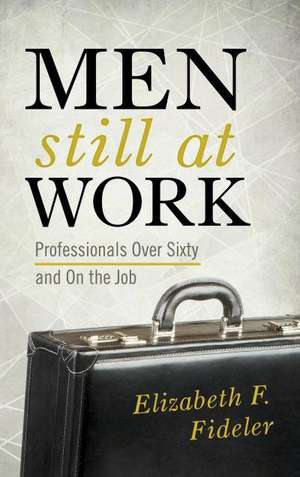
Men Still at Work: Professionals Over Sixty and On the Job
Autor Elizabeth F. Fideleren Limba Engleză Hardback – 18 feb 2014
Preț: 353.97 lei
Preț vechi: 426.80 lei
-17%
Puncte Express: 531
Carte tipărită la comandă
Livrare economică 17 noiembrie-01 decembrie
Livrare prin curier în România Termenul estimat este afișat lângă disponibilitate.
Transport gratuit de la 400.00 lei Plată online sau ramburs, în funcție de opțiunile comenzii.
Retur gratuit în 14 zile Comandă securizată și suport în română.
Specificații
ISBN-13: 9781442222755
ISBN-10: 1442222751
Pagini: 223
Ilustrații: 5 Graphs, 2 Tables
Dimensiuni: 160 x 233 x 22 mm
Greutate: 0.47 kg
Editura: Bloomsbury Publishing
Colecția Rowman & Littlefield
Locul publicării:New York, United States
ISBN-10: 1442222751
Pagini: 223
Ilustrații: 5 Graphs, 2 Tables
Dimensiuni: 160 x 233 x 22 mm
Greutate: 0.47 kg
Editura: Bloomsbury Publishing
Colecția Rowman & Littlefield
Locul publicării:New York, United States
Cuprins
Acknowledgments
Introduction
Perspectives on Aging and Work
A Man's World
The Employment Situation for Adult Workers in the United States
Over Sixty and On the Job
Where Older Men Work
Why Older Men Work
Personal Challenges and Concerns
Doing Unto Others
Men Still at Work
Notes
Bibliography
Discussion Questions
Index
About the Author
Introduction
Perspectives on Aging and Work
A Man's World
The Employment Situation for Adult Workers in the United States
Over Sixty and On the Job
Where Older Men Work
Why Older Men Work
Personal Challenges and Concerns
Doing Unto Others
Men Still at Work
Notes
Bibliography
Discussion Questions
Index
About the Author
Recenzii
In this follow-up to her Women Still at Work (2012), Fideler seeks to understand why many professional men age 60 or older choose to continue working at a time in life when many others have retired, and to describe their experiences as they navigate work life in an increasingly challenging economy. Drawing upon findings from the latest research on men, work, and aging, the results of her own survey, and candid profiles from in-depth interviews she conducted with such men, Fideler provides a glimpse into the complex inner world of this fast-growing segment of the US workforce. Older men's desire to find meaning in their work-and make a difference in others' lives via their work-is an oft-mentioned motive. The author also found that many of these men enjoyed a rich workplace social life through their relationships with colleagues and clientele alike. Surprisingly, more utilitarian and baser motives, such as the need for pay and benefits, or the allure of wielding power and authority, were not nearly as important to these men as one might think. Overall, an engaging, accessible overview of what the future holds for many younger men who will undoubtedly work into their 60s ... and beyond. Summing Up: Highly recommended. All levels/libraries.
It's refreshing that Fideler bases her findings on actual research. Profiles of 60-somethings still on the job are both inspiring and informative.
Elizabeth Fideler has taken on a fascinating and increasingly pertinent subject and through her skillful profiles of men at work in a great variety of fields, the result is a highly engaging book of considerable insight and merit. Bravo, Ms. Fideler!
Should you work beyond "normal" retirement age? Men Still at Work answers important questions and offers encouragement for people who want to remain in the workforce for years. . . or decades.
Elizabeth Fideler has written a fascinating book on the experiences of older working men in today's rapidly changing economy. A follow-up to her study of older working women, Fideler once again demonstrates the value of compiling the personal stories of older Americans who remain on the job well-past traditional retirement age. Her insights will prove valuable, not only to policy makers and human resource managers, but also to older workers thinking about what to do in the next stage of their careers.
Dr. Fideler's powerful profiles of men who have remained hard at work provide us with more than stories. The descriptions of these men's lives underscore the need for our society to get ready for 'what is coming next' as increasing numbers of baby boomers follow the lead of the men introduced to us in Men Still at Work.
I, like many elders I know, am still working because I love what I do and I feel I have knowledge and experience to offer anyone interested. It's a beautiful thing to be a musician still able to perform, compose, and educate at the age of 87. This is a must-read for someone looking for a road map.
We will need to know more about the labor force involvement of Americans over age 65- because this segment of the population will continue to grow, because this stage will represent a greater portion of our lives, and because this group will increasingly impact our economy and culture. Elizabeth Fideler offers us engaging and highly readable stories of men who continue to work while the majority of their cohort has retired, which complements her earlier study of working women in this age group. These accounts remind us of the importance of meaning and engagement at work, and not just for the elderly.
It's refreshing that Fideler bases her findings on actual research. Profiles of 60-somethings still on the job are both inspiring and informative.
Elizabeth Fideler has taken on a fascinating and increasingly pertinent subject and through her skillful profiles of men at work in a great variety of fields, the result is a highly engaging book of considerable insight and merit. Bravo, Ms. Fideler!
Should you work beyond "normal" retirement age? Men Still at Work answers important questions and offers encouragement for people who want to remain in the workforce for years. . . or decades.
Elizabeth Fideler has written a fascinating book on the experiences of older working men in today's rapidly changing economy. A follow-up to her study of older working women, Fideler once again demonstrates the value of compiling the personal stories of older Americans who remain on the job well-past traditional retirement age. Her insights will prove valuable, not only to policy makers and human resource managers, but also to older workers thinking about what to do in the next stage of their careers.
Dr. Fideler's powerful profiles of men who have remained hard at work provide us with more than stories. The descriptions of these men's lives underscore the need for our society to get ready for 'what is coming next' as increasing numbers of baby boomers follow the lead of the men introduced to us in Men Still at Work.
I, like many elders I know, am still working because I love what I do and I feel I have knowledge and experience to offer anyone interested. It's a beautiful thing to be a musician still able to perform, compose, and educate at the age of 87. This is a must-read for someone looking for a road map.
We will need to know more about the labor force involvement of Americans over age 65- because this segment of the population will continue to grow, because this stage will represent a greater portion of our lives, and because this group will increasingly impact our economy and culture. Elizabeth Fideler offers us engaging and highly readable stories of men who continue to work while the majority of their cohort has retired, which complements her earlier study of working women in this age group. These accounts remind us of the importance of meaning and engagement at work, and not just for the elderly.
Notă biografică
Elizabeth F. Fideler (EdD, Harvard University) is a Research Fellow at Boston College's Center on Aging and Work. She is the author of Women Still at Work: Professionals Over Sixty and On the Job (2012) and Men Still at Work: Professionals Over Sixty and On the Job (2014). She is a longtime trustee of the Framingham (MA) Public Library and chairs the library's "one book, one community" initiative.